SAN JOSE — Despite a record high in total value, a weak commercial real estate market has weighed down properties in Santa Clara County, according to a new report that raises questions about tax revenue trends for an array of public agencies.
Read more Seeds of change: Inside the pioneering history of the Davis Farmers Market
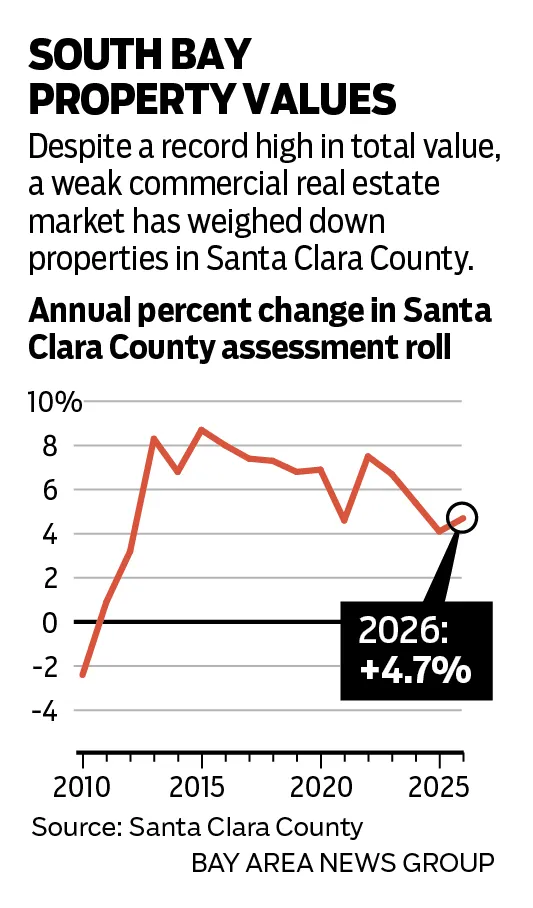
The annual assessment roll in Santa Clara County was about $760.1 billion as of January, the Assessor’s Office reported, up 4.7% from the $725.7 billion reported for January 2025.
“The volatile and unpredictable nature of Santa Clara County real estate causes uncertainty for the future of property values,” County Assessor Neysa Fligor said.
RELATED: San Jose office property bought for nearly half of its prior value
The rate of increase was the third-smallest annual gain since 2012. Only 2021, at a 4.6% rise, and 2025, with a 4.1% gain, produced lower yearly gains.
The pace of annual increases could impact public agencies in the South Bay.
“The major beneficiaries of property tax revenue are public schools, community colleges, cities, special districts, and Santa Clara County,” the Assessor’s Office reported. “More than 50% of local property tax revenue generated in Santa Clara County goes to fund public education.”
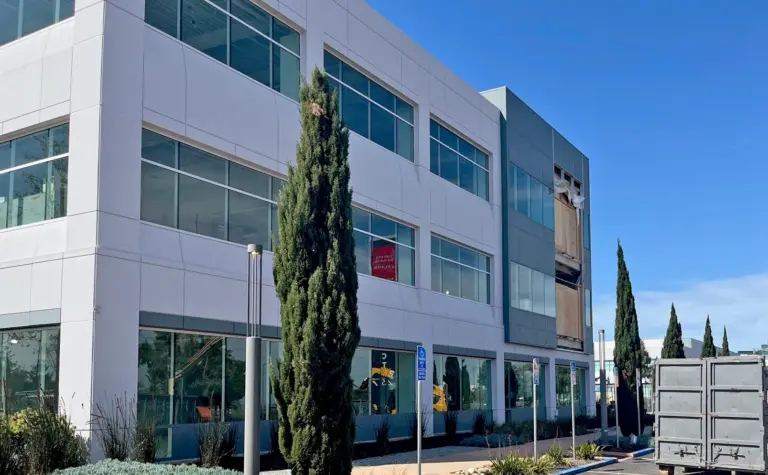
Lower values for office buildings, hotels, and retail centers has become a key factor in the faltering pace of assessment valuations.
“Challenges in the commercial real estate market continue to stunt property values as they sometimes transact at less than existing roll value,” the Santa Clara County Assessor’s Office stated in its report. “Residential property transfer of ownership transactions remained steady and accounted for the majority of roll growth.”
Downward pressure for property values could persist in the South Bay and throughout California due to provisions in a statewide constitutional amendment that was enacted nearly a half-century ago.
Some elements of 1978’s Proposition 8 oblige county assessors to shave the assessed values of a parcel during a time when residential or commercial property markets are in decline in an area. That’s the case in much of the Bay Area and South Bay.
“This year’s roll includes 24,727 properties in Prop. 8 decline status, almost triple the 8,699 in the prior roll year,” the Santa Clara County Assessor’s Office reported.
As of January, Prop. 8-triggered declines were in play for roughly 24,100 residential properties, an increase of 193%, or nearly three times the 8,200 Prop. 8 declines for residential sites as of January 2025, the Assessor’s Office reported.
Prop. 8-linked declines were reported for an estimated 625 commercial properties as of January, up 46% from the 478 that were in decline the year before.
Over the past decade, the value of the assessed roll has risen 81.3%, said Bob Staedler, principal executive with land-use consultancy Silicon Valley Synergy.
“That kind of sustained growth underscores the long-term strength and resilience of the region’s economy, even as the pace has moderated to a more sustainable level,” Staedler said. “It also challenges the increasingly tired narrative that Silicon Valley is in permanent decline.”
Read more Three wounded in Oakland shooting
Still, some trends point to weaker property value growth over a longer term.
During the most recent five years covering 2022 to 2026, the value of Santa Clara County’s assessed roll is up 5.7%. From 2017 to 2021, the value rose 6.6%. From 2012 to 2016, it jumped 7% in a post-recession rebound.
Russell Hancock, president of San Jose-based think tank Joint Venture Silicon Valley, said ongoing growth to record levels is a hopeful sign. Still, some unpleasant times may loom for the entities that depend on property tax revenue.
“For local government and public agencies, this signals belt tightening and reduced services,” Hancock said. “Now, our public officials will have to make painful trade-offs.”
Slumping property values could present at least some silver linings for the South Bay economy.
“Owners will be able to offer lower rents to tenants that want less expensive space,” said David Sandlin, an executive vice president with commercial real estate firm Colliers. “You might also see more companies expanding through purchases of office spaces.”
Apple and Fortinet are among the tech companies that have been busy buying commercial real estate as they seek more elbow room in Santa Clara County. Both companies have landed some commercial sites at discount prices.
On a city-level basis, Sunnyvale enjoyed the largest one-year bump with a 7.2% increase in overall assessed property values.
“Google’s office campus in Sunnyvale added significant assessed value, as did the Applied Materials technology demonstration campus and Intuitive Surgical headquarters,” the Assessor’s Office reported.
After Sunnyvale, the next highest-ranked cities in terms of growth include Los Altos at 6.4% and Los Altos Hills, Monte Sereno and Saratoga all at 5.7%.
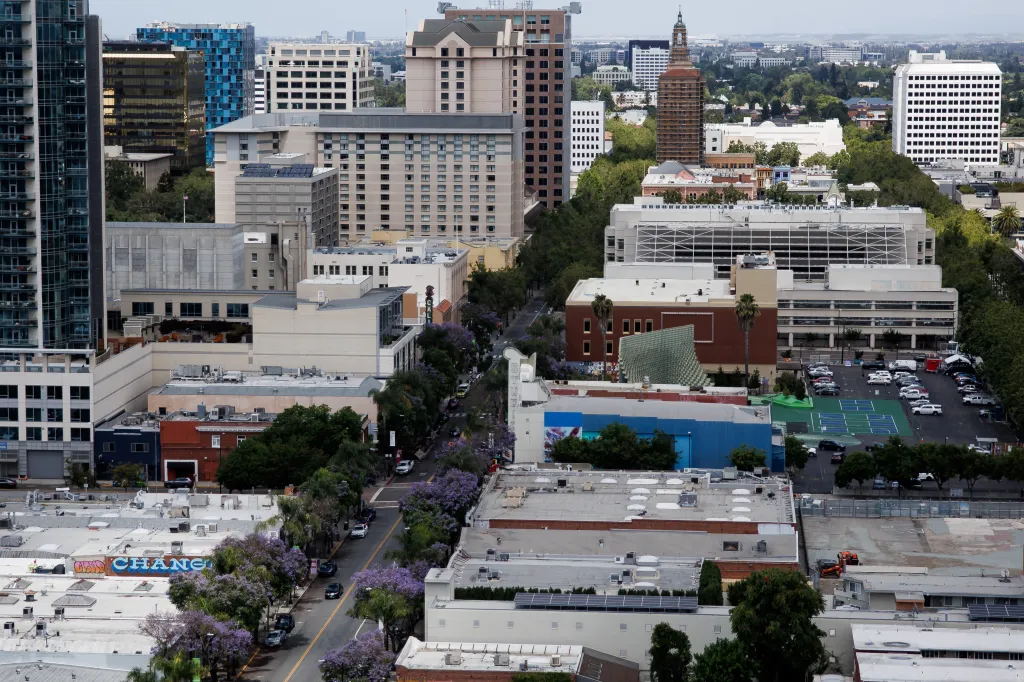
San Jose saw a 4.5% increase in the value of its assessed roll.
The slowest assessment growth occurred in Mountain View with an increase of 2.9%, slightly lower than the next-weakest gain in assessed value of about 3% in Gilroy. Other cities in the bottom five for growth were Milpitas with 3.5%, and Cupertino and Santa Clara, both at 3.7%.
A downturn in office and hotel markets has triggered a growing number of failed loans and foreclosures, county officials warned.
An estimated 98% of the $153.6 billion of assessed value under appeal is commercial property, according to the Assessor’s Office.
“We expect to receive a greater number of commercial property assessment appeals filed this year, which may result in assessment roll corrections changing the value of the assessment roll,” Fligor said.
Read more NYC building on E. 42nd St. in danger of collapse, evacuated after columns buckle
About the Author