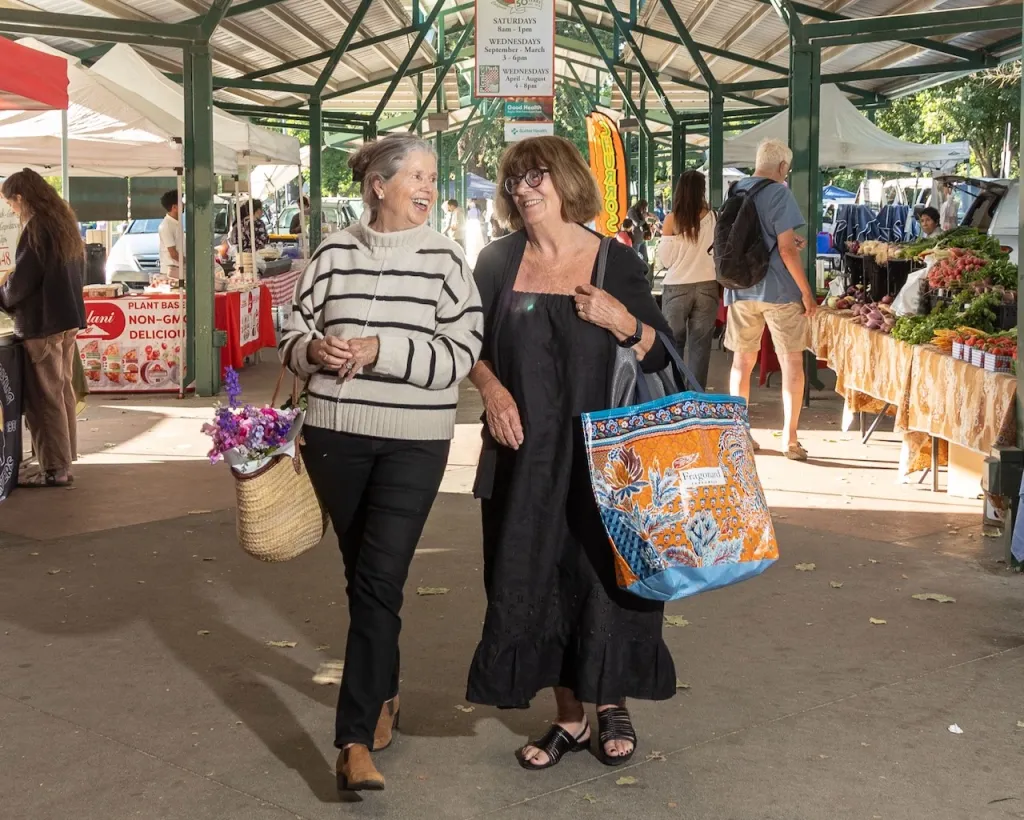
Fifty years ago, the city of Davis made history by becoming the home of California’s first certified farmers market.
Read more Three wounded in Oakland shooting
The market was started by Martin Barnes, Jeff and Annie Main, Henry Esbenshade and Ann M. Evans, who were UC Davis students in the late 1960s and early 1970s, according to Evans.
While Evans worked in then-Gov. Jerry Brown’s Department of Consumer Affairs on a range of food-related initiatives, including supporting farmers markets, the Mains, Barnes and Esbenshade got approval from the Davis City Council to open the Davis Farmers Market.
Around the same time, California’s Department of Food and Agriculture adopted regulations that would allow the nation’s first certified farmers markets — previously, it had been virtually illegal for farmers to sell produce directly to consumers.
These efforts culminated with a series of key events: The Davis Farmers Market opened on Aug. 7, 1976, with three vendors. Later that year, the Davis Food Co-Op opened and pledged to buy unsold goods from the farmers market, providing a key safety net for farmers. Then, in 1977, the market became the first Certified Farmers Market in California.
RELATED: 12 Bay Area farmers markets to explore in summer 2026
Fifty years later, the Davis Farmers Market has become a core part of the community. It draws 7,000 to 10,000 weekly visitors, and has expanded to twice-weekly operations at Davis’ Central Park, plus events at UC Davis and Sutter Health Davis.
It’s clear that these shifts a half-century ago were pivotal in shaping what would eventually become the capital region of the pioneering farm-to-fork movement, led by people rethinking how they can connect more directly with their food and the farmers who grow it.
Leading one prong of this movement was Georgeanne Brennan (who is also a longtime Bay Area News Group correspondent). In the early 1980s, Brennan worked with her friend Charlotte Glenn (later Kimball) to start Le Marché Seed Company, an international heirloom vegetable seed company.
Now, Brennan has teamed up with Ann M. Evans, one of the market’s cofounders, to author and illustrate “Davis Farmers Market: Market Memories Cookbook” with contributed essays commemorating the market’s 50th birthday. The two previously collaborated to write the original “Davis Farmers Market Cookbook,” published in 2016 for the market’s 40th anniversary.
RELATED: How Bay Area farmers markets became a symbol of downtown resilience
We recently caught up with Brennan to learn more. Responses have been edited for length and clarity.
Q: Tell me how the Davis Farmers Market got started and what it was like on the ground in those days.
A: The origins of the Davis Farmers Market really came out of the enthusiasm and optimism of the early 1970s, when it seemed like you could change the world. And the whole idea of growing fruits and vegetables and then selling them directly to people who were going to eat them was a very exciting idea.
However, it was also essentially against the law at the time. In 1937, a marketing order had been established that produce had to meet certain size, labeling and packaging requirements, which were not possible for these farmers.
There was this whole feeling that it didn’t have to be that way. You could just sell from your farm, or bring it to a location and sell directly to the consumer. It was actually a pretty revolutionary idea for California and the country at the time, even though this has been going on in Europe forever. Those vibrant farmers markets are incredible.
I remember in the very early ’70s, living in El Centro, in the Imperial Valley in California, surrounded by lettuce fields. However, the lettuce was shipped to L.A., packaged and then shipped back to El Centro. That was the only way I could buy it.
Having just come back from living in France, I couldn’t believe it. It was ridiculous that this beautiful lettuce was one mile from my house, but I couldn’t buy it.
That’s the thinking behind this group of students, really UC Davis students, getting together and saying, “Let’s just do it.”
They got together and, at the time, Annie and Jeff Main were growing vegetables in their yard and had extras. They said, “Let’s just go downtown and put up a for sale sign on the corner.” And they sold out.
It was then that the State of California developed — with a lot of battling, as you can imagine — the notion of certifying farmers markets, so that if they were selling only what farmers raised at the market, then they would be exempt from the marketing orders.
The Davis Farmers Market was the first to have that certification in the state. Ann Evans was on the Consumer Advisory Board that passed that legislation. So not only did she work as a cofounder in terms of the physical market and the exchange of products, but in being part of the battle to make it legal to even have a farmers market. That’s part of how the history of the Davis market is woven together with community and political activism.
There was this sense of hope and enthusiasm that if we try and find out how to do these things, we’ll get it done.
Today, 50 years later, you still feel that spirit. It’s fun to see. And the second generation is there now.
Q: Tell me more about your Le Marché seed business and how that fits in with this broader historic vision of changing the food system.
Read more NYC building on E. 42nd St. in danger of collapse, evacuated after columns buckle
A: I had been living in France, in Provence, in the early ’70s. My husband and I raised goats and made goat cheese. And then we came back to Vacaville and taught high school there, then for two years in an Indigenous village in Alaska. Then we came back, and I was teaching high school world history and English in Dixon.
My friend in Dixon, Charlotte Glenn, was going to start a vegetable seed company focused on American heirloom seeds. And I said, “I’ll join you and import seeds from Europe for the things that we can’t get here.” This was around 1980, and there wasn’t arugula or all these French lettuces. So we decided to start Le Marché Seeds International.
Through a couple of connections, we got someone from a French seed company, Vilmorin Seeds, to meet us at the Nut Tree in Vacaville. And he came over and helped us choose which of the French varieties of beans, lettuces, radishes, beets, turnips and tomatoes were best suited to what we wanted to do.
We bought an assortment, and it got shipped from France, and we went down to the Port of Oakland and had a customs broker who brought it through. We also got American heirloom seeds.
Then we wrote a catalog and had somebody illustrate it with pen-and-ink drawings, then sent it out to a mailing list, magazines and food and garden editors. After we were written up, we got catalog requests, and then farmers read about us and wanted to buy the seeds in bulk. A lot of these farmers were starting to develop farmers markets and direct-to-restaurant, as well as direct-to-consumer programs.
Inadvertently, Charlotte and I were, with our company run out of her basement, involved at a very seminal level in changing the way America eats in terms of its vegetables.
Q: How do you think the Davis Farmers Market has been able to continue so successfully over the past 50 years?
A: The market manager, Randii MacNear, has been there for 48 years. That’s continuity. And Annie Main and Jeff Main, who started the market with their vegetables from their backyard, are still there.
The community has embraced it as part of their identity.
And Ann Evans, when she became mayor of Davis, helped institute and build the pavilion, which, up until just a few years ago, was the only dedicated farmers market pavilion in California.
Q: What’s the market like today?
A: Now, every Saturday, year-round, there’s always a party. It’s something cheerful to do, something festive, and you see your friends and neighbors. The kids see their friends from school; there’s always lots of kids there. It’s very, very family-friendly.
Q: What impact has this ongoing market had on the community in terms of shaping how people get their food?
A: The market is part of the story. The Davis Food Co-Op was also started around the same time as the farmers market by more or less the same people. When the farmers market started, the co-op said, “Anything you don’t sell, we’ll buy.”
Because that’s always the fear, that you bring this stuff and nobody buys it, and then what do you do with it? Plus, unlike the farmers market, the co-op is open seven days a week, so there’s still an alternative for direct-to-consumer shopping.
I think people in the Davis community think about these various linked institutions as their own.
Q: So were the recipes in this cookbook inspired by your own trips to the market?
A: Yes. We’ve been going to the market for so many years, and this is a combination of our own discoveries throughout the seasons based on how we cook personally. Some are our favorite recipes that go back years, and others are of the moment.
Q: Tell me about the art in the book.
A: That was one of the best things about doing the book. When Ann proposed the idea to me, we decided to each share some books that we like from our libraries. When we showed up, over half the books were the same ones — they were French, and they had line drawings and watercolor illustrations. Ann does botanical drawings, and I do watercolor, and we decided to combine our talents and do our own illustrations. It was really collaborative and kind of unusual because artists typically are pretty possessive of their work. But we just had the best time.
Q: What are some tips for anyone looking to navigate their local farmers market like a pro?
A: I ask: Where are the lines? That’s a clue that there must be something special about what they’re selling there. Also, before you buy anything, cruise the whole market. See what’s there. You might see some strawberries, but then further along, you’ll see even better-looking strawberries at maybe a better price. Get an overview first.
And then just see what strikes your fancy and what inspires you. Rather than having several recipes and then going to the market and trying to make something round fit in a square hole, shop from what looks good at the market, and have flexibility. That’s what enables you to really get the best of whatever it is at peak flavor.
Details: “Davis Farmers Market: Market Memories Cookbook, Celebrating 50 Years 1976-2026,” is written and illustrated by Ann M. Evans and Georgeanne Brennan (Elderflower Press, $35)
Read more Brad Pitt, Ines de Ramon go Instagram-official with pics from Taylor Swift wedding
Recipes from ‘Market Memories Cookbook’
- Grilled Eggplant Sandwiches
- Charred Corn and Poblano Salsa
- Savory Tomato Tart
About the Author