Forty years back, I landed in California, just another kid ready to bet on the Golden State’s economic promise.
Read more Officials raise concerns on proposed charges in Monterey County’s ‘Baby Angelita’ case
Since September 1986, my job working as a business journalist for The Orange County Register and its sister papers has given me a front-row seat to the Golden State’s wild economic show.
If there’s one number that sums up the four decades, it’s this: In 1986, you could buy the typical California home for $105,000. Today, it costs $779,000.
This a symbol of how a 40-year economic thrill ride created numerous fortunes but left too many financially suffocated by the cost of the California lifestyle. The stress housing puts on many Californians, for example, is one of the many long-running tales that have kept me busy over four decades.
Yes, the California growth story is impressive.
Since my arrival, 6 million jobs have been created in the state, as many as 24 other states combined. Paychecks boomed, too, with per capita income jumping to $91,000 from $17,000. Those opportunities drew people as California’s population grew by 13 million, an increase equal to that of 27 states.
Those milestones don’t mean California can ignore some very tough problems.
With the help of my trusty spreadsheet and a few jaded memories, what follows is a decade-by-decade review of my 40 years in California and the hints of what might be next for California’s economy.
1986-1996: Double whammy
My start in California came as the economy was bouncing back from the previous decade’s economic mess.
The Federal Reserve’s tough love — double-digit interest rates — cured nasty inflation but at a serious economic cost.
One of my earliest assignments was following the savings-and-loan industry, a group of real estate-focused lenders whose incompetence was rewarded with inexplicable investment freedoms. California benefited from the aggressive lending by those S&Ls.
The late 1980s were boom times, and for someone who had previously worked in Pittsburgh, a growth story was a change of pace from covering the steel industry’s demise.
Then a dose of global peace became bad business for California. The fall of the Berlin Wall meant the end of the Cold War and its arms race. That translated to slashed defense spending.
California’s aerospace and munitions business tumbled just as those friendly S&L lenders were gone. A double whammy.
To top it off, there was another mess to report: Orange County’s risky investment bets sent the local government into a bankruptcy nobody saw coming.
People forget the enormity of California’s economic weakness during this period.
My spreadsheet shows us that Golden State’s job growth was the 12th-slowest among the states in this decade. Incomes, up 47%, were the third-weakest. And home prices rose by 51%, but that was only the 21st best.
But people kept coming. California’s population grew 19%, the seventh-fastest gain in the country.
1996-2006: Double bubble
The big story in the mid-1990s: Would California ever dig itself out of its economic rut?
Two bubbles “saved” California.
California’s tech wizards were busy helping lead the world into the Information Age, notably the fledgling commercial promise of the Internet.
Funds flew toward California companies trying to figure out how to sell this online concept. At the same time, old defense science became a useful tool for online commerce’s communication needs.
Tech stocks soared. Well, until the promise proved unprofitable. Wall Street’s love for Internet stocks fizzled around 2000.
Meanwhile, real estate fortunes were bubbling as a new wave of lenders, many with S&L experience, tried their hand at risky loans. Housing dodged the dot-com crash, thanks to wild “subprime” lending that let unqualified buyers become homeowners.
Warning: The bill for all that risky borrowing was coming due.
My spreadsheet reminds us how hot California’s economy was in this period.
Jobs jumped 19%, the No. 8 increase among the states. Incomes rose 57%, No. 12. Population grew 14%, No. 17.
This boom’s downside was amplifying California’s cost-of-living headache. Home prices soared 217% – yes, more than tripled in a decade – and the No. 1 gain in the nation.
2006-2016: Crash and recover
The big reporting question: When would housing’s bubble burst?
I didn’t have to look far as much of that wild lending was pioneered in Orange County.
How bad were those mortgages? Well, at one point after the crash, 13% of all mortgages statewide – and 9% nationally – were past due.
Read more Cal’s Memorial Stadium expected to be ‘rockin” for the start of Lupoi era
That Great Recession rippled worldwide. It was an unforgettable mess that drove California’s unemployment rate to 12%.
Yet, as the tale usually goes, the state economy eventually rebounded. The reversal may have been tepid, but the spreadsheet tells you it was better than much of the nation.
Jobs grew only 6% over these 10 years, but that was the 13th-best among the states. Incomes were up 39%, the 18th-largest gain.
Sure, California home prices dropped 14%, the seventh-largest decline. Deep discounting got homebuying back to normal in a hurry, unlike the slow sales we’re seeing in 2026 as prices remain elevated.
California’s population grew by 9%, but that ranked a mere 24th. The Golden State’s appeal was starting to fade.
2016 to now: Growing into illness
California became a hot economy again by the late 2010s.
Tech companies rolled out tools that built the e-commerce world we live in now. Global trade gave a lift to California’s logistics businesses. And the service industries, especially medicine and education, became major job creators.
Then came 2020’s pandemic. California’s tough response irked its business community. Economically speaking, the damage was steep, locally and nationally.
Once again, the Federal Reserve tried to fix things, this time with cheap money. That gave many industries, especially real estate, a quick boost – until it overheated housing and the whole economy.
Inflation came roaring back. The Fed reversed gears, hiking interest rates. And once again, California took a hit. For example, homes became virtually unaffordable to buy.
But as the gyrations historically go, California’s economy somehow steadied in mid-2026, even as the rest of the country stumbles.
It’s an old story: another tech boom, this time powered by artificial intelligence, is leading the way.
But my spreadsheet’s 10-year scorecard isn’t pretty.
California jobs grew by just 4% during the period, ranking a poor 34th among states. Income surged 69%, but the fifth-highest ranking seems weak against a 78% gain in home prices.
Curiously, that’s the nation’s 14th-weakest price gain – a signal that other Americans are suffering affordability issues, too.
California’s sky-high cost of living is keeping folks from making the move I did in 1986. And rising anti-immigrant attitudes is slowing an inflow of foreigners.
If population growth is a popularity contest, here’s the score: California’s headcount grew just 1% in the last decade, the eighth-slowest pace in the nation.
What’s next?
My prediction for California’s economy? Buckle up for more wild swings.
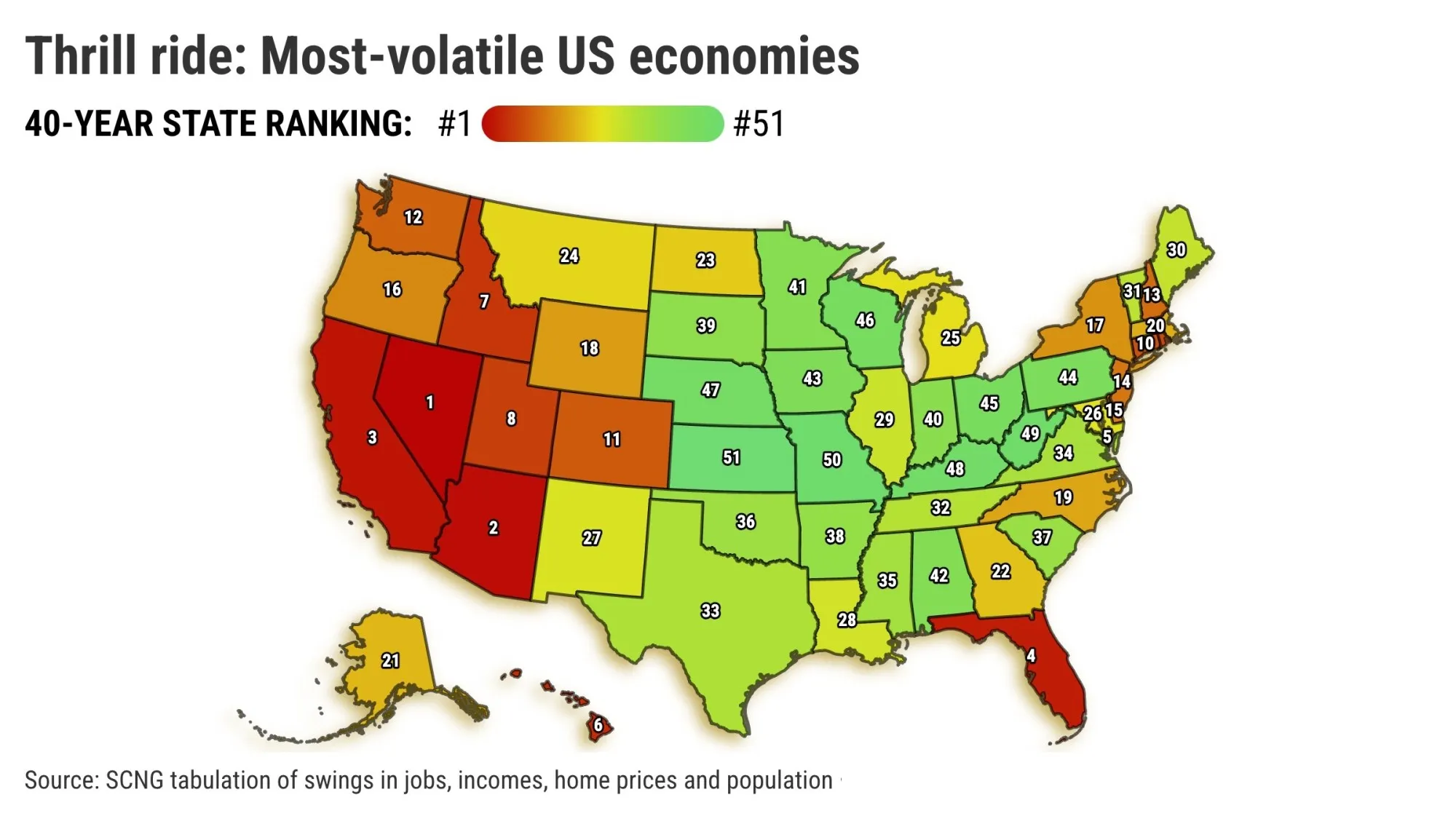
Contemplate standard deviation, a geeky way to measure volatility. Run the numbers on 40 years of jobs, income, home prices and population, and California lands as the third most volatile economy in the country.
Is volatility bad? Peek at who tops the list: Nevada and Arizona. And over these 40 years, using the average growth of those same four metrics, Nevada ranked as the 15th-best state economy. Arizona ranked 11th.
And check out who’s the fourth-most volatile business climate: Florida, which boasts the nation’s seventh-best economy.
You see, volatility comes from a willingness to embrace change. It’s California’s economic secret sauce. By the way, my math, the Golden State economy ranks as ninth-best nationally.
Conversely, stability has a cost.
Consider that Kansas ranks as the steadiest business climate in the country. But it’s also the seventh-worst for overall performance.
Missouri was next for stability, but had the 10th-slowest growth. And West Virginia was the third-most stable and the third-worst for growth.
You see, status quo does not pay. That’s a hint for California, as its economy needs to change.
Jonathan Lansner is the business columnist for the Southern California News Group. He can be reached at [email protected]
Read more The economy feels broken. Meet the South Bay artists fixing things themselves.
- Try Jonathan Lansner’s Substack collection of economic trends. CLICK HERE!
About the Author