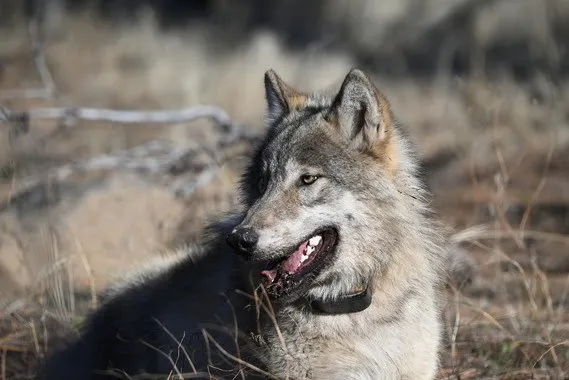
For the first time in a century, a lone gray wolf has been spotted in Mendocino National Forest, state fish and wildlife officials confirmed.
Read more That new trail has a few surprises, Bay Area hikers are warned
The wolf was first spotted and photographed by a hunter on Aug. 24 and by a private land owner the following day in the area where Mendocino, Glenn and Lake counties meet, according to Alicia de la Garza, public affairs deputy director for the California Department of Fish & Wildlife.
“This is the first time in modern times that a wolf has been recorded in this area,” Garza said. “However, this area is, like much of California, part of the historic range of the species.”
A wolf biologist for the department confirmed the validity of the photos taken by the hunter and landowner, Garza said. The images likely showed the same animal due to its age, coat and color, as well as the time and locations of the sightings, she said. Based on the photographs, the wolf appears to be of prime age, likely 2 to 4 years old.
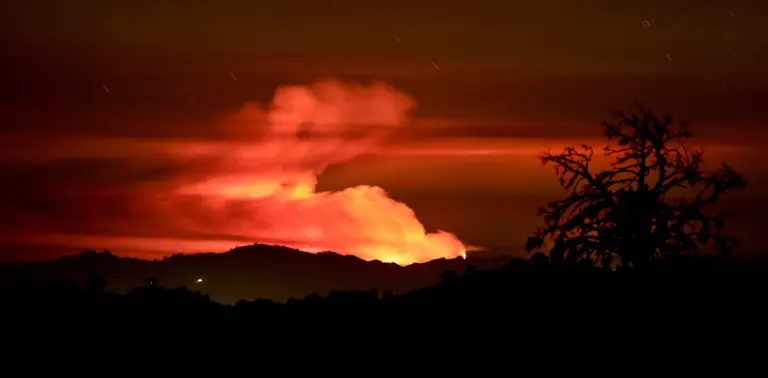
To further confirm the wolf’s presence, fish and wildlife staff surveyed the area where the sightings were reported, in the tripoint boundary of the three counties, which sits in high, rugged terrain north of Lake Pillsbury. On Aug. 26, the team found wolf tracks where one of the sightings was reported, Garza said.
Garza said it’s impossible to know how long the wolf has been in the area and where it might have come from, since the department does not have any prior monitoring data in that area or any previous sightings.
“If genetic data can be collected in the future,” she said, “it may be possible to determine the origins of the animal, but (it’s) unlikely to yield any information of the route the animal took to get there.”
Though gray wolves are native to California, they were believed to have been driven out of the state in the 1920s, according to the state fish and wildlife department. There is no definitive cause for why the wolf population declined, but it is suspected that human activity may have contributed to their apparent disappearance.
Gray wolves, now a recovering endangered species protected by state and federal law, began reappearing in California in late 2011.
The federal government is reconsidering protections for wolves nationwide.
President Donald Trump issued an executive order Friday directing the secretary of the Department of the Interior to determine within 90 days whether gray wolves and Mexican wolves have met recovery criteria for removing or reducing their protections under the federal Endangered Species Act. If the secretary determines the criteria have been met, the order directs the department to begin that process.
The first modern wolf to reappear in California, named OR-7, arrived in 2011, according to Susan Dewar, president of the California Wolf Foundation. The wolf did not stay in California but he did establish a pack in Oregon, leading many of his descendants to form packs in California.
Read more A new California law will ban watering decorative grass, even in non-drought years, starting Jan. 1
In the 15 years since OR-7’s appearance, the wolf population of California has slowly grown. Packs are currently mapped in Siskiyou, Modoc, Lassen, Shasta and Plumas counties. There are at least 50 wolves and 12 wolf packs being monitored in California, according to a July 2026 report from the Department of Fish and Wildlife.
The appearance of a wolf in Mendocino, Glenn and Lake counties is notable because it’s much farther west than where wolves in California are currently established. Dewar noted a potential obstacle to wolves returning to the area could be Interstate 5. Nonetheless, a wolf sighted in the area is a good sign for recolonization, she said.
While a single wolf neither indicates that a pack has formed nor that wolves will permanently establish in the area, “dispersal is a critical part of wolf recovery,” Dewar said. “Every dispersing wolf helps us better understand how the species is expanding into suitable habitat across California, making observations like this both scientifically important and exciting.”
Sightings also allow local communities to learn about wolves before they become established in the area, Dewar said.
At a public meeting earlier this week, Mendocino County Supervisor Madeline Cline mentioned the wolf sighting in the national forest and reinforced that gray wolves are listed under both the California and federal endangered species acts.
“Lethal take is prohibited,” Cline said at the meeting Tuesday, Sept. 1, adding that non-injurious hazing of wolves near livestock is allowed under the state fish and wildlife department’s guidance when wolves are within a quarter-mile of livestock or within 100 yards of a dwelling, agricultural structure, campsite or commercial facility.
Wolves can and will hunt domestic livestock as a source of food, especially when they are more vulnerable and more readily available, Garza said. But the Department of Fish and Wildlife has a variety of resources — physical tools and educational material — to help livestock producers mitigate conflict with wolves.
Garza said the department is also committed to working with local county officials, livestock organizations and rural communities “to provide resources and information on how to live and work alongside wolves.”
Reach Staff Writer Alana Minkler at [email protected]. Reach Staff Writer Kyle Garcia Takata at [email protected].
Read more Review: ‘Onimusha: Way of the Sword’ modernizes a dormant samurai series
The Sacramento Bee contributed to this report.
About the Author