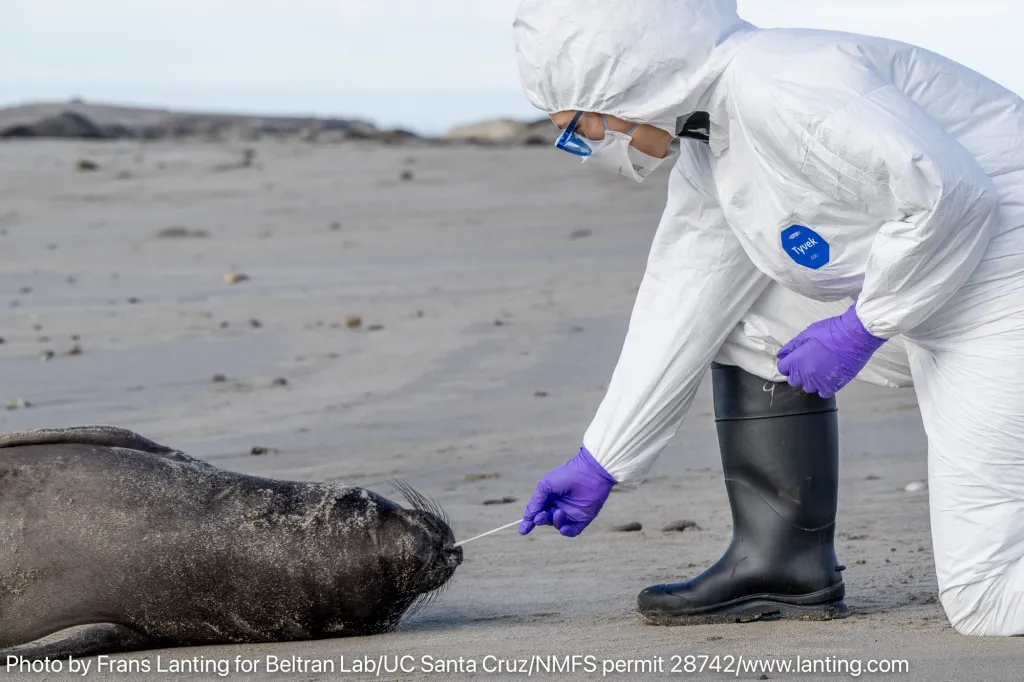
The avian influenza outbreak that put some of California’s most beloved marine mammal and sea bird populations at risk has subsided in marine mammals, according to officials who confirmed no positive cases have been detected since March 14.
Read more San Francisco police officer, suspect, critically injured in shooting following chase
The outbreak in Monterey Bay National Marine Sanctuary marks the first cases of highly pathogenic avian influenza (HPAI) in marine mammals in California and the first detection in northern elephant seals, California sea lions and southern sea otters. The disease decimated populations of other marine mammal species elsewhere, including southern elephant seals in Argentina in 2023.
“This is exceptionally rapid detection and close monitoring of an outbreak in free-ranging marine mammals,” said Dr. Christine Johnson, director of the Institute for Pandemic Insights at the UC Davis Weill School of Veterinary Medicine. “We most likely identified many of the initial cases here because of coordinated teams that have been on high alert with active surveillance for this disease for some time.”
The emergency response, described by partners as “herculean” was mounted by a powerful collaboration including UC Santa Cruz, UC Davis, the National Oceanic and Atmospheric Administration, California Marine Mammal Stranding Network, California State Parks, California Department of Fish and Wildlife and other local, state and federal partners.
This rapid deployment was crucial in monitoring an infection that, while primarily associated with birds, had jumped to marine mammals. Upon detecting the suspicious symptoms, UC Santa Cruz researchers implemented the safety and sampling protocols provided through training by their UC Davis collaborators, who then quickly performed polymerase chain reaction tests to confirm the pathogen and determine that the virus was HPAI H5N1. Follow up work by USDA National Veterinary Services Laboratory confirmed the HPAI H5N1 A3 genotype, tracking its likely spread from avian populations along the Pacific Flyway, a migratory pattern from Alaska to the southern tip of South America.
Early detection transitioned immediately into a full-scale operation. The swiftness of the intervention hinged on established monitoring programs and keen observation by field teams. Roxanne Beltran, ecology professor at UC Santa Cruz, emphasized the importance of this infrastructure. “My team, while in the field, recognized unusual symptoms in the elephant seals we are studying such as tremors, convulsions/seizures, labored breathing, nasal secretions and weakness, quickly shifting us into a full outbreak response,” she said.
This demanding schedule saw researchers from all institutions and agencies pulling long days, often 20-hour shifts focused on monitoring animals, collecting samples and keeping partners informed in real time. The dedication demonstrated by the personnel on the ground at Año Nuevo State Park was a defining feature of the containment strategy.
The scientific pace was equally impressive. Out of 233 animals tested during the main February/March 2026 outbreak, 64 animals tested positive for the avian influenza, resulting in an overall positivity rate of 27%. The majority of the cases were concentrated in San Mateo County. Elephant seals were the most heavily impacted species, accounting for 57 of the positive cases. Additionally, six California sea lions and one southern sea otter were also confirmed positive for the virus. All sequences from this cluster were confirmed to be the A3 genotype.
“We owe great thanks to the many teams who responded to the animals and the close collaboration between researchers, veterinarians, local, state and federal agencies, and stranding networks,” noted Dr. Deborah Fauquier, NOAA Fisheries veterinary medical officer.
Read more Claude Lemieux’s children speak out after death, reportedly by suicide
Furthermore, the team leveraged cutting-edge technology alongside traditional methods. Beltran explained, “We’re combining traditional field observations with newer tools like drone surveys and real-time satellite transmitters to understand what’s happening both on the beach and out at sea.” This multi-faceted approach provided a real-time, comprehensive view of the transmission dynamics, aiding in the successful assessment of the disease’s spread.
While the primary focus was on the elephant seal outbreak, data indicates the virus was circulating earlier. Historic samples taken in November 2025 detected three positive southern sea otters in Monterey County.
The professional urgency of the response was often tempered by a deep personal connection to the animals. Field researchers who spend their careers studying these populations faced a difficult task.
Beltran acknowledged this challenge. “One of the hardest parts of this outbreak is that we know many of these animals as individuals,” she said. “We’ve followed them for years, sometimes across generations.” However, this dedication offered a critical advantage: “At the same time, that long-term dataset gives us the context needed for rapid assessment,” Beltran shared.
While the marine mammal crisis has passed, the wider context of the virus remains relevant with seasonal outbreaks impacting a diversity of wild birds since 2022. During the current season, preliminary detections of avian influenza have been made in 261 wild birds collected from 29 counties in California between October 2025 and April 2026. The most recent avian cases were in waterbirds collected in early to mid-April from San Mateo and Placer counties.
The successful, quick and coordinated response to the marine mammal outbreak now serves as a critical model for future interagency action against zoonotic diseases — harmful germs that can spread from animals to people and cause illness.
The National Oceanic and Atmospheric Administration advises beachgoers to be on alert for any dead or distressed animals — keep your distance, keep your pets on a leash and call the appropriate authorities to report a stranded animal. The hotline for the West Coast Region Stranding is 1-866-767-6114 or go to the West Coast Mammal Stranding Stranding Network page.
Lisa Uttal is science outreach and media coordinator at Monterey Bay National Marine Sanctuary.
Read more Where in California do landlords offer the most discounts?
About the Author