Southern California’s rental market is costlier to the south, but landlords have more pricing power to the north.
Read more Major delays greet BART commuters in Contra Costa County
That’s a theme within my trusty spreadsheet‘s review of a Rentometerreport tracking the rents landlords are seeking for three-bedroom houses in the first half of 2026 in 1,099 U.S. cities – including 163 in California.
To highlight some geographical twists, the state was split into two. A broad definition of Southern California included 99 cities stretching from the Mexican border to San Luis Obispo and Ridgecrest. Northern California, for this math, was 64 cities from Redding to Tulare.
Plus, to remind us how pricey California is, we also peeked at the study’s 936 cities located outside of the Golden State.
Let’s start with what a typical rental house costs in this year’s first six months.
The median in the southern cities was $3,900 per month vs. $3,100 in the north. That’s a 26% gap.
Yet neither is a bargain compared to what other Americans pay. The median rent in the rest of the nation is $2,000.
Or look at the pricing variances this way: How many cities have median pricing under $2,500 a month?
It’s only 8% in the south, 27% in Northern California, and 80% in the rest of the nation.
Price swings
The good news for many tenants is that numerous landlords have lost some pricing power.
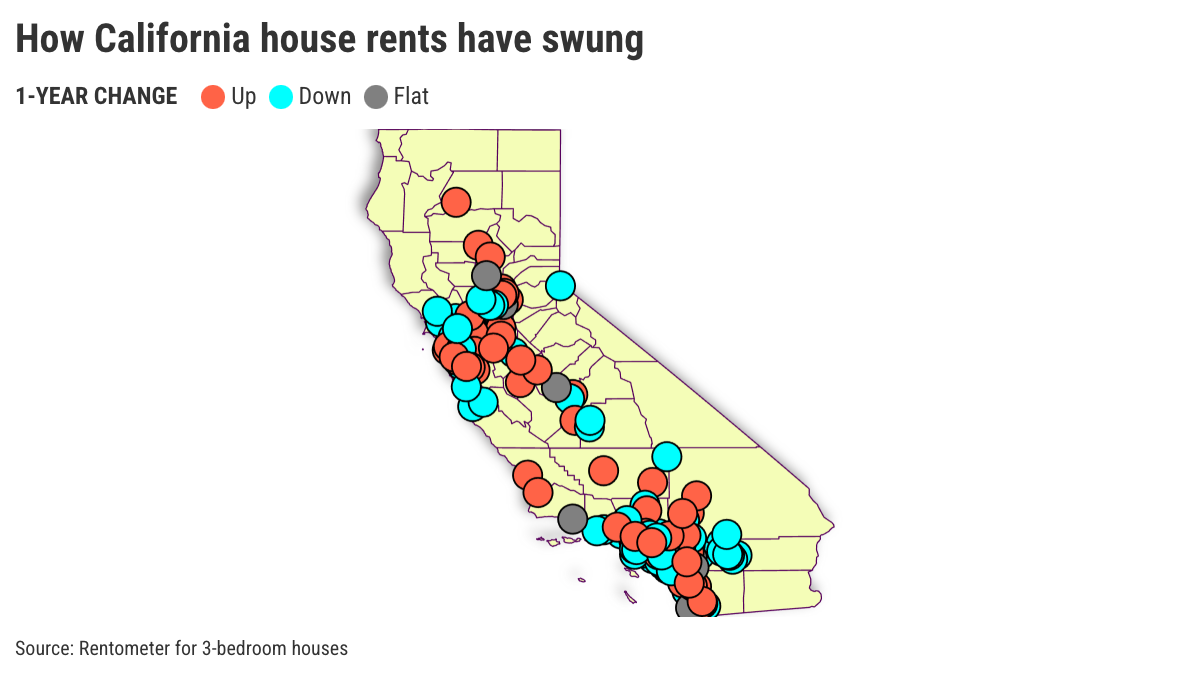
That translates to Southern California median rents running flat over the past year, while rents have gained 4% in the north. New tech wealth around the Bay Area tied to the development of artificial intelligence is seen as a key driver of the northern upswing.
Outside of the Golden State, rents rose 1% over the past year.
Yet many landlords are discounting: Rents fell in 51% of the southern cities vs. 33% in the north. And half of the cities outside of California had declining rents, too.
City levels
Where’s the highest rent?
To the south, it’s in West Hollywood at $8,200 per month, and to the north, in Palo Alto, at $6,300. The rest of the nation’s highest rent was found in Coral Gables, Florida, at $6,375.
Read more Jill On Money: Managing the high cost of kids
Look inland for California’s cheapest pricing.
To the south, it’s in Ridgecrest at $1,600 monthly, and Tulare is the north’s low at $1,900. Both are far from the Pacific Ocean.
For the rest of the nation, the bargain spot is Johnstown, Pennsylvania, at $951.
Price swings also varied.
The south’s biggest gain was in West Hollywood, up 20% in a year to $8,200 monthly. To the north, Sunnyvale was up 11% to $5,000.
And in the rest of America, the No. 1 gain was 54% in Monroe, Louisiana, to $1,850.
The south’s biggest dip was in Rancho Mirage, off 20% to $4,700. Palo Alto’s 9% tumble to $6,300 was the north’s top rent drop.
Outside of the Golden State, the big dip was a 22% decline in Bonita Springs, Florida, to $2,974.
Mind the gap
Consider the spread between high and low rents across the three regions we’ve tracked.
These significant differences tell us that while statistical midpoints are effective for observing trends, they can overlook what’s happening at the extremes. And that might be where your life sits.
So, think about the city-level gaps from the first half of 2026. These price spreads reflect the quality and popularity of rental markets – as well as what’s available to rent. It’s also a reminder that price shopping by geography can save a tenant some money on rent.
Across Southern California, there’s a $6,600 divide between the priciest and cheapest cities. That equals potentially 80% savings, from high to low.
In Northern California, it’s a $4,400 chasm or 70%. And in the rest of America? A $5,424 gap or 85%.
Jonathan Lansner is the business columnist for the Southern California News Group. He can be reached at [email protected]
Read more Used EV market in California sizzles as gas prices soar
About the Author