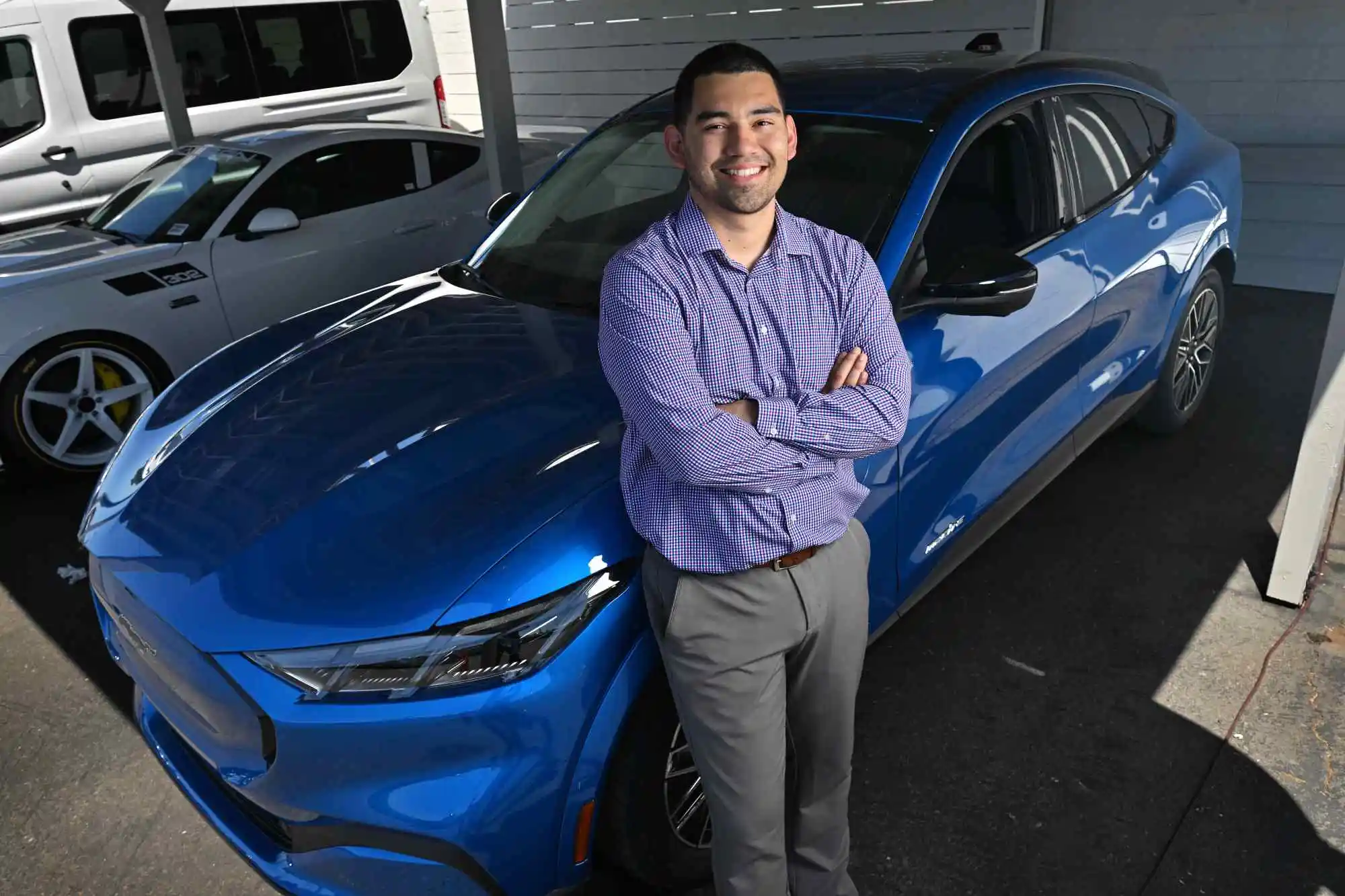
Used car salesman Nicholas Beiza got a call earlier this month at a Southern California Ford dealership from a theology professor looking to buy a new car.
Read more Map: Dove Fire and evacuations in city of Sonora
The Biola University academic was car shopping after his house-sitter totaled his Ford Escape SUV.
RELATED: The $25,000 new car or truck is an endangered species. Here’s why
Instead of putting his customer in a new car, Beiza sold the professor a used one — a sporty, all-electric Ford Mustang Mach-E with 55,000 miles on the odometer. Beiza drove the $25,000 car over to the professor’s home and handed him the keys.
“He previously owned a Mustang long time ago and was super-interested in getting another one, and settled on an EV because of gas prices,” Beiza said.
 Salesman Nick Beiza of Fullerton Ford with a 2026 Ford Mustang Mach-E Premium all-electric EV, July 22, 2026. The EV is similar to a 2023 model that a Fullerton professor purchased from him a few weeks ago to replace his wrecked car. The used EV market is expanding rapidly at a double-digit clip because of rising gas costs and a flood of leased EV vehicles hitting the market. (Photo by Steven Georges, Contributing Photographer)
 Salesman Nick Beiza of Fullerton Ford with a 2026 Ford Mustang Mach-E Premium all-electric EV, July 22, 2026. The EV is similar to a 2023 model that a Fullerton professor purchased from him a few weeks ago to replace his wrecked car. The used EV market is expanding rapidly at a double-digit clip because of rising gas costs and a flood of leased EV vehicles hitting the market. (Photo by Steven Georges, Contributing Photographer)
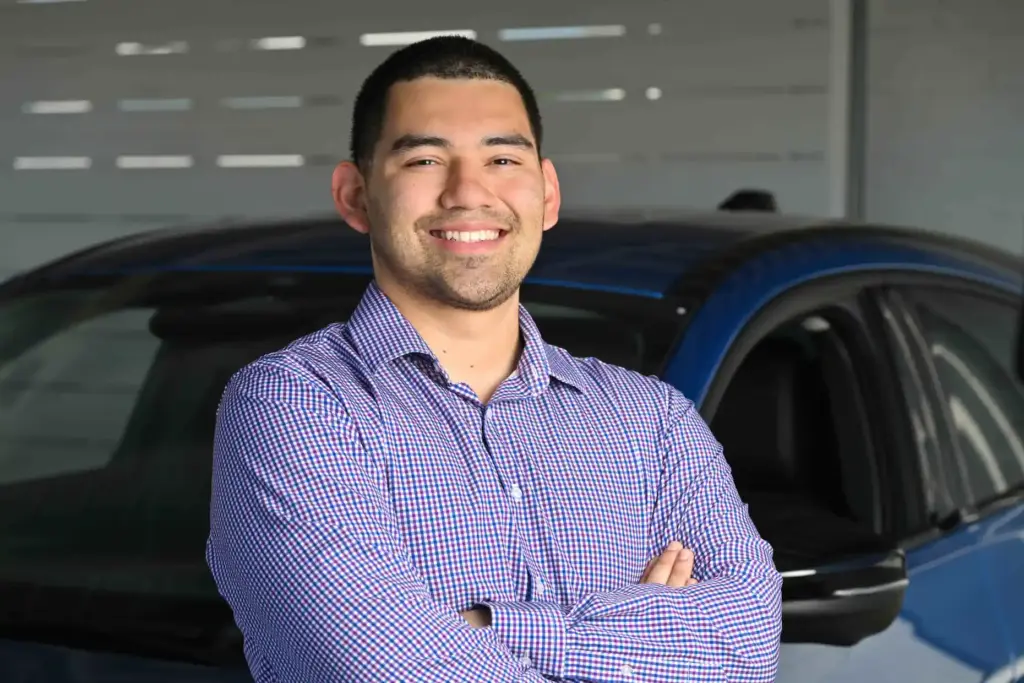
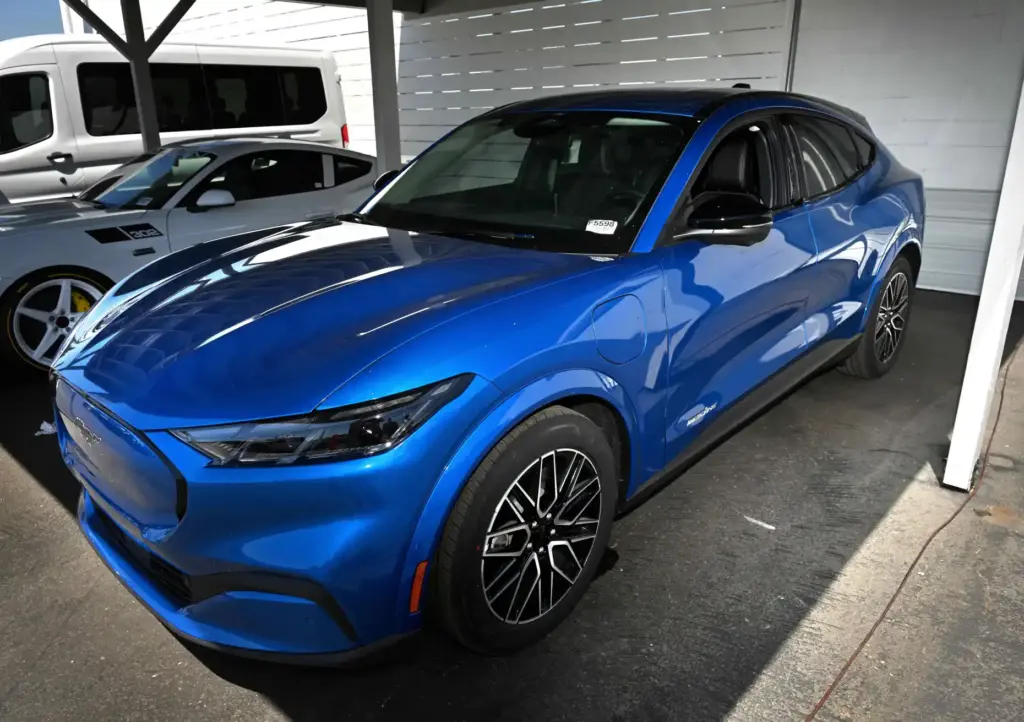
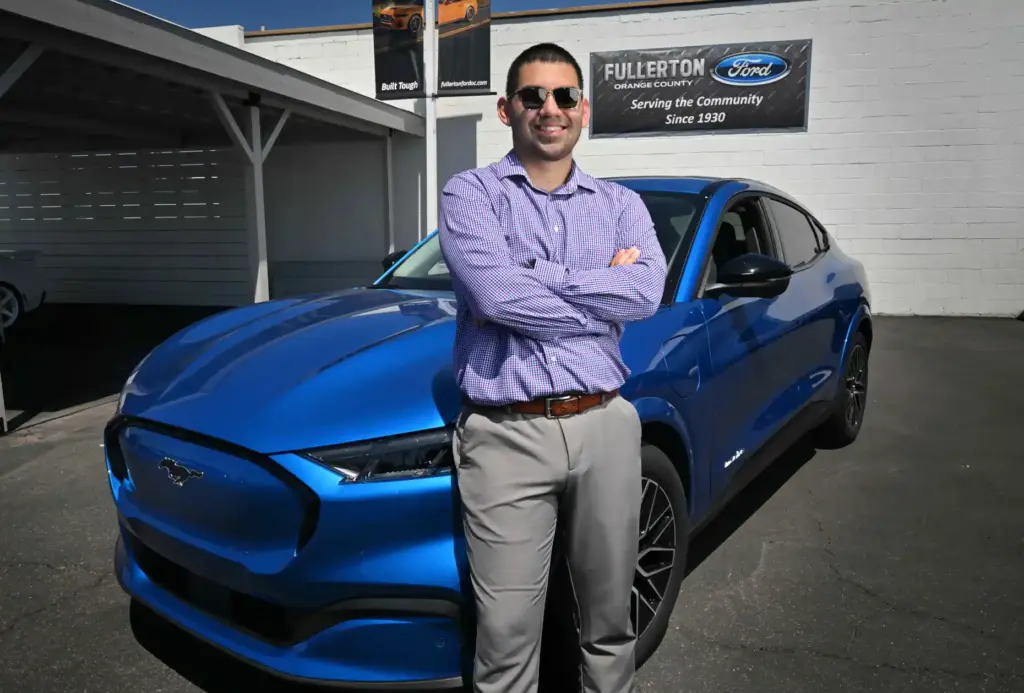 Salesman Nick Beiza of Fullerton Ford with a 2026 Ford Mustang Mach-E Premium all-electric EV, July 22, 2026. The EV is similar to a 2023 model that a Fullerton professor purchased from him a few weeks ago to replace his wrecked car. The used EV market is expanding rapidly at a double-digit clip because of rising gas costs and a flood of leased EV vehicles hitting the market. (Photo by Steven Georges, Contributing Photographer)
Dealerships across the region are seeing a similar trend unfolding as electric vehicle buying rises at a double-digit clip.
Auto experts cite demand from drivers who want to cut out pricey gas fill-ups due to tight supplies caused by the U.S. war with Iran, anda flood of leased EV vehicles helping car shoppers steer clear from new models selling for $50,000 or more. Last fall’s expiring federal incentives created another class of used EV buyers who rushed to buy something before the deals went away in a wobbly economy.
One used EV shopper described a “K-shaped” trend where consumers are buying a vehicle based on their budgets, big and small.
Tim Tipping, a resident of Claremont, bought a used 2023 Chevy Bolt on the last day that the $4,000 federal tax credit was offered — Sept. 30, 2025 — for used EVs before it expired.
“I always wanted an EV, and I didn’t think I could afford a brand new one,” Tipping said. “When I saw that it was the last month the rebate would be offered, I started looking at the used ones. I wanted to get one at under $20,000.”
Tipping said that since the Iran war began, he’s also bought four e-bikes to travel around his neighborhood for work and recreation with his family. “I bought them 100% because of the war.”
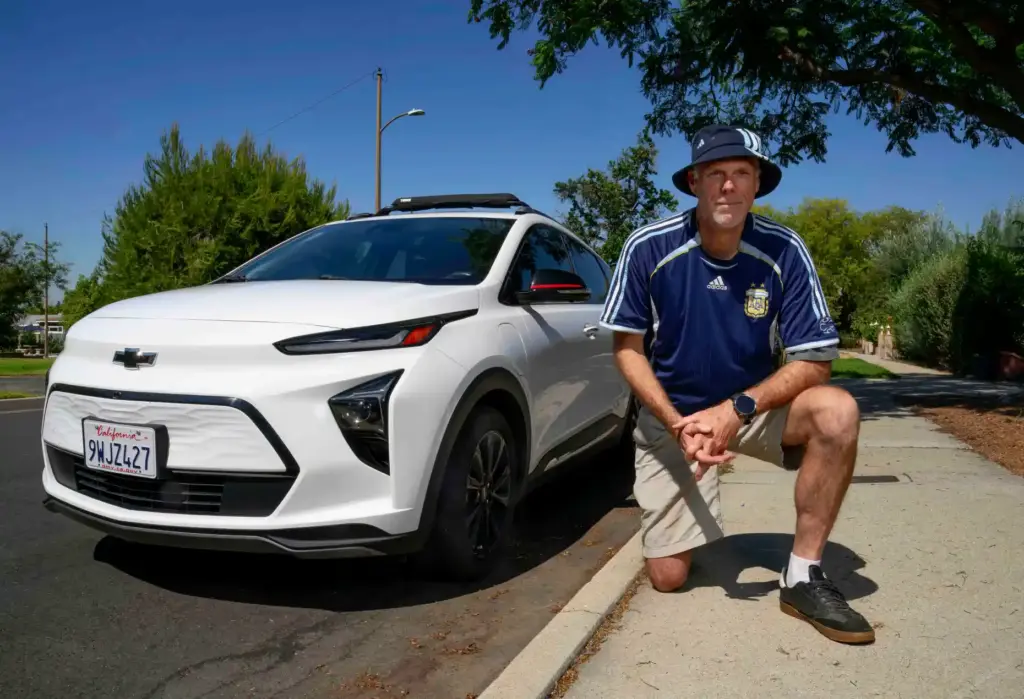 Tim Tipping with his 2023 Chevrolet Bolt EV in Claremont on Wednesday, July 22, 2026. He bought the car on the last day that the $4000 federal tax credit was available. (Photo by Paul Rodriguez, Contributing Photographer)
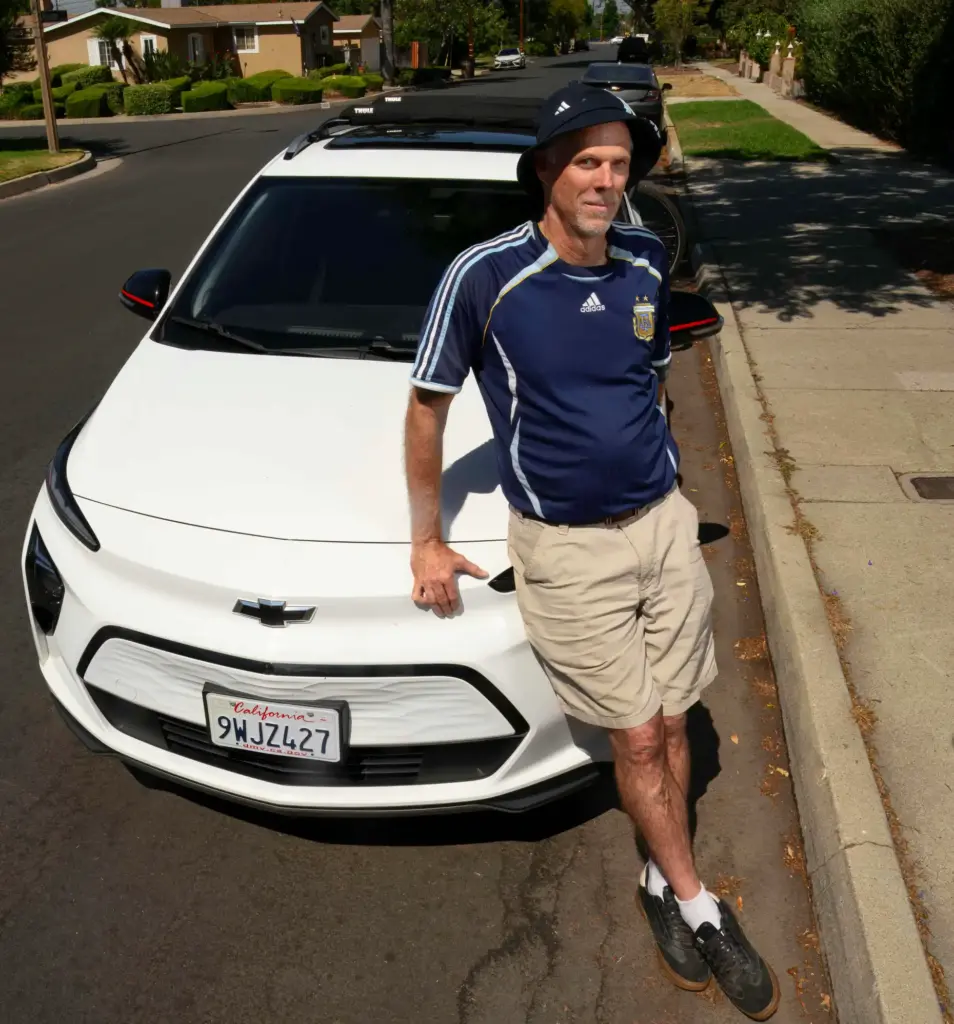 Tim Tipping with his 2023 Chevrolet Bolt EV in Claremont on Wednesday, July 22, 2026. He bought the car on the last day that the $4000 federal tax credit was available. (Photo by Paul Rodriguez, Contributing Photographer)
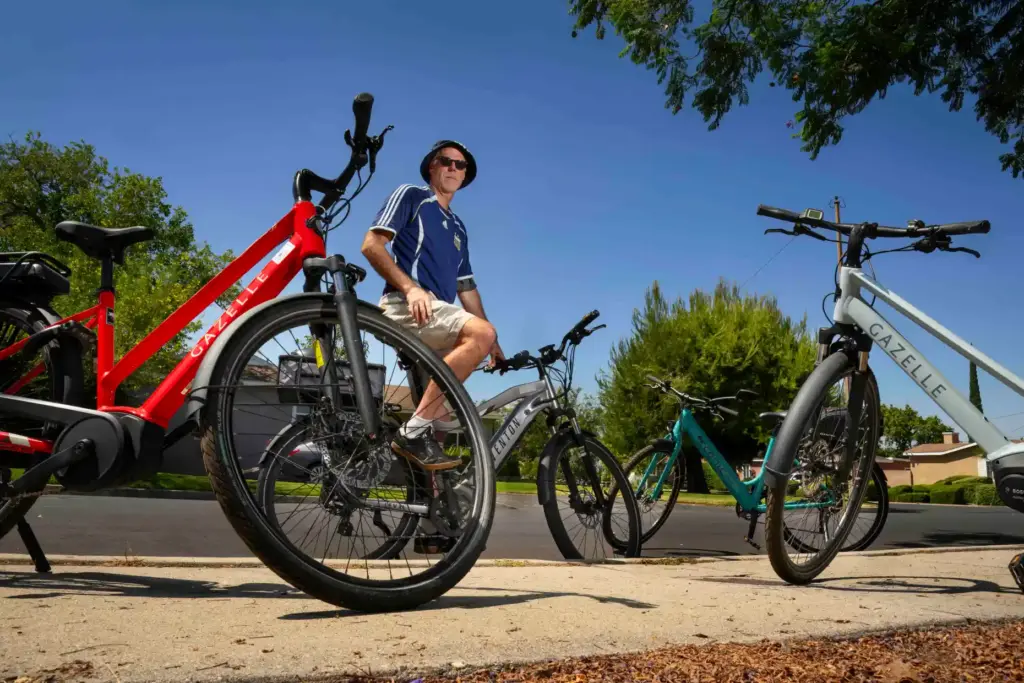 Tim Tipping, who now has four e-bikes he uses for work and recreation with his family, in Claremont on Wednesday, July 22, 2026. He bought them rising gas prices caused by the U.S.-led war against Iran. (Photo by Paul Rodriguez, Contributing Photographer)
Double-digit growth
The EV data for used vehicle sales supports what dealerships already are seeing.
Mobility Global, an automotive data company, provided used EV data to the Southern California News Group showing a forecast of 20% growth this year over the state’s 142,649 registrations in 2025. The 2026 forecast is based on sales figures for the first five months of the year. It does not include extenuating circumstances like further disruptions to the economy, or tax credits — all of which could sway how much is really sold.
Statewide, sales are happening slightly faster than the 18% rate seen nationally over the same period, according to the data.
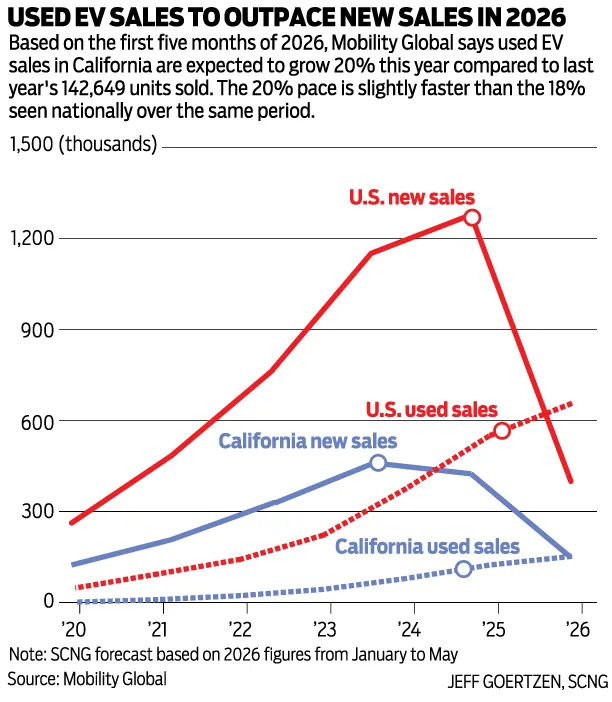
“You’ve got more inventory, and people are interested,” said Stephanie Brinley, associate director of Mobility Global’s AutoIntelligence. “The used market is much larger than ever.”
Meanwhile, new EV sales are projected to plummet 22% in 2026 over last year’s levels in California, while nationwide sales are expected to decline 25% over the same period, the data shows.
Yet another indicator of the market is Cox Automotive’s Manheim Used Vehicle Value Index for EVs — which tracks how many used EV vehicles have been sold at wholesale auctions to dealerships. The index jumped 12.3% in June on a year-over-year basis.
The average listing price for a used, all battery-powered EV was $38,342 in June, up 3.5% from May and 7% year-over-year, according to the index. The bullish pricing was broad-based, including several high-volume brands manufactured by Tesla, Chevrolet, Hyundai and Kia. This category does not include hybrid cars — which typically use an internal combustion engine and a battery-powered electric motor to maximize fuel efficiency.
The story is markedly different for new cars in California and the U.S.
Hybrid sales are booming, having reached their highest share on record in California’s new vehicle market in the first six months of the year. The 22.1% share is up from 19.5% for all of 2025, according to the California New Car Dealers Association.
Read more Jordan Devey, former Raiders lineman, dies days before 15th wedding anniversary
That’s a significant chunk of growth to claim since California’s overall new car market fell 7.7% through the first six months of 2026, while the U.S. market fell 2.8%, according to CNCDA’s July 20 report. Registrations for new zero-emission vehicles (ZEV) — like electric-, plug-in hybrid-electric and fuel-cell electric vehicles — fell nearly 25% in the first half of 2026, compared with the same year-ago period due to the loss of last year’s federal tax credits.
The state hopes to spark a turn around in new EV car-buying with a rebate program, MyFirstEV, that could lead to more ZEV sales — and further boost the used vehicle market down the road as consumers trade-in their cars.
California’s MyFirstEV program provides a $3,500 instant rebate for first-time ZEV buyers, and $1,750 for first time buyers of a used EV that sells for less than $25,000. The $270 million joint initiative is funded by $135.5 million from the state and matched dollar-for-dollar by 13 participating automakers. It launches later this summer.
Other states are trying similar incentive programs, including Colorado, New Jersey, New York and Oregon, according to the Energy Department’s Alternative Fuels Data Center.
Expiring tax credits
The first wave of buying interest in used EVs began to emerge when federal electric vehicle tax credits expired Sept. 30, 2025, following their elimination under last year’s One Big Beautiful Bill Act. The repeal ended the up to $7,500 new vehicle credit and the $4,000 used vehicle credit — which is what Tipping tapped to buy his Bolt.
“I think that the market stalled after the money went away at the beginning of quarter four (October) of last year, but as gas prices continue to rise, especially here in California, the desire for EVs — primarily for pre-owned EVs under $30,000 — has increased,” said John Patterson, owner and president of OC Auto Group and its five Kia, Mazda and Hyundai dealerships in Orange County.
“Between my stores, we were selling zero EVs used, or very few in the fourth quarter (2025) and first quarter of 2026. It’s now increased four times that amount, if not more,” he said. “I don’t think we were expecting the war to go on like it has, and certainly that’s impacted our gas prices here in California at a level that we don’t see elsewhere,” Patterson said. “For used EVs, it’s a unique place we’re in.”
Stewart Benjamin, general manager of McPeek Anaheim Chrysler Dodge Jeep and RAM dealership, also is seeing modest growth in used EV sales.
His dealership once sold plug-in hybrid electric Jeep SUVs and Chrysler minivans until parent automaker Stellantis scrapped them amid the new EV sales slowdown.
“We’re seeing higher demand on used EV cars. People want to get one from $25,000 to $29,000. That’s our sweet spot for used EVs,” Benjamin said. “We’ve had a couple of Teslas, but they pretty much sell faster than the (internal combustion engine) cars. Without question, the used EVs are not the easiest cars to come by. Everybody wants them.”
Still, even with all of the optimism about the market from big dealers, mom-and-pop lots are sounding downbeat.
Chris Lucero, owner of Lux Automotive along Flat Rock Road in Riverside, said that the loss of the federal tax credit hurt his business.
“I was selling four to five used EVs a month before the tax credit expired,” Lucero said. “After it went away, I sell one every three months. I’m a smaller dealership, so it became impossible to do sales on the finance side as credit tightened.”
Lucero said that he’s downsizing his used car and EV dealership because sales are difficult. He blames the slowdown on a limp economy buffeted by inflation and soaring gas prices.
“I was making 20 to 25 used car sales (including EVs) a month over the past year. Now I’m having every car sit three to five months. It has worsened since the war. I’m not shutting down completely, but moving in a different direction toward commercial fleet truck sales, hoping its better.”
Read more Why baseball pioneer Olivia Pichardo picked Cal — and softball — after graduating from Brown
About the Author