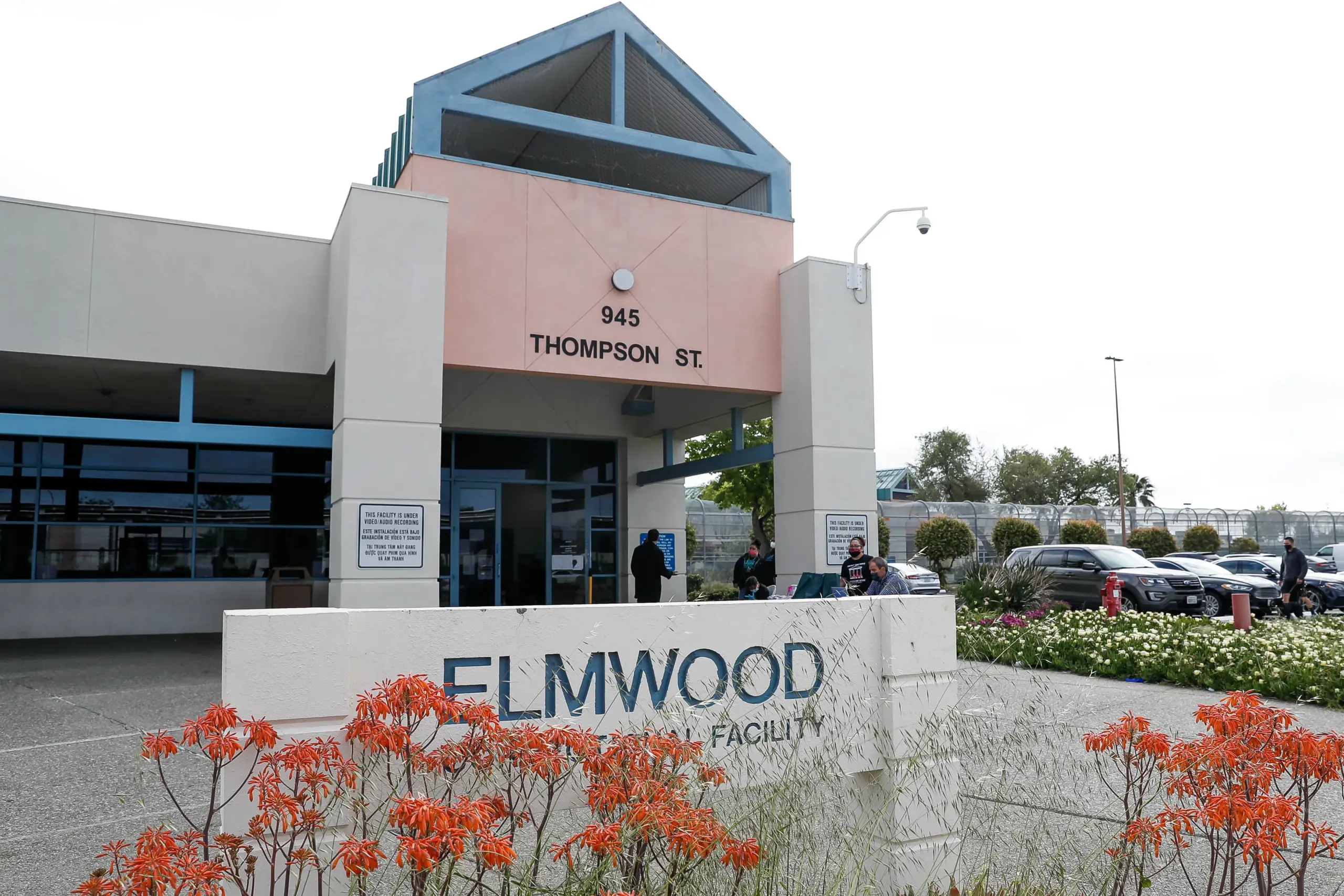
SAN JOSE — Eight years after Santa Clara County agreed to overhaul inadequate medical care in its jails, county officials and prisoner advocates have negotiated firmer benchmarks aimed at accelerating reforms that have repeatedly fallen short.
Federal Judge Nathanael Cousins last week signed off on a plan that gives short timelines, including as soon as this December, for the county to provide more responsive care at the Main Jail in San Jose and Elmwood jail in Milpitas. This pact comes after the Berkeley-based Prison Law Office — appointed to enforce the 2018 decree that settled class-action litigation over jail conditions — asked a federal court last year to hold the county in contempt and start fining the county for noncompliance.
The new agreement has put any potential penalties on hold, for now.
“It did get the attention of the powers that be,” Donald Specter, a senior staff attorney with the Prison Law Office, said of the contempt motion. “They made some significant changes which we hope will improve the care … but we’re still in the beginning stages.”
Under the agreement posted Tuesday, the county must move toward responding to sick calls within 24 hours at least 75% of the time by December. The jails must also reach an 85% target for timely withdrawal monitoring and assessment for inmates who screen positively for substance use, and conduct follow-up assessments within 24 hours on inmates who have been recently removed from suicide monitoring, also with an 85% compliance target.
Additionally, the December deadline applies to a goal to get at least 75% of inmates with chronic illnesses in front of a healthcare provider within 14 days of jail intake. The agreement also sets a January deadline and a goal to provide at least 75% of inmates held in the acute psychiatric unit with a minimum of 17 hours outside of their cells each week.
Read more Blasted for harsh view of missing girl, Monterey County sheriff now says her safety is top priority
County Executive James Williams called the agreement “an important step forward in the county’s ongoing commitment to improving how we provide healthcare for incarcerated individuals.”
“The county has acted with urgency to ensure there were adequate custody officers to support our healthcare functions. We also went far beyond the issues raised in the motion, partnering with the Prison Law Office to create a roadmap with measurable outcomes across key healthcare metrics,” Williams said in a statement to this news organization. “We’re confident that, with continued partnership, we will continue to make critical progress.”
Both sides still have to hash out key details — including what constitutes sufficient medical attention — to avoid scenarios where care and examinations are conducted in a cursory manner to meet numerical goals. The county and Specter’s office are required to negotiate those standards by the end of September.
The specter of a contempt finding still looms as an outcome if the county cannot steadily meet the agreed-upon targets. Officials are required to submit monthly reports; if the jails fail to meet a given target, they have 30 days to remedy the situation, and if they still fall short, the Prison Law Office could revive its contempt motion.
There are also relief provisions should the county meet the prescribed care goals. If the jails meet or exceed a target for 12 consecutive months, that category is removed as grounds for a contempt finding. If the county exceeds the targets by 10 percentage points for an entire year, they could be removed from external monitoring altogether.
Read more Bay Area Oktoberfest 2026: Your guide to beer, brats, music
But some medical staff at the jails are wary, noting that as of now, there is no immediate sign of an increase in resources to help them fulfill the agreement in a real way. They also blame the current circumstance on past tension with management — which has recently changed over — that pitted the interests of compliance, amid budget constraints, against providing meaningful care.
“It created this chaotic tornado of issues where people couldn’t meet the care needs of our inmate population,” said a longtime jail medical employee, who spoke under condition of anonymity out of fear of retaliation. “People were intimidated from doing what was supposed to be done.”
The employee added that external factors, notably third-party care providers and vendors, significantly affect medical response and exam timelines.
“Quantitatively, that target is in range, and it is possible for us to scramble and meet the metrics. But not qualitatively,” the employee said. “The workload is unrealistic.”
The consent decree over inmate medical care resulted from a 2015 class-action inmate lawsuit filed by the Prison Law Office alleging deplorable jail conditions, including inaccessible mental health and healthcare. The suit was filed in the wake of a massive scandal in which three jail deputies beat and killed Michael Tyree, a mentally ill inmate being held in the Main Jail on minor charges. Since then, the jails have experienced several more scandals involving in-custody deaths of mentally ill people, leading to multimillion-dollar county settlements.
Outrage over Tyree’s death spurred the formation of a blue-ribbon commission to conduct a top-down review of jail operations, but a lack of steady progress in adhering to the terms of the decree prompted the contempt motion. Officials have in part blamed industry-wide struggles with hiring and retaining correctional deputies — who are vital to ensure the safety of medical staff — as a key issue with compliance.
Specter is unpersuaded by that stance, contending that staffing is within the county’s control and not a valid reason for exemption from the stipulation. In the original contempt motion, he noted how, in the alternative, the county could also, in conjunction with the Superior Court, take measures to reduce the jail population and improve service ratios.
“You can hire almost anyone if you pay people enough,” Specter said. “They’ve had six, seven years to do this, and they haven’t done it. Part of the broader purpose of the contempt motion was to light a fire, instead of them just complaining they don’t have the staff.”
Read more Three Northern California children treated for rabies exposure after touching bats
About the Author