The Hayward fault line has not had a major earthquake since 1868, but new simulations designed by Lawrence Livermore National Laboratory and Lawrence Berkeley National Laboratory have found the Bay Area’s geography will shape the next “big one,” trapping seismic waves in basins like Livermore Valley and amplifying the destructive energy of quakes because of the earth beneath them.
Read more Asking Eric: I’m so embarrassed about my blunder with my hairstylist
Understanding how “ground motion” from an earthquake can be amplified as it travels away from an earthquake’s epicenter is crucial for Bay Area communities’ earthquake preparation, because damage isn’t solely determined by how big the magnitude of an earthquake is, but how kinetic energy spreads over topography and is magnified by local geology.
“Basins like San Pablo Bay or down in the Livermore basin, they will always amplify the ground motion, because when the (kinetic) waves come into the soft sediments, they convert into larger motion and they remain trapped,” said Arben Pitarka, a Lawrence Livermore National Laboratory scientist and co-author of a study published in Seismological Research Letters.
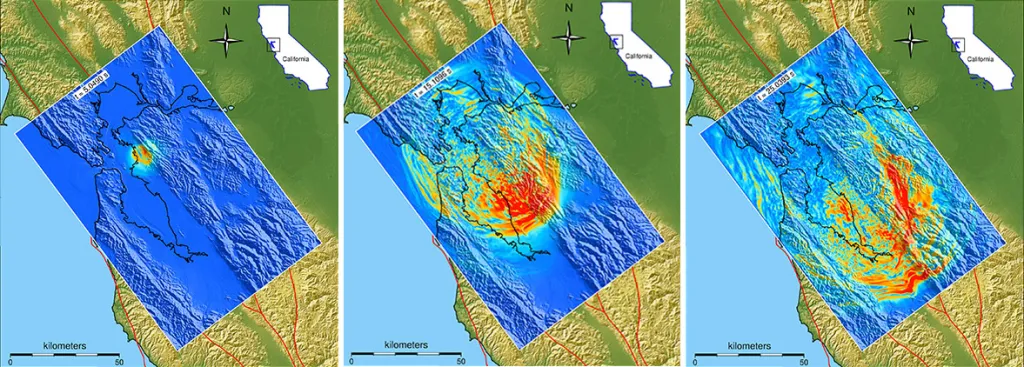
A Department of Energy project, led by Lawrence Livermore National Laboratory with support from Lawrence Berkeley National Laboratory, analyzed the effects of a 7.0 magnitude quake along the Hayward fault, combining physics-based rupture modeling with a detailed wave-propagation simulation run on supercomputers to create, “for the first time,” a synthetic ground motion database, Pitarka said.
The last major earthquake on the Hayward fault line occurred Oct. 21, 1868. The California Department of Conservation estimates that a major quake on the fault line occurs roughly every 140 years, making the fault line overdue. The U.S. Geological Survey has since estimated a 33% chance of a 6.7 magnitude earthquake or greater by 2043, making the Hayward fault the most dangerous in the Bay Area.
Earthquakes have marked the end and beginning of eras in the Bay Area.
In the 1906 earthquake, the San Andreas fault line moved 32 horizontal feet and left San Francisco in flames. In 1989, the Loma Prieta earthquake shifted the fault line again by 6 horizontal feet and 4 feet up, causing the collapse of major traffic arteries across the Bay Area, according to the U.S. Geological Survey. In preparation for the next “big one,” scientists are simulating how a tectonic shift on the Hayward fault line will spread across the region.
“Every time a major earthquake happens, you learn something new,” Pitarka said. “The issue that we face is that earthquakes do not repeat themselves.”
The energy from an earthquake doesn’t travel through sediments uniformly. Ruptures occur at various depths, faults hold varying amounts of potential energy, and tectonic plates break at different speeds — each affecting how the quake is felt even from a short distance away, Pitarka said.
These conditions are only further complicated by the complex geography of the Bay Area, the study’s authors wrote. Sharp contrasts across fault lines, like hard bedrock in one area and loose sediments in basins like Livermore Valley cause shaking to vary dramatically from one area to another. Seismic waves traveling between the Diablo mountain range and the region’s valleys create a maze of fluctuating energy.
Read more Horoscopes May 30, 2026: Idina Menzel, observe and do what’s best for you
To study the Bay Area’s seismic ecosystem, the project team conducted more than 100 simulations of a typical 7.0 magnitude earthquake along likely spots of the Hayward fault line, Pitarka said. Scientists then observed how kinetic energy rippled across a topographic map of the Bay Area in the moments after a quake using a “heat map” to show where the most violent shaking occurred. In their simulations, seismic waves were most intense in the low-lying areas abutting San Francisco Bay and and in Livermore Valley, while energy dissipated in Berkeley and the Oakland hills.
“The engineers and the seismologists know now what are the areas that could be more vulnerable during an earthquake,” Pitarka said. “After every new development, like this new database, there’s always a positive impact on building design codes and change to techniques that are put in place to prepare for the big one.”
During the Loma Prieta earthquake, the severity of damage was highly localized based on the geology of the soil and the structures built on top. The Marina District of San Francisco, built on an artificial landfill made partly from mud dredged from the bay, suffered severe damage because of the weak sediment below. The double-decker Cypress Street Viaduct of the Nimitz Freeway in Oakland partially collapsed and was never rebuilt.
The study’s findings are being shared with seismologists and engineers who can use the simulated ground motions to test and design buildings, roads, bridges, and civil infrastructure for when the Hayward fault line ruptures.
“The study is another reminder that the Hayward fault risk is real, significant, and relevant to East Bay residents today, not a distant possibility,” said Janiele Maffei, chief mitigation officer for the California Earthquake Authority. “Californians have tools to act now: earthquake early warning, home retrofits, and household preparedness all meaningfully improve resilience.”
The project team is collaborating with the Pacific Earthquake Engineering Research Center in the Bay Area to share data nationally and across the Pacific “Ring of Fire,” the most active seismic zone in the world. Those involved include early-warning developers, public agencies, and international researchers, Pitarka said. The database already has hundreds of users worldwide, he added.
Meanwhile, Pitarka and other seismology researchers are expanding their scope beyond the Hayward fault to model earthquakes along other parts of the San Andreas fault that follows nearly the entire length of California and can produce 7.5 magnitude earthquakes or greater.
“We are lucky that institutions like mine have supercomputers that are made available to us to actually simulate this, understand it a little bit better, and our duty is to provide to other people what we have learned,” Pitarka said.
Read more Dear Abby: Why do these brazen women keep showing up at funerals?
About the Author