There’s a lot on the line in the race for San Mateo County assessor. The winner will not only oversee the largest county department of its kind in the state, but will have to balance four critical responsibilities: overseeing a property tax roll of at least $341 billion, managing the logistics of countywide elections, and serving as the official keeper of both vital and real estate records.
Read more Educators look to nonprofit archive to keep Filipino-American history alive
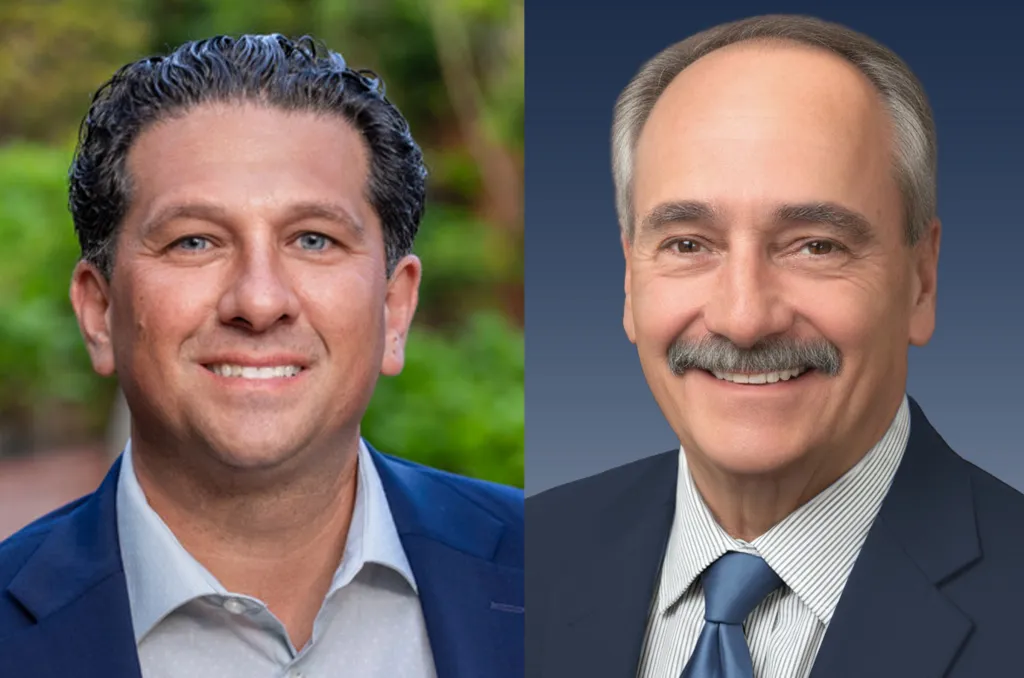
One candidate, Jim Irizarry, says the best way to do that is to continue the work done by longtime San Mateo County Assessor Mark Church, who announced in January that he would not seek another term. Irizarry has served as Church’s assistant since 2013, and says the office needs deep technical expertise and strict independence.
His opponent, David Canepa, is a former Daly City councilmember now approaching his ninth year on the San Mateo County Board of Supervisors. He contends the office needs a strong executive leader and manager for a fresh start.
Whoever wins will face immense pressure as San Mateo County, like local governments across the state, faces deep uncertainty with state and federal funding sources, yet must continue to provide critical services as one of the most unaffordable counties in the country.
Earlier this month, the county released its proposed $5.2 billion budget, detailing critical investments in emergency preparedness, infrastructure, health services, and homelessness prevention.
But while the budget is technically balanced, its foundation is precarious.
The plan heavily relies on drawing down county cash reserves and assumes the recovery of millions in vehicle licensing revenues it says are currently being held hostage by the state. If the licensing fees are not returned, it could spell program and service reductions after reserve funds dry up.
This makes an accurate assessment of local taxable assets and properties, a financially imperative duty of the next head of the combined office, even more critical.
About a quarter of the collected property tax funds are allocated to the county, with the largest share directed to its general fund to support healthcare, welfare, public assistance, and criminal justice programs.
The vast majority of the revenue goes directly to local school districts, which receive just over half of the total allocation. Meanwhile, 15% is distributed to cities to fund fire, police, and other community services , while the remaining 7% goes to special districts to support operations like public libraries, flood control, and healthcare systems.
“The stakes are higher than ever before in this election,” Irizarry told this news organization’s editorial board. “We have done a tremendous amount of good work, winning 22 national awards and being extremely innovative and a leader in the state.”
He believes the office has embraced technological innovation under his and Church’s leadership, and contends that momentum must continue.
Canepa, who served as board president last year, meanwhile, trumpets his own background managing intricate county budgets, and what he calls his capacity to “speak the language” of Silicon Valley’s corporate giants. “I’ve had the opportunity to meet with the CEOs of these companies, such as those in biotech,” Canepa said. “I can sit in a room, talk with them, and work with professional staff to figure out solutions.”
Canepa’s current term on the Board of Supervisors runs through 2028. If he becomes the assessor in January 2027, his board seat could be up for a special election.
Canepa contends the assessor’s office has gone “stale” and points to a high internal vacancy rate, saying it was close to 30%, as a sign of distress within the office. “What’s lacking is a deputy running the department, setting goals, and establishing performance metrics,” Canepa said.
Irizarry rejected that narrative, maintaining the actual vacancy rate sits at 14%, close to countywide rate, and attributing personnel friction to standard management decisions, such as strictly enforcing the county’s return-to-office mandates for public-facing services.
Much like neighboring Santa Clara County, San Mateo serves as a hub for dozens of multi-billion dollar tech and biotech giants, including Meta, Gilead Sciences, Electronic Arts, and Genentech. Because these corporate heavyweights routinely challenge county valuations, their property and asset assessments wield a massive, direct impact on the region’s local tax revenues.
Read more Calistoga’s Clos Pegase returns, newly revamped and art-focused
One of Canepa’s main criticisms of the department under current leadership centers on a long-running case in which biotech giant Genentech challenged the county’s assessment of the company’s property.
The Board of Supervisors approved a stipulated judgment to settle the dispute in late 2023, resulting in a staggering $20 million refund that is hitting the budgets of local cities and school districts this year.
Irizarry disputed Canepa’s assertion that the assessor’s office had failed in the Genentech case as “misinformation.”
While he maintained that the original valuations were accurate and had successfully held up to initial court scrutiny – a subsequent appellate reversal he attributed to Genentech’s access to “high-powered attorneys” – he countered that the underlying dispute actually dates back to assessments made between 2000 and 2006 under a prior administration. He also pointed out that the Board of Supervisors, including Canepa, had been regularly briefed on the litigation for years before voting unanimously to approve the final settlement in late 2023.
“Then he comes back after and says he did not know what he was voting on,” Irizarry said. “He should have known. That’s his job. That is a political statement, a political game.”
An April story in the San Francisco Chronicle showed Irizarry had registered to a right-wing party, the American Independent Party, which his opponent argued should be a disqualifier for an elections chief.
Irizarry rejected the reports as politically motivated. He explained to this news organization that he had mistakenly checked the box years ago thinking that it indicated neutral, independent voter status.
“Any attempt to characterize that clerical misunderstanding as an endorsement of far-right politics is not only inaccurate but also misleading,” Irizarry said.
He also pointed out his leadership alongside Church in spearheading San Mateo County’s 2015 all-mail ballot election system as evidence of their commitment to technology and voter rights, noting it made San Mateo the first county in California to do so.
Canepa lists among his institutional support, backing from the San Mateo County Democrats, the influential San Mateo County Central Labor Council, SEIU, and the Deputy Sheriffs’ Association. His campaign also boasts prominent statewide endorsements from Treasurer Fiona Ma, State Controller Malia Cohen and Senator Scott Wiener.
Meanwhile, Irizarry counters with deep internal support, carrying endorsements from a majority of Canepa’s colleagues on the current Board of Supervisors, including former Congresswoman Jackie Speier.
Despite the challenges of campaigning while being second-in-command of a massive public agency, Irizarry is confident that his hybrid strategy of blending digital outreach with direct, in-person meetings will successfully reach constituents.
“I am certainly a professional and not a politician,” Irizarry said. “I am beholden to no one. I am here every day administering the complexities of the largest consolidated department in the state of California .”
For Canepa, despite not having appraisal experience, he said he is seeking this office because he wants to continue to serve his home community.
“I have no interest in doing Congress, or being in the Assembly,” Canepa said. “I’m a fourth generation San Mateo County resident and I really want to help. We’re about helping people. I want to take something that’s broken, and I believe I can fix it because I have experience on the board .”
Read more David Tamarkin’s recipe for Greens, Grains and Fried Egg works for any meal
About the Author