Growing up in the Bay Area, Wayne Jopanda rarely learned about Filipino-American history in school. An encounter a decade ago changed all that. Now, at San Jose State University, he is looking to expand that knowledge for others.
Read more Calistoga’s Clos Pegase returns, newly revamped and art-focused
As an assistant professor of Asian-American studies who specializes in ethnic studies and Filipino-American history in California, Jopanda highlights former Filipino laborers, and shares images of immigrant families along with numerous other historical treasures tucked away in an archive.
It’s a shared history he never really knew growing up in Hayward, he said, until he got to college.
“I just remember only seeing one small paragraph of the Filipino-American War,” Jopanda said of his early childhood history classes.
When he attended UC Berkeley about a decade ago, that changed as he dug deeper into his own roots and why families in the Philippines were so often fractured by overseas work, particularly in the United States.
As a member of an immigrant family from the Philippines himself, he remembers feeling “a little resentful” toward his parents for working overseas when he was a child. It’s a phenomenon many Filipino-American families experience for generations, and one that left Jopanda with questions about how it affected people’s behaviors.
Jopanda needed answers, but extensive research on Filipino-American history wasn’t easily accessible at the time, he said.
During his undergrad studies at UC Berkeley, he read a book on Filipino migrant labor, “Migrants For Export,” by Bay Area native Robyn Magalit Rodriguez, a Filipino American and professor affectionately known by her students as “Dr. Rod.”
The book, which details how the Philippine government regularly exports its own workers, “opened up my eyes,” Jopanda said.
“I was just so inspired as an undergrad. I didn’t even know we could have books like this about Filipino-American history at this level,” Jopanda said. “When I read that book, it really was a moment of ‘Aha, I now see why my parents, my uncles, my aunties, my friends and their parents in the Philippines are feeling separated.’”
Jopanda reached out to Rodriguez, longing for answers that explained so many unanswered questions he carried about Filipino people through his childhood.
When they met, Jopanda said as an undergrad he immediately felt inspired to dig deeper into his longing to know more about Filipinos who came to the U.S. It was a moment that changed the trajectory of his life.
“I owe her a lot,” Jopanda said of his career in education. “Without her, I would not be here.”
With Rodriguez’s encouragement, and because of his new fascination in Filipino-American history, Jopanda earned his Ph.D. in cultural studies at UC Davis so he could become a professor. He studied directly under Rodriguez, who at the time served as chairwoman of the university’s Asian American Studies department.
At UC Davis, Rodriguez was developing the Welga Archive, her first major project dedicated to cataloging and preserving Filipino-American history with oral interviews, cultural artifacts, and documents detailing the lives of the Delano Manongs around the 1960s farmworker movement.
California public schools by law are required to teach Filipino-American history – something that was largely ignored until Assembly Bill 123 mandated it in 2013, Jopanda said.
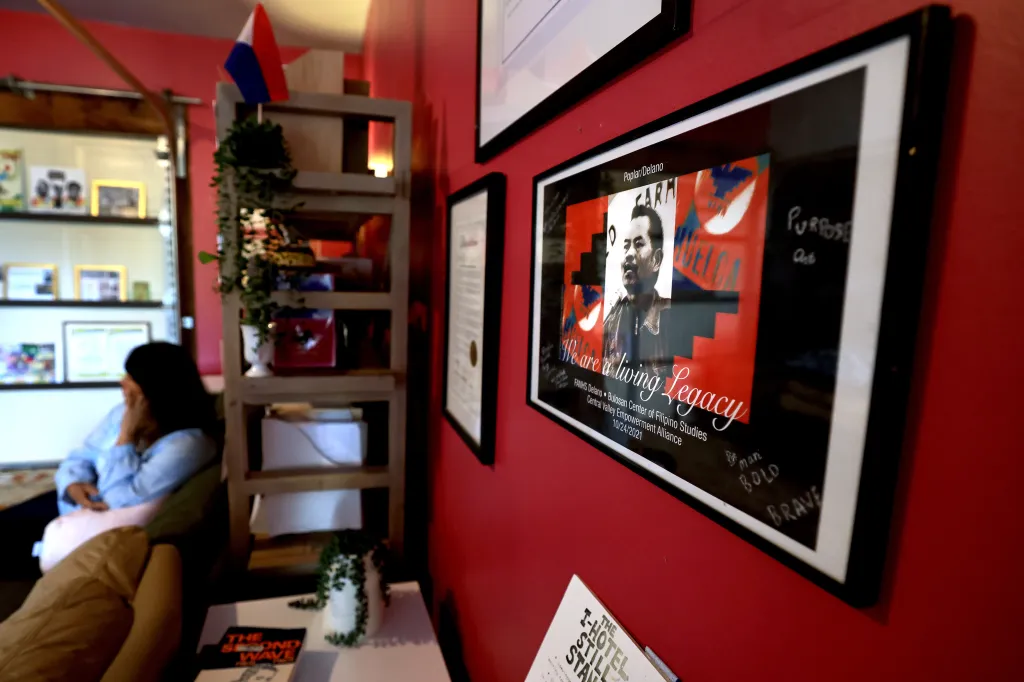
In 2018, Rodriguez enlisted Jopanda and other students to help combine the works of the Welga Archive and launch the Bulosan Center for Filipino Studies, which gained recognition as the first-ever Filipino-American history-focused studies center at any university in the country.
“She’s building in her own way, in her own right, a pathway for teachers to get themselves, not just educated, but have the tools to teach Filipino-American studies,” Jopanda said. “In the state context, I don’t think there’s anything that’s been given to the teachers. Dr. Rod, she’s filling that void.”
Read more David Tamarkin’s recipe for Greens, Grains and Fried Egg works for any meal
With Rodriguez at the helm, part of the Bulosan Center’s mission was to establish a kindergarten-12th grade curriculum that included vast collections of Filipino-American history to supplement learning materials for teachers to comply with AB 123. This curriculum could then be used statewide.
A $1 million grant in 2019 from the state, championed by California Attorney General Rob Bonta, helped to catapult the center’s early success. The facility became a hub for UC Davis students to study collections of Filipino-American history that couldn’t easily be found anywhere else in the state.
The Welga Archive and the Bulosan Center provided a history of Filipinos and their contributions as they first started immigrating to the country en masse beginning in the 1920s.
“Those are the stories that are invisible or unseen and not shared out to the community. … It’s everyday people, the folks in the working class or the migrant workers,” Jopanda said. “It’s those stories that become some of the most enriching or rewarding for me to teach from.”
Despite its valued contribution to academia, the project’s lifespan would prove short-lived.
“A million dollars sounds like a lot,” Rodriguez said. “It’s nothing.”
Eventually, her department’s funding sources dried up. Then in 2020, Rodriguez lost her son, Amado Khaya Canham Rodriguez, who died in the Philippines while doing humanitarian work.
Rodriguez decided to leave the university in 2023.
That same year she launched the Amado Khaya Foundation, a nonprofit organization meant to keep her work and the spirit of her son alive. Her archive would find a new home in the foundation, which is headquartered in a mountainside house in Kelseyville, overlooking Clear Lake State Park.
The foundation now hosts the Amado Khaya Filipino American & Diaspora Archive & Library – a new initiative combining the work of the former Welga Archive and Bulosan Center with more collections of Filipino-American history. And while Rodriguez has found a new purpose in her nonprofit, continuing her academic work has provided new challenges without the institutional support of a university.
“A physical archive needs space, and space comes at a premium,” she said. “There’s nothing like being able to touch history.”
The need for her historical resources continues to grow.
Jopanda said he regularly relies on Rodriguez’s archives to teach. Despite the AB 123 mandate, educators across California lack readily-available, dedicated scholarly resources to teach Filipino-American history, he said.
Bernard Remollino, a professor at San Joaquin Delta College, said he also regularly uses materials from Rodriguez’s collections – largely because the state does not accessibly provide educators with materials to teach Filipino-American history.
He said there is no widely-accepted, single textbook on the subject available in the state, except for the foundational collections in the Welga Archive, the Bulosan Center, and the Amado Khaya Foundation.
“The banks of information just do not exist in ways that make it sustainable for creating lesson plans,” Remollino said. “It’s relatively inaccessible.”
Remollino and Jopanda agree there are other resources on Filipino-American history, such as the Filipino American National History Society, with chapters in Stockton, Delano, and elsewhere across the country. But Jopanda said the resources in Rodriguez’s archives are one-of-a-kind.
Rodriguez said the work of her organization and that of Filipino-American educators continues to be an uphill battle. She said she will continue to find new ways to build out the state’s foundational knowledge of a largely unknown history.
“It’s a fight. We have to be willing to fight,” Rodriguez said. “Nobody wants to give this to us. We have to always make the case for why our stories matter.”
Read more Horoscopes May 24, 2026: John C. Reilly, take the initiative
About the Author