When the world seems out of control, sometimes there’s nothing more reassuring than going out into the backyard and simply looking up.
Read more Michael Kors and UPS are playing hot potato with my $687 refund — how do I win?
Amateur astronomy is a popular hobby in the Bay Area, and there’s plenty happening in our night skies this summer and early fall to illuminate and wow. So there’s no better time than right now to cut off the screens and the urban gray noise, and bask in a show that’s been going on for billions of years.
There’s a reason that stargazing can make us feel centered in chaotic times, says Andrew Fraknoi, astronomy-faculty emeritus at Los Altos Hills’ Foothill College and an astronomy professor at USF’s Fromm Institute.
“At a time when our political leaders seem to be completely unpredictable, there’s some sense of reassurance that the cycles of the sky go on. They go on just as we predict from our understanding of celestial motions and gravity, and there’s an order and regularity there that’s so often missing from our everyday lives,” he says.
Not that predictable means dull. Like they say on “Star Trek,” space is our final frontier.
“Many amateur astronomers tell me that when they’re out there in their backyard — maybe with their small telescope, looking up at distant things like a nebula or even another galaxy — it gives them this remarkable sense of connecting with the frontier. It’s connecting with something much bigger than themselves, which is a lovely feeling,” Fraknoi says.
How can a newbie get started in their own backyard? First off, it helps to know the schedule. This summer will see a blockbuster meteor shower, the Perseids, as well as a blood-red lunar eclipse. There is an International Asteroid Day in which the world will probably not get demolished, a visit from a 5-year periodic comet and views of the Milky Way’s brilliant core. (See below for a monthly breakdown of astronomical events.)
The only gear most people will need is their eyes. It helps to let them adjust for 5 or 10 minutes before heading outside – don’t go out directly after watching TV. Beyond that, telescopes continue to get more accessible and capable, but even the more expensive computer-assisted telescopes that are all the rage now among amateur astronomers aren’t needed for basic backyard explorations.
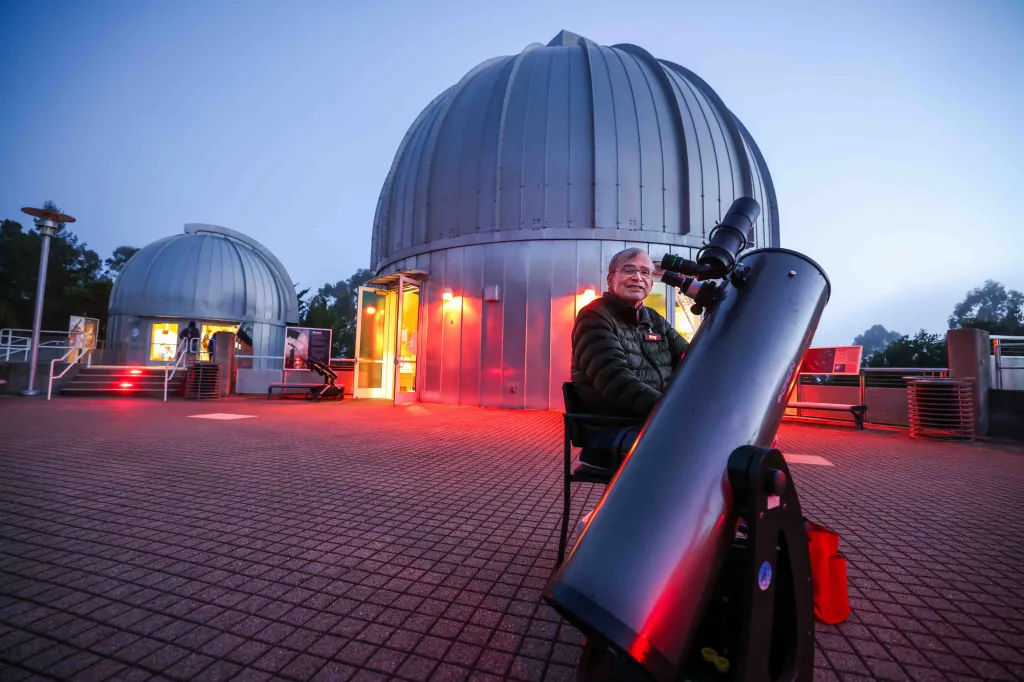
“Personally, I think people should get a manually operated telescope, initially, say a 6-or-8 inch Dobsonian reflector or Newtonian reflector. A manually operated telescope will require you to actually find things in the sky yourself, and for me part of the enjoyment is learning the sky,” says Raymond Howard, outreach coordinator for the century-old Eastbay Astronomical Society.
A note about light pollution: Some communities have attempted to reduce urban glare, like those by the Lick Observatory near San Jose (which transitioned to less-intense street lights) and in West Marin (which is working to create an internationally recognized “Dark Sky zone”). If you face a light situation in your yard akin to a bumpin’ disco, you can ask your neighbors to please dim their lights or visit a friend who lives in a low-light area. Del Valle Regional Park in the Livermore hills is good, as are places in the Diablo Range or Santa Cruz Mountains. Even better is up north by Lake Sonoma, where many serious astronomers trek.
You can also supplement your backyard stargazing with visits to Bay Area observatories, which offer darker vistas and sophisticated equipment. The Chabot Space & Science Center in Oakland has free public viewings on weekends, for instance, run by the Eastbay Astronomical Society. There are weekly workshops for making your own telescope, and the chance to admire Chabot’s equipment, including a 36-incher named “Nellie.”
But the most important thing? That’s to have fun, of course.
“If you can show something in the sky to kids or grandkids — or get the neighbors in and share with them what’s going on — what a nice community-building, family-building activity,” says Fraknoi. “I think that’s something we desperately need more of in these times.”
WHAT TO LOOK FOR IN …
MID-JUNE
For something different, a supernova called SN2026kid could be visible by telescope this month before it gradually fades from view. Bob Schiff, a Danville-based astro-photographer, actually examined the star in April with no idea that it was about to go kablooey. “While I did not image the event itself, I was within five days of this supernova explosion,” he says. “On a galactic scale of millions of light-years, that is darn close!”
Asteroid Day falls on June 30, on the anniversary of the extremely powerful Tunguska Event. It’s a United Nations-sanctioned day of public awareness about defending the planet from space rocks. Thankfully, recent sky surveys have shown no threats from larger bodies. “So I wouldn’t take out extra insurance on my home for asteroid destruction,” says Fraknoi.
JULY
There are a couple of meteor showers popping off this month: the Southern Delta Aquariids and the Alpha Capricornids. Viewing conditions from California and the moon’s bright phase will make them difficult to spot, however. It’s probably worth waiting for next month’s peak of the always jaw-dropping Perseids.
Read more Our happy place: Why Bay Area residents love their backyards
While you wait, how about getting some quality time with the Moon? Our nearest celestial neighbor is the perfect starting point for backyard astronomers desiring to see a celestial object “up close.”
“Indeed, a pair of 8x 42mm or 10x 50mm (10 times magnification power, 50mm objective-lens diameter) binoculars will enable you to explore the moon’s impact craters, mountain ranges and basins,” Schiff says.
Another neat diversion is using the naked eye to spot the International Space Station as it whizzes by overhead. NASA provides a mobile app that gives its location and timing (nasa.gov/spot-the-station), and from there you can get about 5 minutes of tracking its path.
“It looks like a very bright star moving across the sky, and it’s always fun to point out to kids,” Howard says. “’There goes the space station! Russians and Americans, getting along!’ That kind of thing.”
AUGUST
The Perseids are one of the most reliably impressive meteor showers, and this year will peak overnight from August 12-13 (though they will be visible for days on either side of that window). The shower is expected to be especially good this year, thanks to blackened skies from a new Moon.
Make your viewing spots as dark as possible – no lights on in the house! — then ditch the telescope and enjoy this cosmic gift with your eyes. Ponder that the beautiful, streaking fireballs you’ll hopefully catch are actually just sky garbage, streaking off the 16 mile-wide comet Swift–Tuttle.
“This comet sheds material as it gets near the sun. Its ice evaporates and dust and dirt are left behind, very much like that character Pig-Pen in the Peanuts cartoons,” Fraknoi explains. “The dust and dirt burns up in the earth’s atmosphere, and then makes these flashes of light that we call shooting stars.”
On the night of Aug. 27-28, an almost-total lunar eclipse will occur as the Earth’s shadow covers the Moon. The maximum eclipse occurs at 9:12 p.m. PT when only a little sliver will be bright, the rest tinted blood-red due to atmospheric optics. Every backyard astronomer should be able to see it without any special equipment (if the weather cooperates).
“If you’ve got your kids or grandkids, one of the most amazing things you can point out to them is the shape of the Earth’s shadow as it slowly moves across the Moon,” Fraknoi says. “The shape is clearly round. So despite what some very famous basketball players say, the Earth is not flat.”
In August, there’s also a comet that should be visible with small telescopes. Comet Tempel 1 comes around about every 5 years, and people should look for it when it’s very dark (say, around 11 p.m.) as it crosses various constellations.
SEPTEMBER
From August through September, we will be facing the central part of the Milky Way, the brightest region that’s easiest to see and is full of intriguing sky targets. Find dark skies and point your telescope toward the Milky Way to view the Lagoon Nebula – a star-forming region in the constellation Sagittarius, like a stellar nursery.
“Globular cluster M13 is also an excellent target,” Howard says. “And there’s also the Ring Nebula, which is caused by a dying star expelling an envelope of gas.”
During this same period, people who stay up late will have a new and improved view of Saturn’s rings. “Last year they were almost invisible, because they were edge-on to us or horizontal. They’re going to look better this year because they’re opening up more,” explains Howard.
Adds Fraknoi: “If you look through a modest telescope at the rings of Saturn, you’ll get your socks knocked off.”
Read more Are UC degrees still worth it? New report says yes
About the Author