NBA star and San Jose native Aaron Gordon could have been speaking for a lot of people in the Bay Area when he revealed his “happy place” early in his career.
Read more Are UC degrees still worth it? New report says yes
No, it’s not Disneyland.
Living far from his hometown at the time while playing for the Orlando Magic, the then-21-year-old said he missed his family’s South Bay backyard.
“My backyard is where I spent most of my childhood growing up,” the Archbishop Mitty High School graduate said. “That’s my happy place. Anytime I need to go somewhere, that’s where I go.”
Gordon, who now plays for the Denver Nuggets, paid tribute to his favorite place by naming his line of basketball shoes “Backyard.”
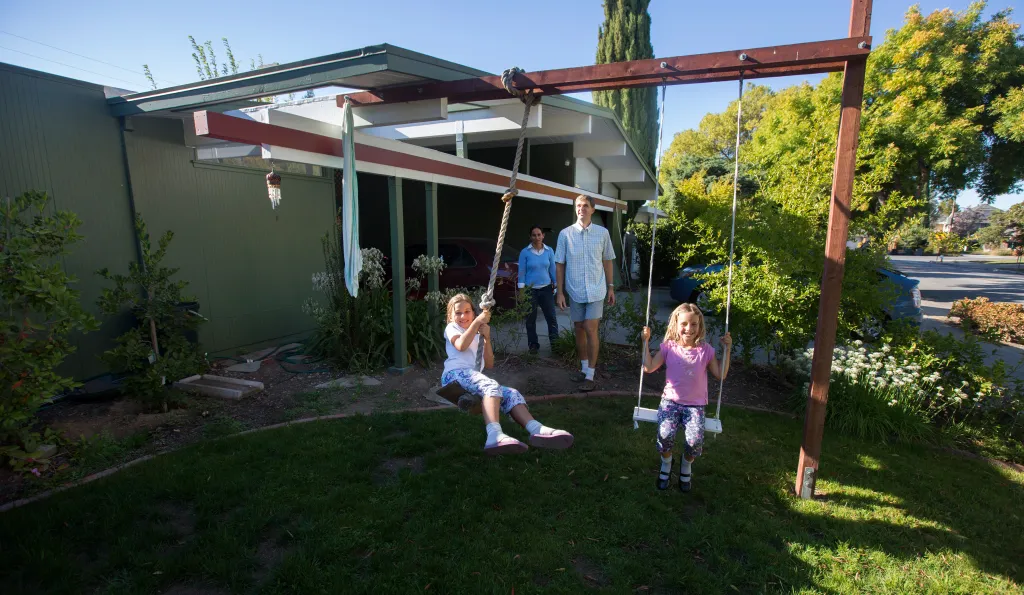
Other Bay Area residents feel the same connection to their own backyards. For children, the backyard is a place of wonder, suitable for imaginative play of all types. For adults, it provides a private refuge and an easy way to get into nature. It’s where they relax, dine with family, entertain guests, let the kids run around, raise pets, exercise, practice golf swings, do art or look up at the stars. This can be the case whether they rent or own, and whether their home’s outdoor space is a small patch of lawn, a cool pool deck, a meticulously landscaped garden or a hillside with a spectacular view.
In the Bay Area, some residents fashion their backyards into showcases for their unique tastes and pursuits – like the owner of Hillsborough’s famed Flintstone House, where prehistoric dinosaurs roam the property above Interstate 280. For the Bay Area’s uber-wealthy, backyards can become displays of success and power, such as Larry Ellison’s 23-acre Woodside property with private lake and tea house — his take on a 16th-century Japanese emperor’s palace.
But no matter who’s doing the landscaping, there is a particular psychological connection to backyards that Bay Area residents share, said Stefani Bittner, an East Bay-based landscape designer and author.
“In California, our gardens are an extension of our homes,” said Bittner, whose Homestead Design Collective created Sunset Magazine’s test kitchen and other ecologically diverse gardens for clients from Palo Alto to Wine Country. “With the climate that we have, and with people in high-density housing and in other places where you may only have so much space depending on where you are, your garden is actually an additional room.”
“It’s a refuge, and I think most people value that, and that’s one reason they like to have a garden to go out to,” said Valerie Matzger, a veteran landscape designer and avid birder from Piedmont who formerly served as the city’s mayor.
It’s long been argued that California pioneered the concept of indoor-outdoor living in American homes, with its Mediterranean climate allowing residents to be outdoors pretty much year-round. At one time, people with property around their homes tended to use it for practical purposes – like growing food, chopping wood and laundering and drying clothes — according to a history of Sunset magazine, which became strongly associated with the emerging postwar lifestyles of upwardly mobile suburbanites in the Western U.S.
But that changed in the decades following World War II. For one thing, the advent of washing machines and other modern conveniences meant that backyards could be used for leisure. At the same time, California’s population was growing exponentially and people gravitated to new subdivisions in the suburbs, where they could achieve the dream of owning a home that also was ringed by land. Both ranch-style homes and the sleek, modernist residences built for the masses by developer Joseph Eichler emphasized having windows and glass doors looking out onto their outdoor spaces, which new residents could fashion according to their personal needs and tastes.
The “California style,” as developed by pioneering landscape architect Thomas A. Church, promoted the idea that people were meant to live as much in their backyards as they did indoors. With that, he also created the concept of the “outdoor” room, sub-areas of yards that would flow from the house, where residents could lounge, cook, eat and more. In translating these concepts, Sunset and other new lifestyle magazines showed readers how to integrate decks, outdoor kitchens and barbecues into their garden plans.
Church created one of the most famous backyards in American history with his work for the Donnell family of Sonoma. As featured on a 1951 cover of House Beautiful magazine, Church’s design spotlighted two components that would become synonymous with the California style of backyard: the swimming pool — particularly the kidney-shaped swimming pool — and the lawn.
The backyard pool took off in California in the mid-20th century, according to Dave Weinstein, the former features editor at CA-Modern magazine and an expert in Eichler home design. Due to postwar prosperity and changes in pool-construction technology, private pools were no longer considered luxuries but within reach of the burgeoning middle-class.
Backyard pools were also a sign of status, while also helping to “articulate a vision” of the California backyard as a private sanctuary, Weinstein said. Pools, including the more affordable, above-ground Doughboy style, were popular with young families as they raised their boomer and Generation X children. While Bittner said she herself was never “a pool person,” she inherited a house with a pool and came to appreciate its value when her kids were young,
“I was like, ‘I want to be the house where all the kids come to,’” she said.
Lawns, too, became a status symbol, harkening back to when lush, vast, manicured carpets of green were seen as emblems of wealth among the European aristocracy. In 20th century California, lawns became democratized as the new middle-class found that they, too, could afford to install and maintain them, according to a report by the National Wildlife Federation.
Read more As America turns 250, Bay Area residents wrestle with what to celebrate
Fast-forward to the 21st century: People still like their pools, even though periodic droughts and growing concerns about water resources and climate change in California have raised questions about their sustainability. Pool professionals like to point out that, once filled, private pools use less water annually than a section of lawn across the same surface area.
Whether or not that’s a viable argument for building new pools, it’s lawns that have become public enemy number one — at least to the growing Bay Area movement towards sustainable landscaping. This movement encourages the use of low-water, native plants in order to reduce water use and to bring birds, bees and other wildlife back into people’s backyards.
“My understanding is that lawns became popular because they came over from England, and it was a sign of wealth and gentility,” said Kathy Kramer, a native plants enthusiast who started the annual Bringing Back the Natives Garden Tour in the East Bay in 2005. “But it rains a lot in England, and it doesn’t rain that much here. So (the Bay Area) is a really inappropriate place for the lawn.”
The most recent Native Gardens Tour featured gardens in more than 70 private homes in Alameda and Contra Costa counties, and there were no swimming pools or lawns in any of them — a sign of where backyard trends may be heading. Kramer is grateful that the use of native plants in people’s yards is becoming “more mainstream.”
Kramer quotes Douglas Tallamy — the entomologist, ecologist and professor at the University of Delaware who has become a patron saint among native plant enthusiasts — saying that America’s 40 million acres of lawns are ecologically dead spaces that consume 3 trillion gallons of water annually.
“He’s a god,” Kramer said, citing Tallamy’s books and talks on how native plants attract insects, bees and other pollinators, which not only facilitate the reproduction of flowering plants but also serve as a primary source of food for birds.
While Tallamy doesn’t say people should rip out their lawns – though he does say they should have smaller ones – Matzger took his admonitions to heart after hearing him speak in 2017. “I thought the gardens I had been designing are exactly not what I should be doing,” she said, recalling clients who wanted backyards laid out in the English style, including with lawns and plants that used a lot of water or weren’t native.
During COVID-19, Matzger sat at home looking at the rolling lawns in her front yard and back, and decided to rip them out and replace them with serpentine pathways, stone walls, terracing and massive numbers of native plants.
Since then, Matzer is delighted in how her backyard now teems with life. “I know when I go out in my garden and I sit down and I watch the birds and it’s like I am there with the birds. I’m out of myself — whatever tensions or whatever I’m dealing with, it just kind of goes away and you have this feeling of peace and optimism,” she said.
Like Matzger, Bittner emphasizes the use of native plants in her backyard designs, a trend her clients embrace, though some are reluctant to part with their lawns. “They’re like, ‘Let me keep my lawn!’ And I’m like, “OK, let’s cut it in half,’” she said.
These days, homeowners don’t have much choice in adjusting their landscaping ambitions to make their properties safe from wildfires; they risk not getting insurance if they don’t, Bittner said. Fire-proofing strategies include using noncombustible materials in decks and fences, moving plants away from houses and limiting the use of certain beloved plants — like rosemary or junipers — because they are known to be flammable.
As has always been the case, emerging trends in backyard design likewise reflect the realities of life in the Bay Area. People with the means are installing plunge pools and saunas to promote wellness, and are building ADUs not necessarily to rent out, but often to house children who’ve returned home from college or elderly family members, Bittner said. During COVID, these ADUs also became places to work remotely.
And Bittner has been delighted to see people increasingly adopting one of the original functions of backyards — to grow food.
“It’s been nice to see that people have caught up with edible landscaping,” Bittner said. “People don’t want to grow all their own food – they don’t want to be farmers—they just want to have a garden, have some things at their fingertips. People really value food in the Bay Area.”
Read more Durbin: It’s time for a constitutional amendment to protect the right to vote
About the Author