With widespread student debt, surging tuition costs and an increasingly difficult job market reshaped by artificial intelligence forcing many students to question the value of higher education, the University of California has released new data asserting a UC degree is still worth the investment.
Read more As America turns 250, Bay Area residents wrestle with what to celebrate
, concludes that UC graduates earn more on average, incur less debt and break even on their educational investment six years after enrolling, among other findings.
“As costs are rising nationwide and college graduates enter one of the most competitive job markets in recent history, UC’s commitment to making a college education more affordable and accessible has never been more important,” said outgoing UC Board of Regents Chair Janet Reilly in a news release announcing the data. “This data shows that a UC degree not only remains within reach for California families, but continues to give graduates a measurable, lasting advantage.”
The research brief comes as the , requiring university undergraduate and graduate programs to demonstrate that graduates earn more than holders of the typical high school diploma and bachelor’s degree, respectively, or risk losing access to federal student financial aid.
It also comes amid criticism over alleged lackluster application standards for prospective UC students, prompting the University of California to consider reinstating standardized test requirements for undergraduate admissions, six years after dropping the tests entirely.
The newly released University of California research brief compared UC graduates’ earnings to out-of-pocket costs for a degree — like tuition, books and other expenses — and the “foregone wages,” or the potential income missed out on, of high school graduates in the same age cohort while enrolled and after graduating.
The brief’s findings revealed that median earnings for UC alumni are greater than high school graduates and other degree holders across the state.
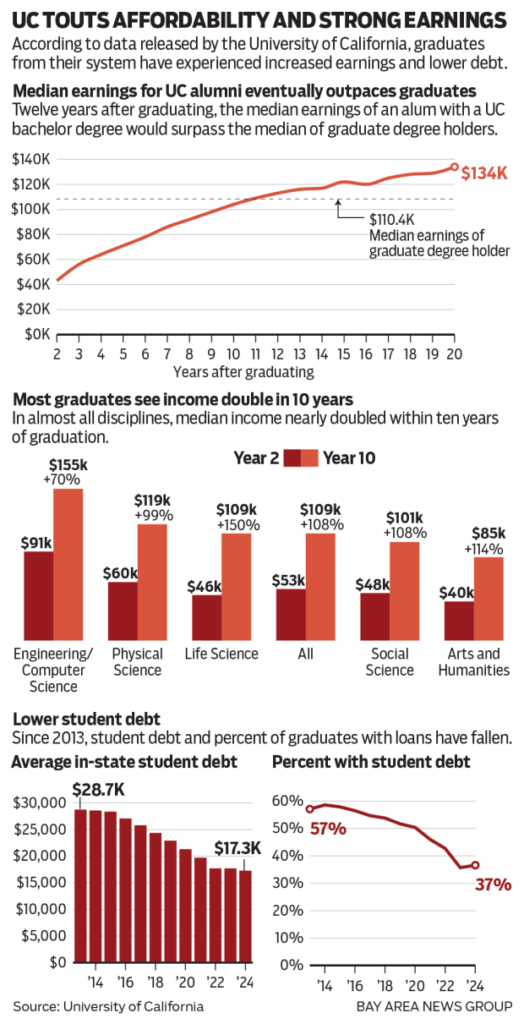
Two years after graduation, UC bachelor’s degree recipients earned a median of $43,000 — about the same as someone in California with a high school diploma.
Seven years after graduating, UC students earned a median income of $86,000 — surpassing other California bachelor’s degree holders, who earned a median income of about $80,900, according to the data.
And 12 years after graduating, UC students earned over $113,000 in median earnings — surpassing California graduate degree holders, who earned a median income of about $110,400.
But the new data showed UC degree recipients’ earnings grew at a slower pace compared to the 2021 data, which found UC graduates earned more than those who completed a bachelor’s degree within six years of graduating and more than other Californians who completed a graduate degree within 10 years after graduating.
Still, the brief’s conclusion of the economic value of a bachelor’s degree echo a research brief released by the Public Policy Institute of California earlier this spring, which found California workers with a bachelor’s degree earn a median annual wage of $96,000 — double the $48,000 median wage for high school graduates.
But graduates’ earnings were highly dependent on their major. UC’s data showed higher median income for engineering and computer science students, physical science students and life science students than students who graduated with a degree in social sciences or arts and humanities.
According to the brief, UC graduates with an engineering and computer science degree earned a median income of $90,826 two years after graduating and $154,791 within 10 years of graduating, while arts and humanities students earned a median income of $39,798 within two years of graduating and $85,076 within 10 years.
Read more Durbin: It’s time for a constitutional amendment to protect the right to vote
That’s similar to PPIC’s findings, which found that U.S. college graduates’ wages vary tremendously across majors, with U.S. college graduates in computer science earning a median wage of $130,000 annually in 2024, compared to college graduates with a liberal arts and humanities degree, who earned a median income of $78,000 in 2024.
The UC research also found that 63% of UC undergraduates leave with no debt, while the average debt amount for in-state students has declined.
Between 2013 and 2023, the percentage of students graduating with debt fell by 20 percentage points. During the same period, the average debt for in-state students has declined from about $29,000 to about $17,000, according to UC’s undergraduate affordability dashboard which was updated in June 2026.
That’s similar to PPIC’s findings, which revealed that students at public colleges — including public California universities — are less likely to take out student loans. An estimated 27% of California students at four-year universities took out student loans in 2023-24, compared to a national rate of 41%.
About a quarter of CSU and UC students took out loans compared to 43% of students at four-year nonprofit private colleges and nearly 70% at four-year for-profit colleges.
PPIC, however, found that while college remains a good investment overall, higher education is still not attainable for many Californians.
The institute found that if current enrollment and completion rates continue, most California 9th graders will not earn a bachelor’s degree. And at every step along the way, low-income students — who account for more than half of the state’s public K–12 students— are less likely than their higher-income peers to make it to and through college.
Trust in higher education is also waning, with 70% of Americans saying that higher education is heading in the wrong direction, according to a 2025 survey by the Pew Research Center.
A further highlighted concerns about cost, admissions, campus climate and broader uncertainty about the purpose of higher education.
UC President James Milliken’s opening remarks at a May UC Board of Regents meeting touched on the shifting perception of higher education and said universities built trust “not by defending the past, but by adapting and meeting the needs of a changing society.”
In addition to federal pressures under the Trump administration, Milliken said, UC must address “rising costs and debt, healthcare, economics, technological change, growing skepticism toward institutions in general and deepening political and cultural divisions.”
“The University of California has always existed and exists today to serve the people of this state and the nation through education, discovery and opportunity,” he concluded. “The mission has not changed — expectations will continue to evolve. Our task is to meet them. And if we do, we will help define what higher education must be in the years ahead. And we will not only rebuild trust, but we will increase it.”
Read more California forest fires aren’t just getting bigger. They’re burning more severely
About the Author