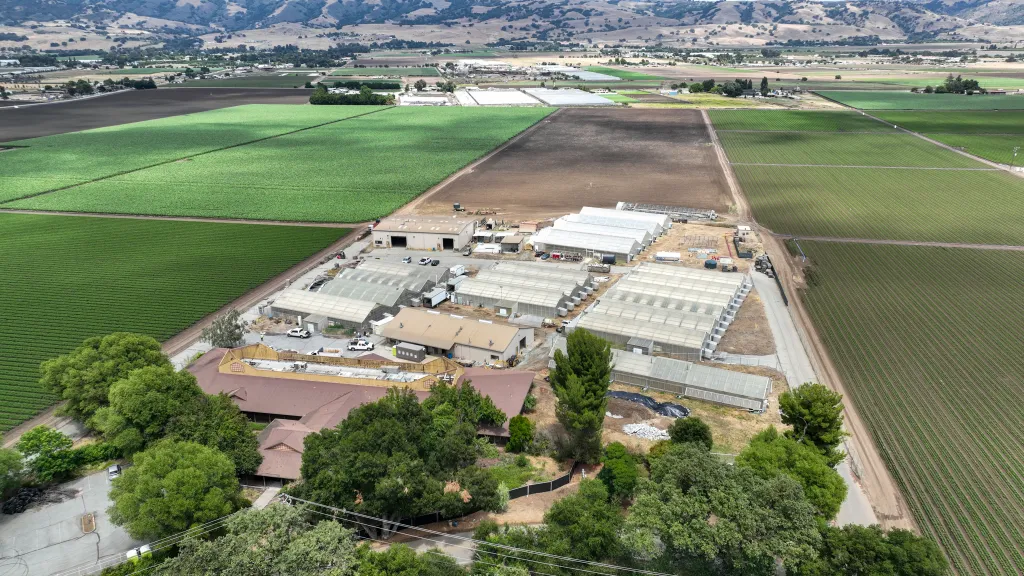
California and Santa Clara County sued the Trump administration Wednesday in a bid to halt what officials described as a secretive, already-under-construction U.S. Immigration and Customs Enforcement detention facility on Gilroy’s outskirts, alleging federal officials bypassed environmental laws, ignored local land-use restrictions and failed to consult with state or county leaders before moving ahead.
Read more Opinion: Tom Steyer’s stumble shows the perils facing self-funded candidates
Filed in U.S. District Court in San Jose, alleges the facility would violate federal environmental laws because the government failed to produce an environmental assessment or impact statement before entering the lease and starting construction. It also claims the project would run afoul of federal immigration law because it is planned for land zoned exclusively for agricultural use, near habitat for several endangered and threatened species.
The facility, just east of Highway 101 and the Gilroy city limits and north of Highway 152, appears to be designed to hold up to 150 people, said Tony LoPresti, Santa Clara County’s top lawyer. But federal officials have declined to officially acknowledge the project, which was revealed through news reports based on federal property-procurement documents.
The lawsuit seeks a court order permanently stopping development of the site into an ICE detention facility. It remains unclear what effect the legal action could have on a project the federal government has not publicly confirmed.
The case may turn partly on who would operate the facility. Legal experts have said the Constitution’s supremacy clause gives the federal government broad power to override state and local opposition when it runs a facility directly. But if the facility is privately run, the county and state may have more room to challenge the project through zoning, environmental and other local laws.
The lawsuit also targets what state and county officials described as the secrecy surrounding the project. It alleges the Trump administration violated the Intergovernmental Cooperation Act by moving ahead without giving the state or county a meaningful opportunity to weigh in.
“Since returning to office, President Trump and his administration have led a mass-detention and deportation campaign that has led to cruel, inhumane and unacceptable conditions at immigration holding and detention facilities across California,” California Attorney General Rob Bonta alleged in news conference Wednesday in San Jose.
LoPresti called the administration’s plan a “reckless attempt to build an ICE facility on sensitive and protected land without regard to its impacts on the environment, the community, and, most critically, the humans who would be detained there.”
The White House referred questions about the lawsuit and California officials’ claims to the U.S. Department of Homeland Security, which includes ICE. Neither DHS nor ICE responded to questions Wednesday.
Named as defendants in the lawsuit were ICE and the U.S. Department of Homeland Security, which includes ICE. DHS last month said in a statement it had “no new detention centers to announce at this time,” that it was “conducting law enforcement activities across the country to keep Americans safe” and that “it should not come as news that ICE will be making arrests in states across the U.S. and is actively working to expand detention space.”
“We have reason to believe it’s a facility designed to temporarily hold detained individuals before shipping them off to larger detention facilities,” LoPresti said. “It’s the type of facility that is the subject of lawsuits throughout the nation for warehousing people in inhumane conditions.”
LoPresti said that when such facilities are built, “it signals that there is going to be an immediate ramping up of detentions and all kinds of different ICE activity.”
Bonta alleged that across the U.S., ICE has been “misusing short-term holding facilities as de facto long-term detention sites, where people face overcrowding, prolonged multiple-day detention and other inhumane conditions without required safeguards, services and oversight required for extended confinement.”
The county’s zoning prohibits detention facilities of any size on the land where the center is planned, LoPresti said.
Read more Walters: Egged on by Trump, right-wing ecosystem makes baseless claims of California voter fraud
County and state officials said in a news release that the project threatens agricultural land protected since the 1960s and “could also have severe impacts on vital infrastructure, straining waste and drinking water infrastructure and leading to the deterioration of critical roadways.”
LoPresti said past research and development work at the site led to 30 years of chemical leaks and spills.
“There is, as we speak, active construction disturbing a potentially contaminated site, putting construction workers, and employees, and potentially detained individuals, at severe risk,” LoPresti said.
LoPresti also warned of “potentially devastating impacts” on a subspecies of steelhead fish in an adjacent creek.
“The supremacy clause does not allow the federal government to do whatever it wants,” Bonta said at the Wednesday news conference, citing the Constitution’s Tenth Amendment safeguarding states’ rights. “In our cases where we sue the Trump administration to stop it from doing what it wants when it wants … we’re winning 80% of the time.”
LoPresti said he expected the federal government to “try to hide behind the supremacy clause” as it pursues the new detention facility. He added that his office has requested access to the property for an inspection, and if permission is denied, his office will seek an order in state court to allow access.
In May, Bonta’s office released , pointing to “an unprecedented surge” in the number of people held, from 2,303 in 2023 to 6,028 last year. Detainees last year were subjected to inadequate medical care and delayed treatment, overcrowding, inadequate food, and excessive use of force by guards, the report claimed.
“Most of the detainees shouldn’t even be in detention,” Bonta said Wednesday, noting that in the past, many people suspected of being in the country illegally were allowed to remain free as their immigration cases proceeded. “Most have families, have jobs, have strong roots in the community, have no criminal record, can be and should be in the community.”
The Trump administration has said its deportation campaign prioritizes the “worst of the worst,” but under the law, people in the country without legal authorization can be deported even if they don’t have a criminal record.
Assembly Speaker Robert Rivas, who represents Gilroy in the Legislature, said Wednesday, “Our community is not a dumping ground for Trump’s ICE chaos.”
Although LoPresti said earlier that the prospect of a legal fight tying up the detention facility project in court past the end of Trump’s administration was “something we have to be and are thinking about,” Bonta said Wednesday that such a delay played no part in the legal strategy behind the lawsuit.
Bonta and LoPresti said they had not yet determined what type of court order they would seek — such as a temporary restraining order or preliminary injunction — to get the project stopped while the case proceeds.
“We need to move expeditiously,” LoPresti said. “We will certainly be looking for the court to take action quite soon.”
Read more Horoscopes June 11, 2026: Peter Dinklage, pay attention to your health
About the Author