The California Air Resources Board just passed a significant overhaul of the Cap-and-Invest program — a cornerstone of the state’s climate action policy — but it’s too early to tell what the changes mean in the long run for drivers in the Golden State, who pay the highest prices in the country for gasoline.
Read more California dog trainer on trial for deaths of nearly a dozen canines in his care
The revisions that passed on a 10-3 vote made accommodations to industry, but oil companies say the new rules don’t go far enough to ensure that more refineries won’t exit California, while environmental groups say the amended Cap-and-Invest program undermines the state’s decarbonization efforts.
The policy director for Communities for a Better Environment called the changes a “huge step backwards” that amounted to “handing billions to oil executives.”
The oil industry wasn’t exactly gushing with enthusiasm, either, with a spokesman for the Western State Petroleum Association trade group saying in an email to the Union-Tribune, “It is clear the state is not serious about keeping refineries in California.”
In sessions that ran all day and into the night Thursday and concluded on Friday after more than seven hours of further deliberations, CARB leadership and staff on multiple occasions said they were performing “a careful balancing act” to update the 13-year-old program.
“By moving forward today, we are responding to real affordability concerns,” CARB Chair Lauren Sanchez said in a statement, “while sending a clear and unwavering signal to the world that we remain committed to long-term investment in clean energy, good jobs and healthier communities.”
What is Cap-and-Invest?
Cap-and-Invest requires power plants, food processors and other large industries such as refiners and cement manufacturers that emit greenhouse gases to purchase permits on the carbon pollution they produce.
The program is designed to encourage investment in cleaner energy and more efficient technologies to help California meet its ambitious climate goals — such as reducing greenhouse gas emissions to 40% below 1990 levels by 2030 and 85% by 2045.
The money raised by the program funds multiple state initiatives aimed at reducing vehicle pollution, as well as the California Climate Credit that delivers automatic reductions in utility bills during various months of the year to customers of the state’s investor-owned utilities.
CARB says Cap-and-Invest has generated $35 billion in statewide climate investments during its lifetime.
The program used to be called Cap-and-Trade but the name changed to Cap-and-Invest last year when Gov. Gavin Newsom and the Legislature joined forces to pass a law extending and updating the program for another 20 years.
Updates to Cap-and-Invest come at a precarious time for consumers.
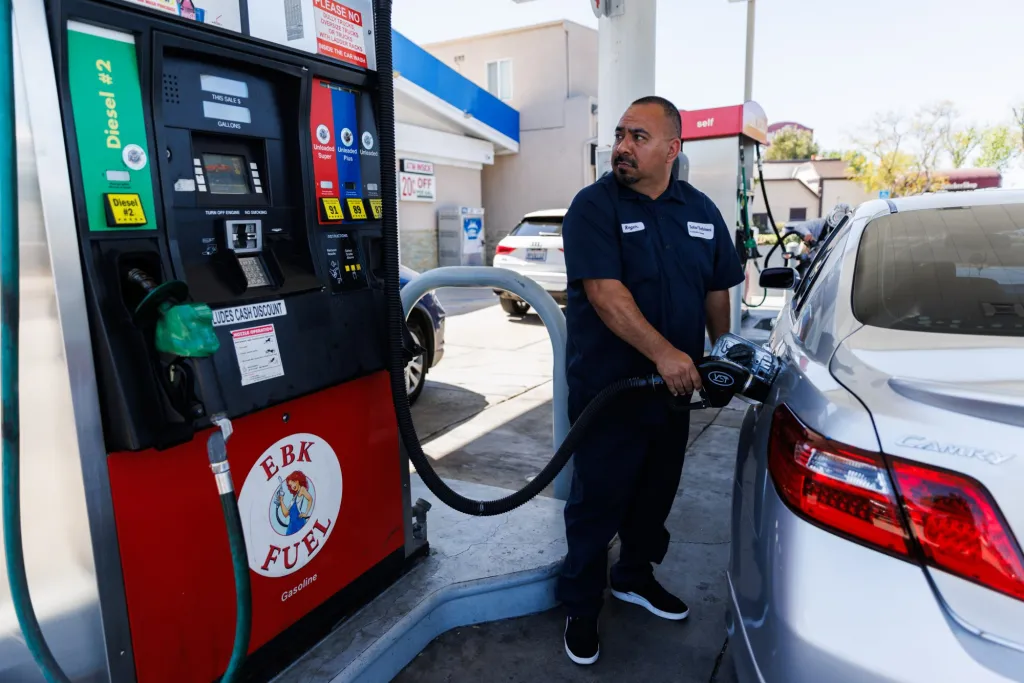
Cap-and-Invest adds about 24 cents to the price of a gallon of gas that Californians pay at the pump — and that does not include other state taxes and fees.
The cost of a gallon of regular has soared in the wake of the war in Iran. With oil tanker traffic in the Strait of Hormuz clogged since hostilities started on Feb. 28, the average price for regular-grade gasoline in San Diego has exceeded $6 a gallon for nearly a month, according to AAA.
What’s more, the Valero refinery in the Northern California town of Benicia and the Phillips 66 twin refinery in the Los Angeles area shut down operations in recent months. The two facilities combined to account for about 18% of California’s total refining capacity to process gasoline, diesel, aviation and other transportation fuels.
Imports from foreign countries can help pick up the slack, but the closures may leave the state vulnerable to price spikes. The state is now down to seven major refineries that produce gasoline.
The outlook even rattled 15 Democrats in the California Assembly, who earlier this year wrote a letter to CARB leadership, worried that the revisions to Cap-and-Invest “will further destabilize California’s fuel supply, economy, and working families.”
Debating the update
CARB came up with proposed amendments to the program in January and then made further updates ahead of Friday’s vote.
Read more Video of unattended Peninsula vote center sparks concern
One of the changes that drew the most attention is the establishment of a , that provides $4 billion to support industry — including refiners — “doing business in California and to help make up for the loss of federal incentives.”
Hailed by CARB leadership as a first-of-its-kind initiative, the MDI would see the agency issue 118 million new Cap-and-Invest allowances through 2030 to industry, provided the companies invest in emissions reductions projects in the future.
But oil companies said they need assurances beyond 2030.
Jodie Muller, president of the Western States Petroleum Association, told CARB voting members on Thursday that while the update to Cap-and-Invest is “a step that provides some near-term relief and greater competitiveness for in-state operations,” it does not address concerns the industry has post-2030, “particularly for the large capital investments needed to maintain safe and reliable refinery operations.”
Chevron, which operates two of the largest refineries still left in California, expressed similar concerns. In a letter to CARB on May 4, the company said the Cap-and-Invest changes still make “long-term planning difficult and will only increase the likelihood of leakage occurring” — referring to the risk of strict California climate regulations driving industries to move out of state.
Asked if the changes adopted Friday make Chevron any more likely to maintain its refinery business in California, a Chevron spokesperson referred to last month’s letter, which concluded by saying California’s “energy industry’s economic, industrial, environmental and national security benefits have been the foundation of a health, prosperous state, and we would like this to continue.”
Conversely, 28 Democrats in the Legislature , warning that the Cap-and-Invest changes will “put both our 2030 (climate) targets and the stability of the Greenhouse Gas Reduction Fund at risk.”
The Greenhouse Gas Reduction Fund is a dedicated source of money collected through revenue generated by the Cap-and-Invest program that invests billions of dollars annually into various pollution-reduction projects.
“These changes to Cap-and-Invest allow more pollution and undermine the program’s ability to support investments that cut emissions and costs for families,” Katelyn Roedner Sutter, California senior director of the Environmental Dense Fund, said in a statement after the vote, calling the update “deeply misguided.”
“CARB’s mandate is to protect public health — not subsidize Big Oil,” said Kaya Allan Sugerman of Physicians for Social Responsibility – Los Angeles.
According to the nonpartisan Legislative Analyst’s Office, the updates may cut the fund’s annual revenues in half — but CARB staff disagrees with that.
CARB officials say the revision establishes more stringent allowance budgets that align with 2030 and 2045 climate targets, provides $10 billion for electricity bill credits and maintains $8 billion for the Greenhouse Gas Reduction Fund.
The board added a provision Friday ensuring CARB can claw back MDI money from companies that don’t make good on their emissions reductions projects. The board also agreed to hold off on issuing those allowances until CARB’s executive officer takes a close look at them and reports back to the board.
CARB chair Sanchez used to be Newsom’s chief climate adviser, and the outgoing governor praised the passage of the Cap-and-Invest updates.
“California’s nation-leading Cap-and-Invest program has proven we can cut pollution, create jobs and invest in a cleaner future at the same time,” Newsom said in a statement.
He also took a shot at President Donald Trump, who last year signed three Congressional Review Act resolutions that included rescinding a 2020 executive order by Newsom that mandates the elimination of sales of all new gasoline-powered passenger vehicles throughout California by 2035.
Newsom said California is staying focused while “Trump sows ongoing chaos and uncertainty.”
Read more Eye on the Hills: Cozy new Thai restaurant opens in Oakland’s Montclair
The Cap-and-Invest updates are expected to go into effect Sept. 1.
The Associated Press contributed to this article.
About the Author