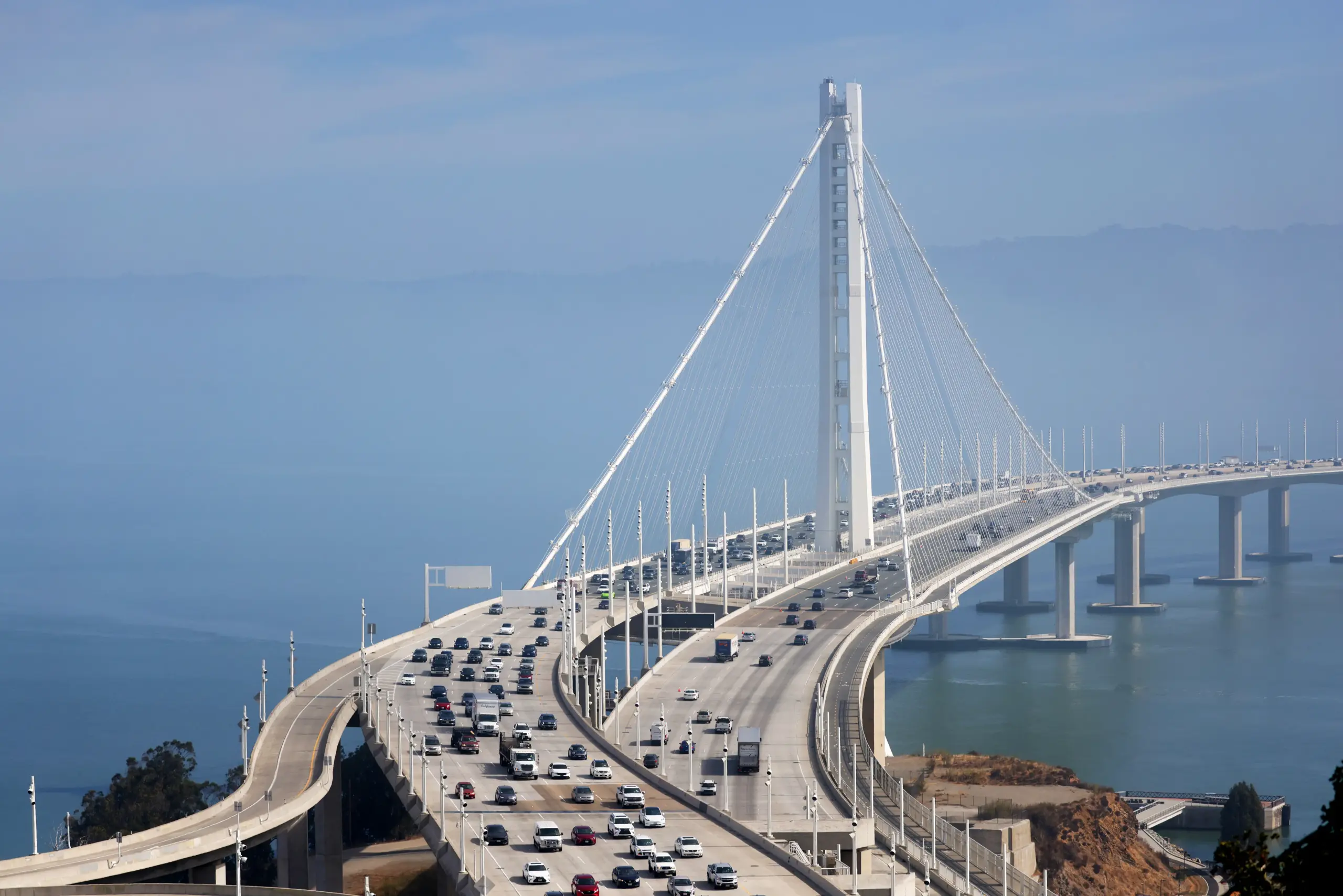
Rush-hour traffic delays on the Bay Bridge could more than double if voters reject two transit tax measures this November and agencies implement planned service cuts, according to a study co-produced by SPUR, a nonprofit policy group that sponsored the regional measure.
Read more San Jose school official charged with attempted sex trafficking, enticement of minor
The study by the consulting firm Jacobs and the San Francisco Bay Area Planning and Urban Research Association, or SPUR, modeled the effects of service cuts if voters reject the Regional Transit Measure and San Francisco’s Proposition H, a separate parcel tax to fund Muni.
The analysis focused on key highway bottlenecks and assumed that BART and Caltrain would close stations with the lowest ridership. Neither agency has determined which stations would close.
According to the study, peak-hour traffic delays on the Bay Bridge could increase by 33 minutes heading west in the morning and 43 minutes heading east in the evening. Eastbound afternoon delays at the Caldecott Tunnel could increase by 27 minutes, from 13 minutes to 40 minutes. The analysis also projects worsening congestion along Interstate 580, Interstate 680 and U.S. 101.
“It’s important to note that these bottlenecks compound,” said Laura Tolkoff, SPUR’s transportation policy director. “What the data shows is that the Bay Bridge approaches are going to be the most profound. Second to that is the Caldecott Tunnel. And if you drive through Caldecott, you might go through the State Route 13 interchange or across the Bay Bridge.”
Bay Area transit agencies have contingency plans for service cuts if they cannot secure additional funding for 2027 and beyond.
Under those plans, BART could close up to 15 stations and end service at 9 p.m. each night. AC Transit would seek to preserve coverage for low-income areas, but even then the agency would lay off more than 200 workers and cut hours. Caltrain could close more than one-third of its stations.
The study primarily examined BART, Caltrain and Muni because AC Transit had not adopted its contingency plan when the analysis was conducted. It did not model a complete BART shutdown.
“Losing a half hour on the commute home is not an abstract number. That’s time spent with family, missing breakfasts with your kids, missing picking your kids up at school, missing appointments for seniors,” said Jeff Cretan, spokesperson for Connect Bay Area, the campaign behind the regional measure.
If passed, the Regional Transit Measure would raise the sales tax for 14 years by half a cent per dollar in Alameda, Contra Costa, San Mateo and Santa Clara counties, and by one cent per dollar in San Francisco. It is projected to raise roughly $980 million annually to help preserve transit service and fund other local transportation needs and improvements for riders.
San Francisco voters also face Proposition H, a parcel tax projected to generate $170 million annually to help cover Muni’s operating deficit.
Read more Opinion: Health care is more badly broken than political leaders admit
“The burden of transit cuts would fall hardest on people who cannot simply switch to driving, including low-income workers, students, older adults, and people with disabilities,” according to the study. “But the consequences would ultimately be shared by everyone.”
Opponents of the regional measure argue that transit agencies’ reliance on taxpayers has enabled poor financial stewardship.
“The pandemic shock was real, and it wasn’t the transit agencies’ fault. But their response was to preserve a cost and compensation structure built for the old ridership level rather than adapt it — and voters are being asked to bail out that choice for the next fourteen years, no matter what happens to costs, ridership or how the Bay Area gets around,” said Gregg Dieguez, president of the Committee for Affordable Bay Area Transit, in a statement on social media.
Dieguez has argued that taxpayers should reject the sales tax measure this November among a series of requests. He has instead called for the $1 billion reallocation of high-speed rail funding to be shifted toward Bay Area transit for the next year, a new transit funding plan to be completed within a year, and creating a new, more modest sales tax proposal for a future ballot, according to Dieguez.
“This isn’t a one-year dip agencies just need to wait out – it’s the new baseline,” Dieguez said.
Ridership at BART, Caltrain, Muni and AC Transit remains below pre-pandemic levels. At a budget meeting in February, BART Director Victor Flores warned about the consequences of losing more passengers.
“If riders leave, it will be unsustainable,” Flores said. “And then the conversation is not going to be about which communities do and don’t have stations. It’s going to be about how we have to adapt.”
BART’s ridership has increased but remains far short of the average of 404,552 rides per weekday in the month before the COVID-19 pandemic. The agency recorded an during August.
Tolkoff said the rebound is due in part to companies asking some workers to come into the office more, as well as marquee events like the Super Bowl and World Cup. But she warned that growth could reverse if the network begins cutting services.
“I think you’ll have a lot of people who don’t make recreational trips. If BART, Muni and Caltrain all end service by 9 p.m., think about every sports game and concert that starts at 7 p.m. You’re not getting out of there before 10 p.m. It makes people think twice about going out for a night in San Francisco,” Tolkoff said.
Read more Asking Eric: Are my wife and I making people uncomfortable with our affectionate behavior?
About the Author