Bay Area residents see their own lives and the region around them in dramatically different ways.
Read more Election 2026: Is Proposition 45 a housing solution or developer loophole?
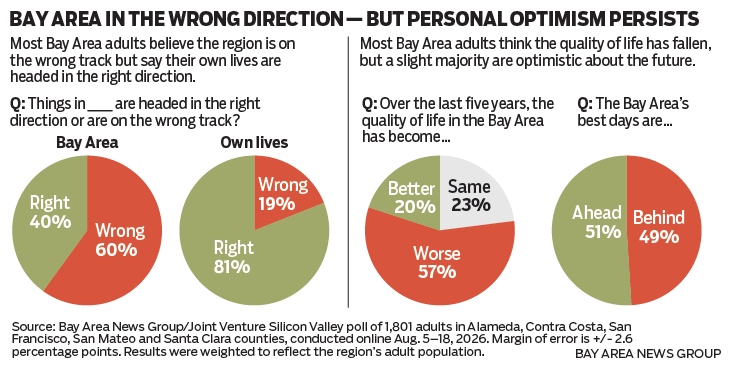
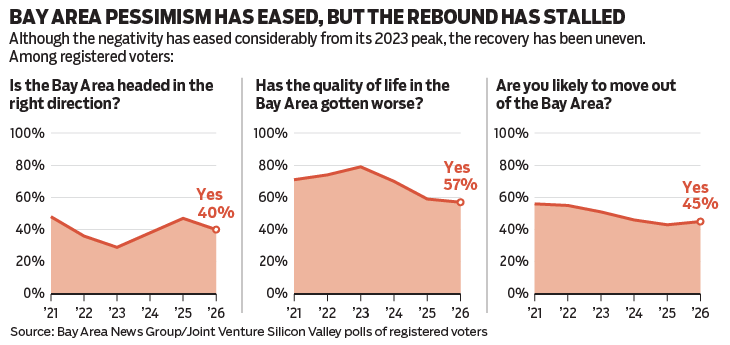
While 81% say their personal lives are headed in the right direction, just 40% say the same about the Bay Area, according to the 2026 Silicon Valley Poll.
RELATED: SV Poll: Bay Area residents feel they belong — but nearly half say they’re likely to leave
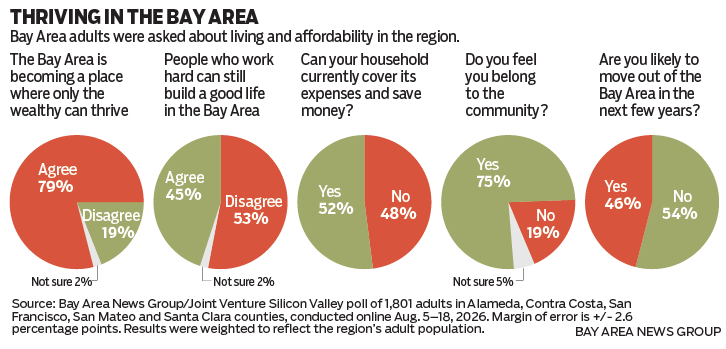
That 41-point gap captures a central tension in this year’s survey: Residents generally remain optimistic about their own lives and connected to their communities but express far less confidence in the Bay Area’s direction and its economic opportunities. Only 45% agree that people who work hard can still get ahead and build a good life here.
A majority, 57%, say the region’s quality of life has deteriorated over the past five years. Nearly 4 in 5 believe the Bay Area is becoming a place where only wealthy people can thrive.
Russell Hancock, president and CEO of Joint Venture Silicon Valley, said the findings suggest the region’s longstanding economic bargain has eroded. Residents historically accepted its high costs and sacrifices because buying a home and establishing financial security still seemed attainable.
“There was that sense that, yes, it’s harder, but it’s worth it,” Hancock said. “That’s what we’ve lost.”
The poll, conducted for Joint Venture Silicon Valley and Bay Area News Group by Embold Research, surveyed 1,801 adults in Alameda, Contra Costa, San Francisco, San Mateo and Santa Clara counties from Aug. 5 to 18. The overall margin of error is plus or minus 2.6 percentage points. The poll also included an additional oversample of 100 Black residents.
The poll was conducted online, and the results were weighted by age, gender, race and ethnicity, education, county, and 2024 presidential vote.
The region’s mood darkened over the past year after showing signs of improvement in 2025. Among registered voters, 60% now say the Bay Area is on the wrong track, up from 53% last year. That remains below the 71% who expressed that view in 2023.
Housing, the cost of living and homelessness rank as residents’ most widespread regional concerns.
Ninety-five percent of residents consider housing and housing costs a serious problem, including 78% who call them “very serious.” The overall cost of living follows at 94%, with homelessness at 92%.
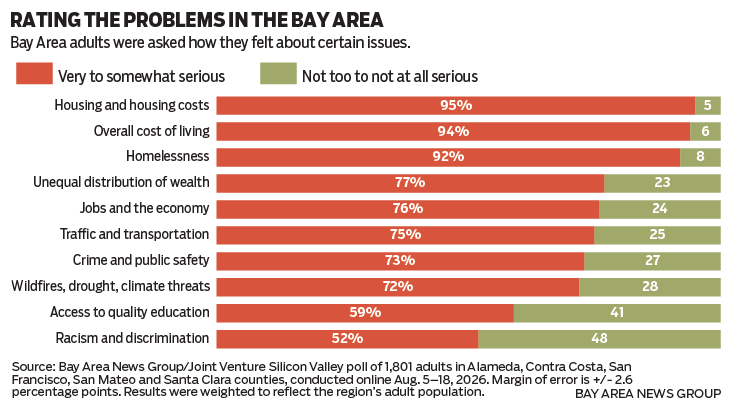
By comparison, 77% consider the unequal distribution of wealth a serious problem, 76% say the same about jobs and the economy, 75% about traffic and transportation and 73% about crime and public safety.
The economic pressure is evident in residents’ daily decisions. Although 52% say they can consistently pay their expenses and put money aside, 48% say they cannot.
Matthew Holian, an economics professor at San Jose State University, said housing competition is central to understanding those results.
“Households compete against each other for housing,” Holian said. “When incomes rise, households are able to offer more for homes and rents. So someone earning a relatively good income can still struggle to save because their primary expense — rent or mortgage — is also high.”
Over the past five years, 77% have cut back on eating out, entertainment or hobbies to make ends meet. Sixty-nine percent have delayed a major purchase, 59% have cut back on groceries or other necessities and 57% have used savings or retirement money to cover expenses.
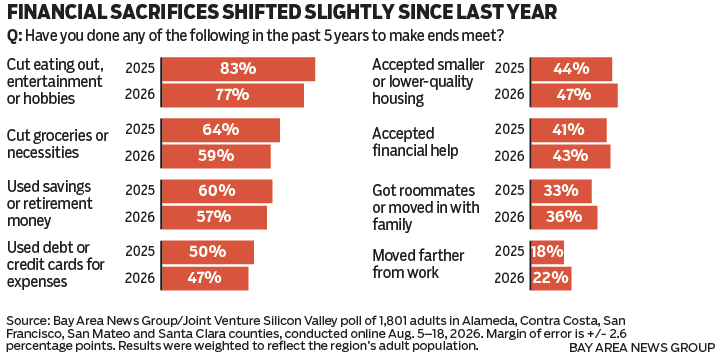
Nearly half have taken on debt or used credit cards to cover expenses. Forty-three percent say they have skipped or delayed medical care because of the cost.
For prospective buyers, persistently high home prices have collided with much higher borrowing costs. The median Bay Area single-family home sold for $1.4 million in June, according to the California Association of Realtors, while the average rate on a 30-year mortgage was 7.03% as of Sept. 24 — more than double its record low in early 2021, according to Freddie Mac.
The obstacle today, Hancock said, is no longer simply assembling a down payment.
“It’s the monthly payments that you cannot contemplate, even if you’re making really good professional salaries,” he said. “That’s what’s changed.”
Those pressures are also shaping major life decisions. Thirty percent say they have delayed having children or starting a family because of the cost of living.
Read more Fatal Highway 99 bus crash ruled murder-suicide by Tehama Sheriff
Among childless adults younger than 50, 56% say they are unlikely to have children. Of that group, 58% cite the inability to afford raising children here as a major reason, more than any other factor measured in the poll.
At the same time, the survey found that dissatisfaction with the region does not necessarily amount to alienation from it.
Three-quarters of residents say they feel that they belong in their communities, and 77% say people like them are welcomed and accepted. Even among residents who say they are likely to move away, about two-thirds still feel that sense of belonging.
Hancock said those sentiments are not contradictory.
“People can have a real sense of belonging here,” Hancock said. “Now, at the very same time, they can also be deeply frustrated that they’ll never own that house, that they’ll always be renting, that the rent will always be increasing, that it’s always going to keep getting harder, not easier.”
Overall, 46% say they are likely to leave the Bay Area in the next few years. That is down from 56% in 2021, although it edged up from 43% last year.
Residents also expressed deep skepticism about the region’s technology industry and the artificial intelligence boom reshaping it.
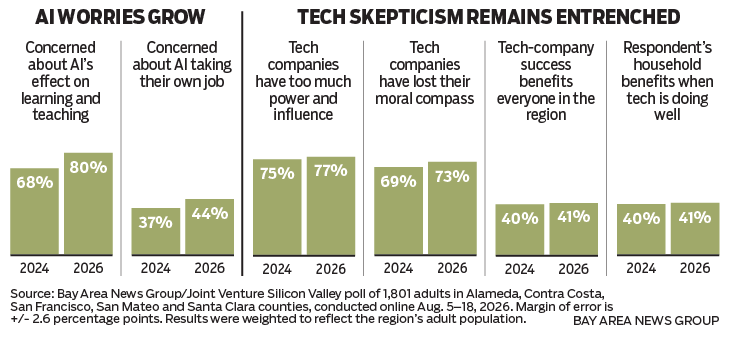
Seventy-seven percent agree that Silicon Valley’s leading technology companies have too much power and influence, while 73% believe those companies have lost their moral compass. Only 41% say the success of the technology industry benefits everyone in the region, and the same percentage say their own households benefit financially when the industry is doing well.
The divide was evident in the poll’s demographic breakdowns. Among respondents in tech-company households, 75% said their household benefits financially when the industry does well, compared with 33% of respondents in non-tech households. Separately, 51% of homeowners said they benefit, compared with 32% of renters.
Holian said tech growth can increase total regional income while producing different results for individual households. Workers whose incomes rise and homeowners whose properties gain value may benefit, while renters whose incomes do not change can be hurt by higher housing costs.
Nearly two-thirds say artificial intelligence is advancing too quickly. Forty-seven percent expect AI to have a negative effect on society over the next 20 years, compared with just 18% who expect a positive effect.
Residents voiced especially broad concern about whether governments can keep pace with AI, its effect on privacy and the career prospects of young people. Concern about AI’s impact on schools, respondents’ own jobs and the environment has also increased since those questions were asked in 2024.
The poll also provides an early snapshot of attitudes toward one of the region’s biggest decisions on the November ballot. Among residents who say they plan to vote, 48% support the proposed regional transit sales tax, 34% oppose it and 18% are undecided.
Because the survey sampled Bay Area adults rather than constructing a likely-voter electorate, those results should not be read as a forecast of the election. They do, however, show the measure beginning with a lead as transit agencies warn of severe service reductions without new revenue.
Even so, 51% of residents believe the Bay Area’s best days are still ahead, although that is statistically indistinguishable from the 49% who say they are behind it.
The youngest adults were the most hopeful: 63% of residents ages 18 to 34 believe the region’s best days are ahead.
Hancock called the generational divide one of the survey’s most striking findings.
“They’re hopeful,” Hancock said. “And good for them. I’m glad they feel that way. That’s the old Silicon Valley magic right there.”
But that optimism does not necessarily mean they expect to remain here. About half of residents ages 18 to 34 also say they are likely to leave in the next few years.
Taken together, the findings suggest that for many residents, believing in the Bay Area’s potential is not the same as being confident they can afford a future in it.
Read more Small-ball Rays beat the sloppy Yankees 5-2 for a 2-0 lead in AL Division Series
About the Author