A dispute between the Sonoma County Farm Bureau and local immigrant rights advocates has highlighted tensions within an industry that relies heavily on immigrant labor and is represented locally by an organization that often aligns with law enforcement.
The conflict has come to a head in recent weeks amid the Trump administration’s escalating immigration crackdown, focused increasingly on people with no criminal record and reliant, at least outside California, on assistance from local and state authorities.
In April, ahead of a summer surge in federal arrests, the Sonoma County Board of Supervisors passed an ordinance limiting federal authorities’ access to county property and information, the latest among a suite of county and statewide measures to further limit the overlap of federal immigration enforcement with local government.
Advocates, led by the Sanctuary Coalition of Sonoma County, said the long-sought ordinance didn’t go far enough, specifically because it did not address a key point of friction: the continued flow of inmate custody and release information — in particular cases — from the county jail to federal authorities, which is the primary way that Immigration and Customs Enforcement, or ICE works with local officials.
The Sanctuary Coalition responded in part by setting its political sights on the Sonoma County Farm Bureau, which in May voiced its support for the Sheriff’s Office policy of communicating with immigration authorities about local inmates convicted of certain crimes. After activists targeted the organization for that support, holding a July 20 demonstration outside the group’s Santa Rosa headquarters, the bureau doubled down with a public statement in August from its top administrator.
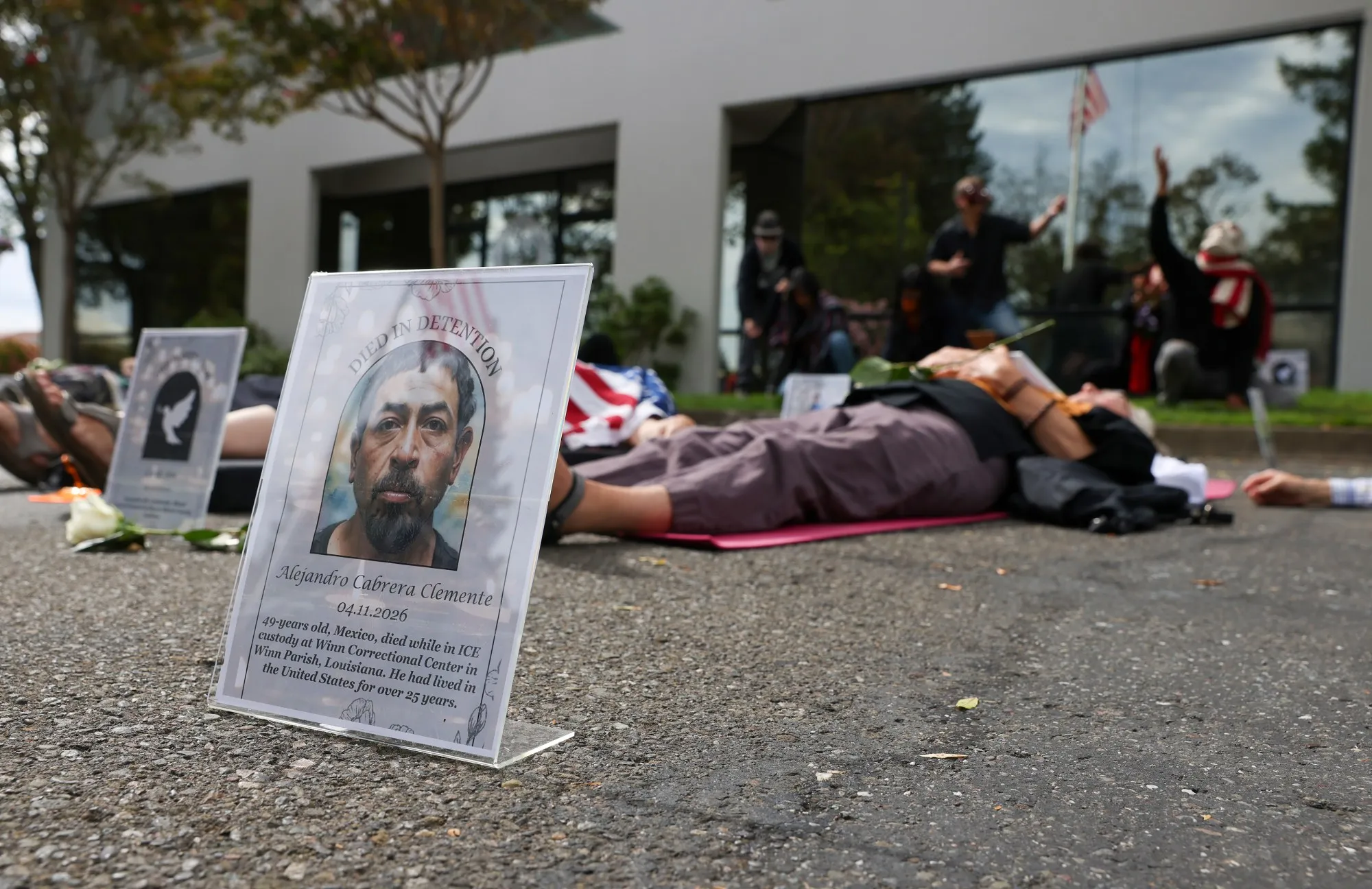
At the July 20 protest, more than two dozen demonstrators staged a rally and “die-in” on the Farm Bureau’s parking lot, decrying the organization’s support of the sheriff’s policy. The group sang and prayed in remembrance of people who have died in federal immigration detention centers across the country.
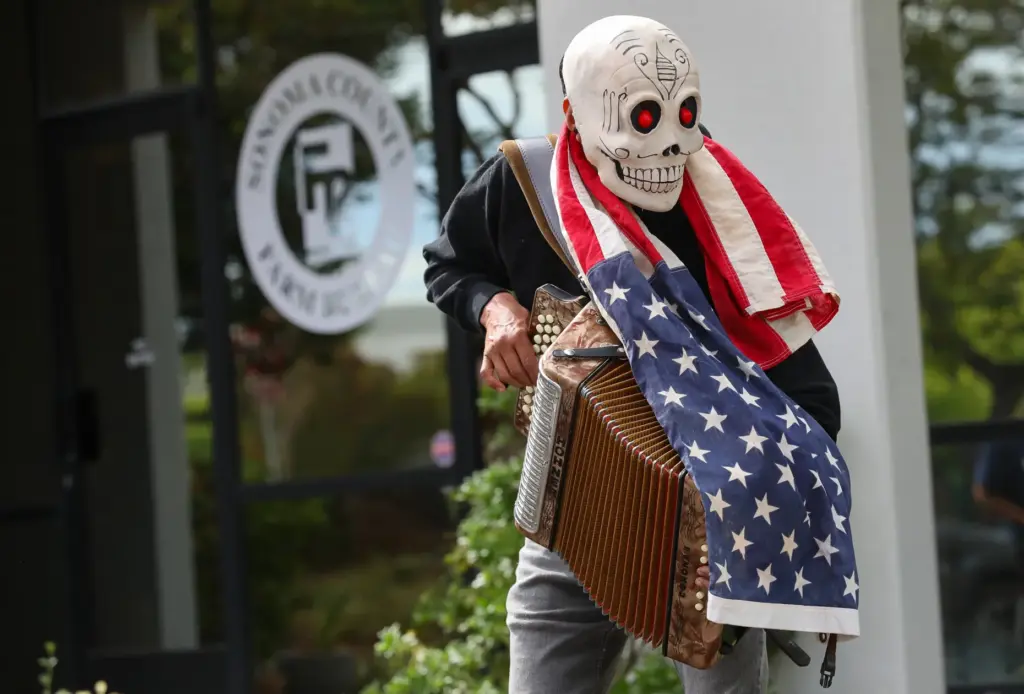 Nicolas Valdez performs during a Sonoma County Sanctuary Coalition protest on July 20 at the Sonoma County Farm Bureau office in Santa Rosa. (Christopher Chung/The Press Democrat)
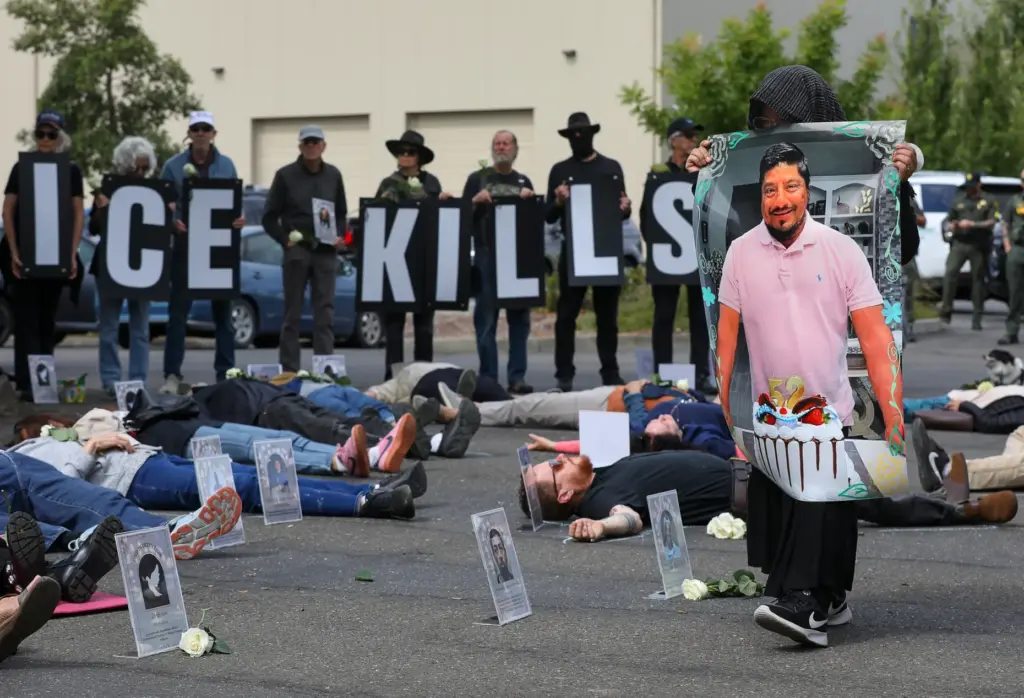 A protester carries a photograph of Lorenzo Salgado, who recently died in ICE custody, during Sonoma County Sanctuary Coalition’s “Die In” protesting the Sonoma County Farm Bureau’s support of Sonoma County Sheriff’s collaboration with ICE, at the Farm Bureau’s office in Santa Rosa on July 20. (Christopher Chung/The Press Democrat)
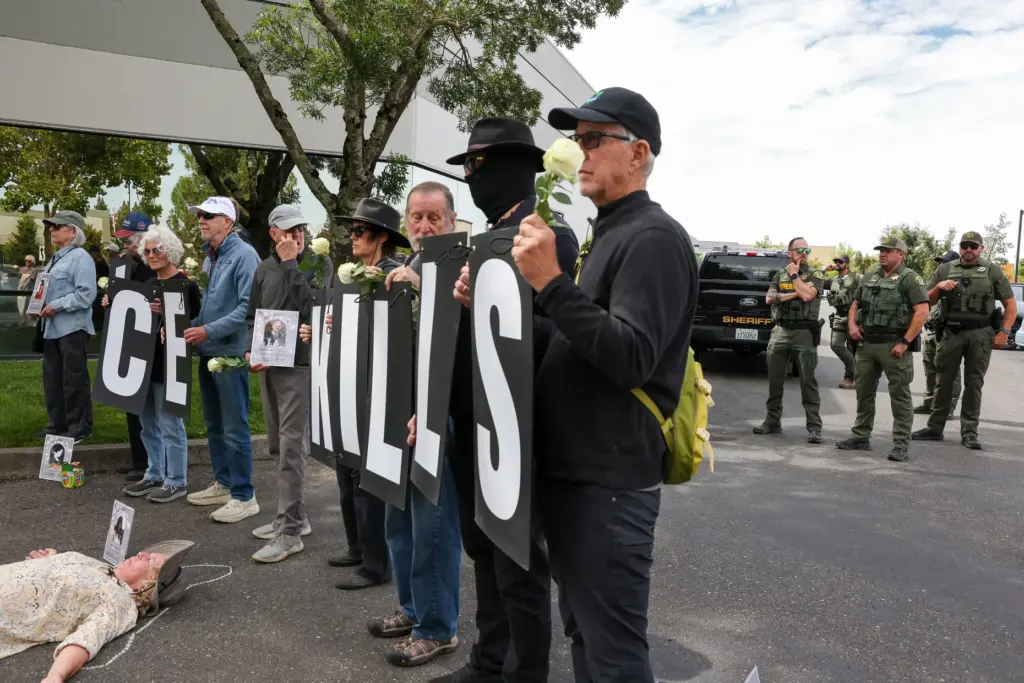 Sonoma County Sheriffs Officers gather behind protesters during Sonoma County Sanctuary Coalition’s “Die In” protesting the Sonoma County Farm Bureau’s support of Sonoma County Sheriff’s collaboration with ICE, at the Farm Bureau’s office in Santa Rosa on July 20. (Christopher Chung/The Press Democrat)
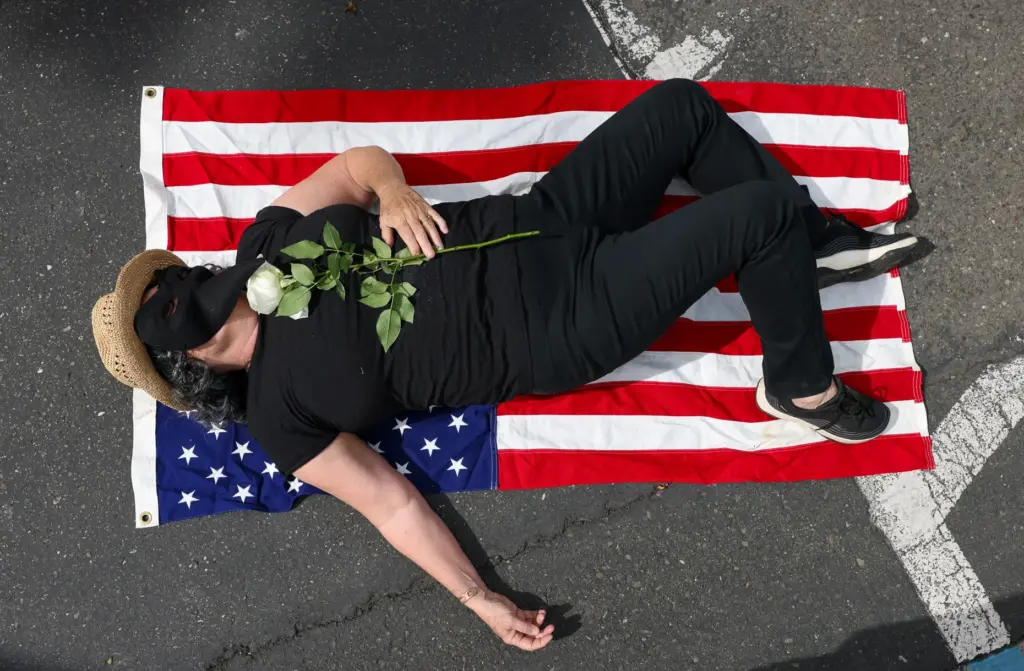 A protester, who declined to provide their name, participates in Sonoma County Sanctuary Coalition’s “Die In” protesting the Sonoma County Farm Bureau’s support of Sonoma County Sheriff’s collaboration with ICE, at the Farm Bureau’s office in Santa Rosa on July 20. (Christopher Chung/The Press Democrat)
The Sheriff’s Office dispatched at least six deputies after receiving a request for police presence. Deputies let the demonstration go on, advising protesters they were assembling on private property.
A farmworker who identified herself as Sandra addressed the Farm Bureau directly. “If your businesses are so important to you, why not have the safety and wellbeing of your workers be part of that?” she said. “You have the responsibility to ensure our safety. So we don’t want any more collaboration between the sheriff and ICE, and demand these large businesses who benefit from immigrant labor stop supporting it.”
Almost two weeks later, the protest prompted an official and somewhat extraordinary written response from the Farm Bureau, one of the North Bay’s largest agricultural trade groups, with members ranging from Friedman’s Home Improvement to Francis Ford Coppola Winery.
Executive Director Dayna Ghirardelli, in a statement published Aug. 3, leaned in on the organization’s support of the sheriff’s policy, calling it “common sense.”
“The easiest course would have been to remain silent,” Ghirardelli said.
“The Sonoma County Farm Bureau supports the Sheriff’s policy, and we make no apology for doing so. Not because we oppose immigrants. Not because we support indiscriminate immigration enforcement. And certainly not because we lack appreciation for the thousands of immigrant families who are indispensable to Sonoma County agriculture. We support it because a policy allowing limited cooperation with federal immigration authorities when individuals have been convicted of serious or violent felonies is reasonable, responsible, and rooted in common sense.”
Sheriff’s policy on information sharing with ICE
In May, shortly after the passage of the county’s limited sanctuary ordinance, the Sonoma County Farm Bureau sent a letter to supervisors ahead of an annual Sheriff’s Office report on interactions with federal immigration officials, voicing support for what it described as the sheriff’s “balanced approach.”
In recent years, Sonoma County Sheriff Eddie Engram, whose department runs the jail, has put additional limits on when information is shared with federal immigration agencies – responding to requests for information, including release timing, for people convicted of a narrowed list of felonies. ICE uses that custody information to make arrests at the jail, a common interception technique.
While Engram’s policy is more restrictive than some neighboring jurisdictions, some advocates say any coordination is unacceptable, especially given the high-profile violence ICE has displayed and inhumane conditions and deaths reported at ICE detention facilities.
Still, Engram and most Sonoma County supervisors have decided the local policy strikes a balance between safeguarding immigrant communities and maintaining public safety.
The Farm Bureau’s redoubled stance has drawn pushback from advocates for immigration policy reform and some local small-scale farmers who note the bureau’s members have for decades relied on immigrant workers to support their businesses.
That workforce has been upended by the Trump administration’s crackdown, clouding daily life for immigrant families, including those in the North Bay, advocates note.
Renee Saucedo, organizer with Sonoma County Sanctuary Coalition, said support of the sheriff’s policy undermined safety for farmworkers already facing demanding and sometimes hazardous working conditions — to “make large profits for the Farm Bureau’s members,” she said.
“True common sense dictates that a thriving community cannot be built on the intimidation and marginalization of its community members,” Saucedo added.
Local Farm Bureau’s vocal stance
The Aug. 3 statement appears to make the Sonoma County Farm Bureau unique if not an outlier among other Farm Bureau chapters across the state. Outside of the pushback from some groups in the wake of a series of farm and packing house raids in Southern California last summer, few seem to have so vocally waded into debates about local authorities’ cooperation with ICE.
After some of that pushback, President Donald Trump was reported to have ordered a pause on ICE raids on farms and hospitality businesses. The California Farm Bureau also conducted a study over the past year finding that enforcement efforts directly and indirectly impacted growers and employees, creating a “chilling effect”, including in the North Bay, as fears of enforcement and raids grew.
Gina Garibo, an organizer with the nonprofit North Bay Organizing Project, said 56 people have been detained by federal immigration agents in Sonoma County from January 2025 through Aug. 30. Those arrested, according to the North Bay Rapid Response Network, a grassroots tracking effort, have included people taken into custody on their way to work and outside their homes.
At the time of the July protest, local Farm Bureau officials opted to not comment, staying on the sidelines until Ghirardelli’s Aug. 3 statement. A similar version was published Aug. 25 as an op-ed in The Press Democrat.
While Ghirardelli noted immigrant farmworkers’ “tremendous contributions” to the agricultural economy, she said Engram’s policy serves the public interest.
“If it were legally possible, I would support deporting some individuals convicted of the most serious and violent crimes who are U.S. citizens as well,” Ghirardelli wrote. “Of course, our Constitution rightly does not permit that.”
Read more Dangerous waves forecast for Bay Area coastline over weekend
She said her concern is focused on “protecting our communities from people who repeatedly demonstrate through serious criminal conduct that they pose a danger to others.”
Ghirardelli also criticized protesters for their messaging around the topic. “Efforts to balance competing interests are dismissed as betrayals. Complex issues are compressed into slogans, and anyone who refuses to embrace ideological absolutes is treated as an adversary,” she said.
“Some activists would have the public believe there are only two acceptable positions: oppose any cooperation with Immigration and Customs Enforcement under any circumstance or be labeled anti-immigrant,” she said. “That is a false choice. It deliberately blurs important distinctions and reduces a complex public policy issue into an ideological litmus test.”
Ghirardelli did not respond to an interview request for this story.
Advocates, farmers respond
The Farm Bureau post sparked renewed outcry from immigrant advocates and others in recent weeks.
The Sanctuary Coalition responded Aug. 5 on Facebook, sharing comments from several of its members. Among those weighing in was activist Alegría De La Cruz, who faulted the Farm Bureau for “flawed logic, historical revisionism, and a refusal to account for the real-world consequences of the policies being championed.”
De La Cruz, now a top official with the California Rural Legal Assistance Foundation and a daughter of pioneering California farm labor organizers, previously served as director of Sonoma County’s Office of Equity from 2020 to 2024. She called the Farm Bureau to task for what she described as a political and legislative record of opposing critical climate and land-use regulations and resisting stronger labor protections and wage standards for agricultural workers.
“When local entities advocate for stronger ties to federal enforcement mechanisms that jeopardize human rights, they are actively endorsing a system that inflicts terror on the very communities they claim to represent,” she wrote.
Nicolas Valdez, in the same post, criticized the timing of Ghirardelli’s statement amid ongoing separations of families due to federal enforcement actions.
Valdez, a writer and the sanctuary coalition’s education and outreach specialist, said Farm Bureau’s post echoed language used during periods of “widespread police abuse” against Mexicans.
“More than a century later, it is revealing to see the Sonoma County Farm Bureau relying on a similar framework — distinguishing between ‘good’ and ‘bad’ immigrants — to defend continued cooperation with an enforcement system that has brought violence, family separation, and loss to countless communities,” Valdez said.
Some locally-based farmers also expressed their concerns. Wendy Krupnick, president of Sonoma County’s chapter of Community Alliance with Family Farmers, said while the organization has not taken an official stance on the sheriff’s policy, the local chapter does not stand with the Farm Bureau on all matters.
“We support legal protections for people, no matter what their status is,” Krupnick said in an interview. “I do know when these ICE actions started happening, some of our local growers contacted CAFF and asked, ‘What can we do to protect our workers? Our workers are frightened, and we’re frightened.’”
CAFF spokesperson Evan Wiig also shared the organization’s January statement, saying it “condemns the disturbing overreach of federal immigration enforcement” and “to support fair and just processes for those facing immigration action.”
Will Holloway, owner and operator at the certified organic business Longer Table Farms, told The Press Democrat on Aug. 24 that he wondered why the bureau took a formal stance on the sheriff’s policy. “They are very quick to endorse various political bills, candidates, and policies that have nothing (or very little) to do with farming,” he said
That far-ranging activity included, notably in 2020, $20,000 spent by the Farm Bureau’s political action committee to defeat Measure P, the local initiative ultimately approved by nearly 65% of Sonoma County voters to bolster civilian oversight of the Sheriff’s Office. The Sonoma County Farm Bureau’s executive director at the time, Tawny Tesconi, credited the department with “an excellent job in supporting agriculture,” and questioned the need for additional oversight spending.
Holloway said the Farm Bureau’s political profile and activity “tends to leave part of the agricultural community feeling left out or alienated, particularly BIPOC and LGBTQ folks.”
“I do not believe that is their intention, but it has left a bad taste in the mouth of many folks that might otherwise love to be a part aligned under the umbrella of agriculture.”
In his own op-ed piece published Aug. 31 in The Press Democrat, retired Santa Rosa police lieutenant Ernesto Olivares, who served 12 years on the Santa Rosa City Council, including as mayor, also took issue with the Farm Bureau’s stance.
“When an organization steps beyond its traditional mission to take a position on a controversial public policy, it assumes a responsibility to explain not only what it believes but also why the issue belongs in its lane and what evidence supports its position,” he wrote.
He pointed to a lack of data shared on whether the sheriff’s policy “addresses a significant public safety problem in Sonoma County involving undocumented immigrants.
“Why use the Farm Bureau’s institutional voice to support a law-enforcement policy involving ICE, rather than focus its immigration advocacy on workforce stability, legal protections, family security and the economic consequences of aggressive enforcement?” wrote Olivares, who ran for sheriff in 2018.
Holloway, sharing his worries, signaled more attention ought to be paid to the potential fallout on Sonoma County’s farm laborers given the likelihood of federal immigration actions one day playing out here as they have elsewhere.
“Regardless of legal residency or citizenship status, farmworkers would likely (and understandably) be too scared to come to work if broader enforcement actions happen,” he said. “As an employer, I could not ask them to take that risk.”
Staff Writer Natalie Hanson can be reached at [email protected].
Staff Writer Marisa Endicott can be reached at [email protected].
About the Author