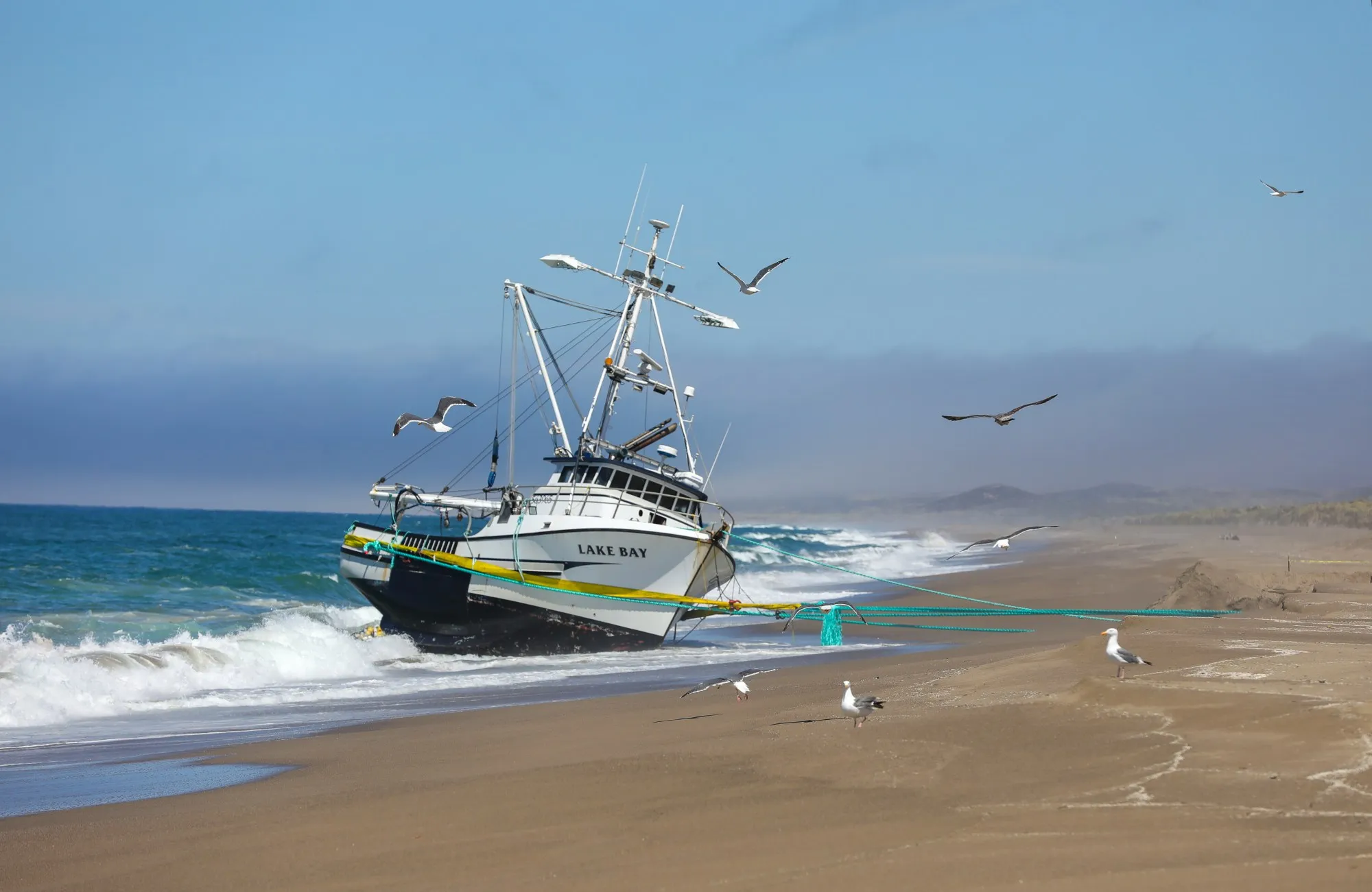
Work crews are well along in their unenviable and aromatic task involving the 58-foot Lake Bay, a fishing vessel that ran aground Aug. 22 on Point Reyes National Seashore’s North Beach.
Read more Dangerous waves forecast for Bay Area coastline over weekend
Once the boat had been pulled by bulldozers out of the surf zone, a feat that took five days, salvagers turned their attention to the next phase of job: removing between 30 and 50 tons of congealed squid that had begun decomposing in the catch tank, below the main deck.
On Wednesday afternoon, workers in white hazmat suits could be seen maneuvering a small, orange backhoe up and down a sand ramp leading to the Lake Bay’s port-side hull.
Scooping up the calamari in the backhoe’s bucket, salvagers have been depositing the catch in secure containers, then moving those containers off the beach “to prepare them for off-site disposal,” said Joshua Winchell, a spokesman for the National Park Service, which took over the salvaging operation from the Coast Guard once the Lake Bay was out of the surf zone.
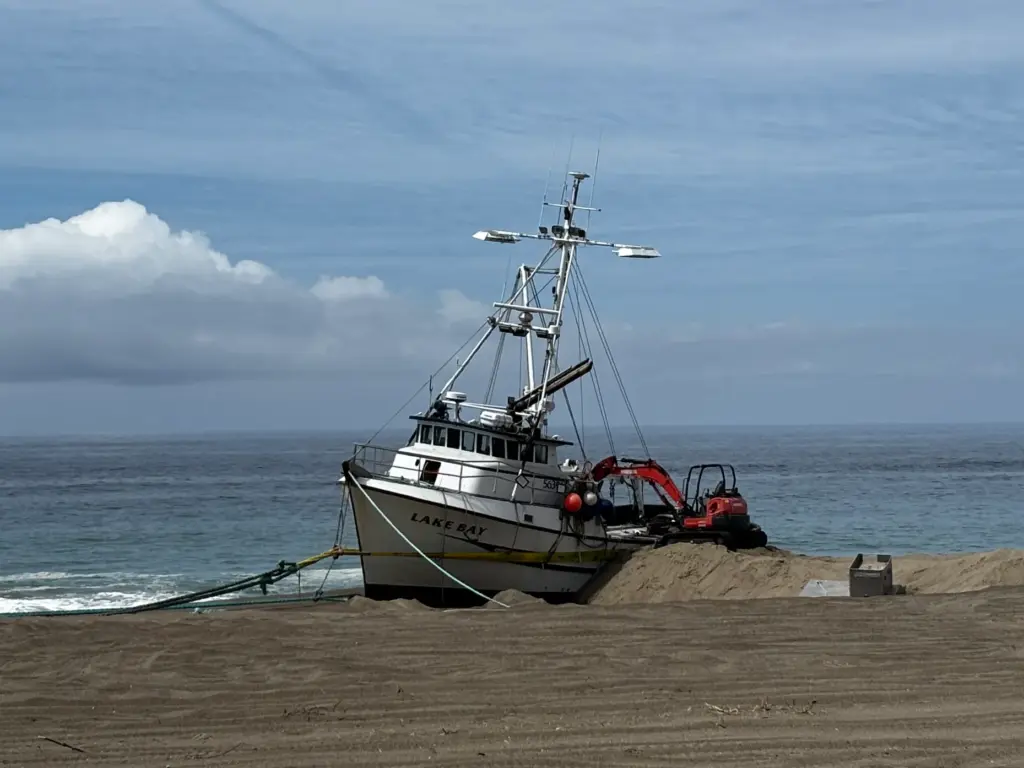 Crews work to remove 30-50 tons of rotting squid from the 58-foot fishing vessel Lake Bay on Point Reyes National Seashore’s North Beach on Wednesday. The boat, which ran aground Aug. 22, is set to be dismantled once the squid is removed, the National Parks Service announced. (Austin Murphy / The Press Democrat)
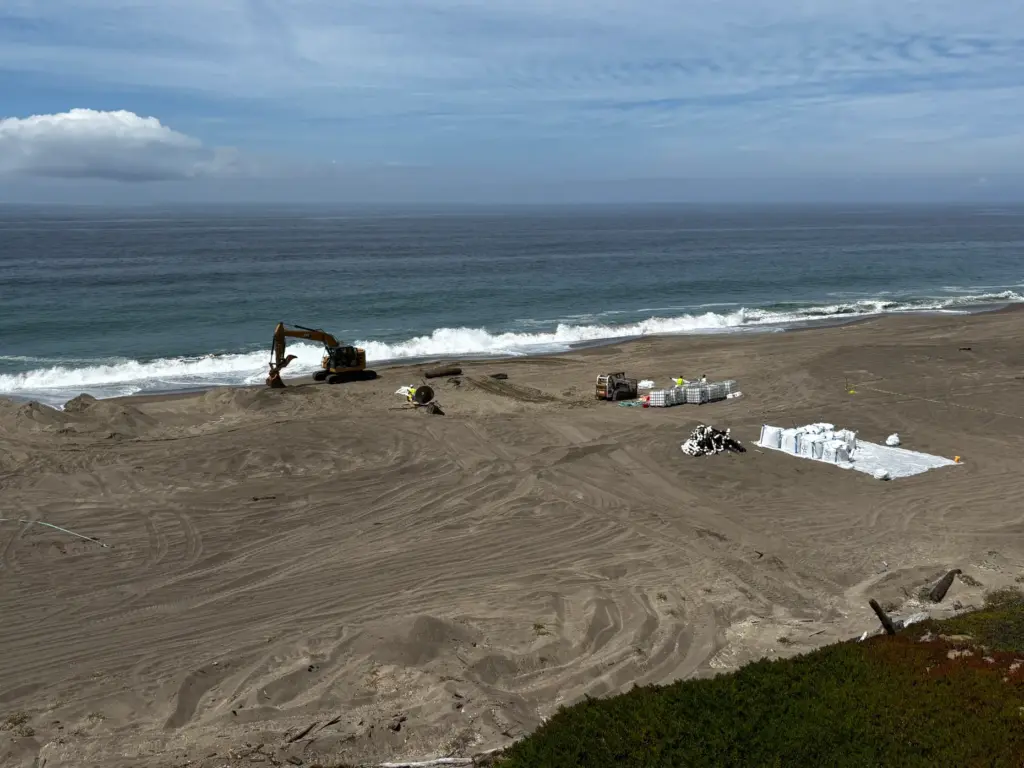 Crews work to remove 30-50 tons of rotting squid from the 58-foot fishing vessel Lake Bay on Point Reyes National Seashore’s North Beach on Wednesday. (Austin Murphy / The Press Democrat)
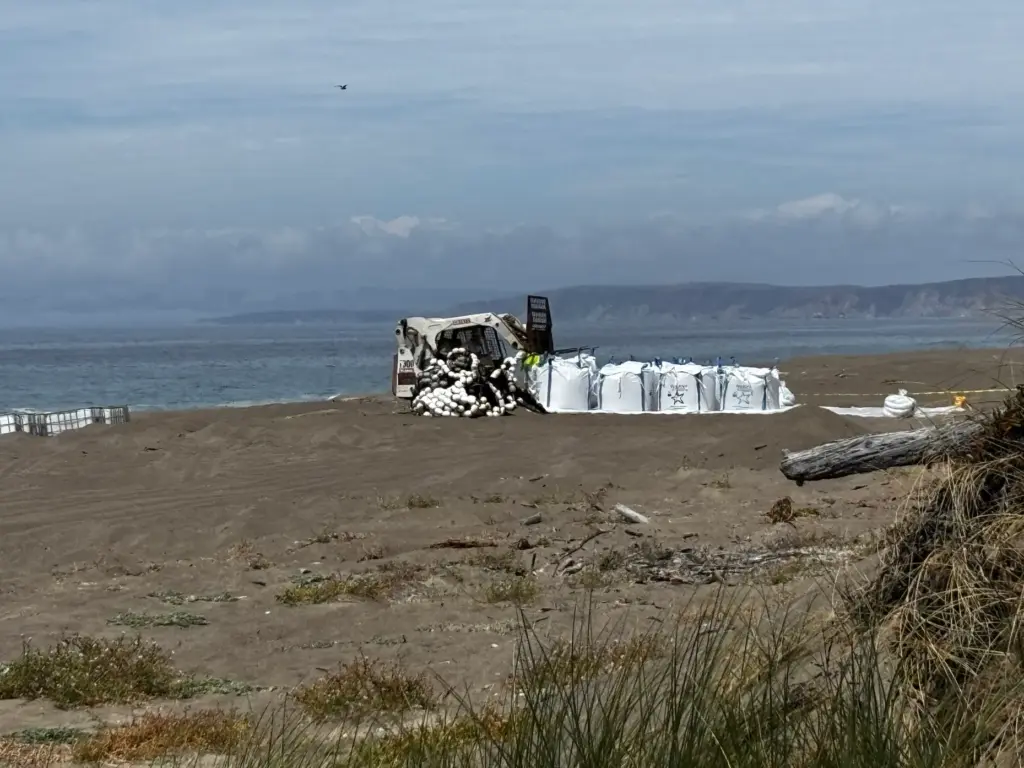 Crews work to remove 30-50 tons of rotting squid from the 58-foot fishing vessel Lake Bay on Point Reyes National Seashore’s North Beach on Wednesday. (Austin Murphy / The Press Democrat)
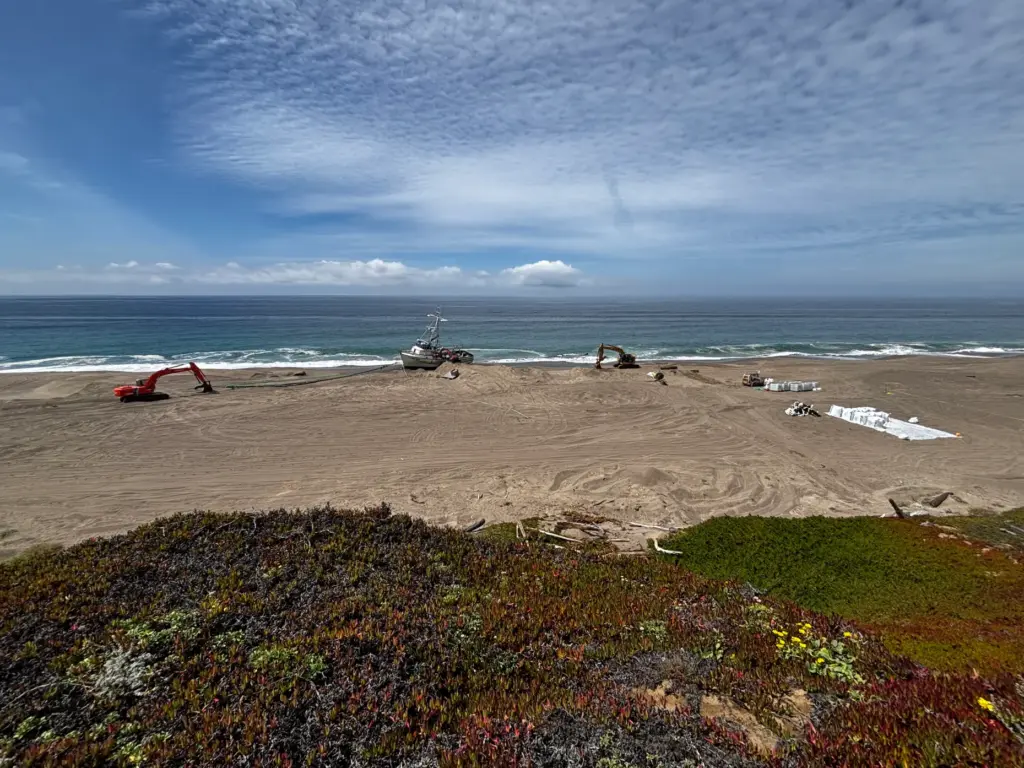 Crews work to remove 30-50 tons of rotting squid from the 58-foot fishing vessel Lake Bay on Wednesday. (Austin Murphy / The Press Democrat)
Lake Bay to be ‘dismantled’
After all the squid is removed, Winchell shared in an email Thursday, “the salvagers will move the vessel higher up the beach then dismantle it for transport out of the park.”
With that statement, he confirmed what many in the North Bay’s wider commercial fishing industry had feared.
Regardless of whether the Lake Bay could be repaired and refloated, and despite its sterling pedigree — its fiberglass hull was built in 1975 by Delta Marine, known for the high quality and extreme durability of its vessels — the boat’s fate had been sealed the moment it got stuck on that sand bar.
Coming to the Lake Bay’s aid, after it ran aground around 1 a.m. on Aug. 22, was the Night Wind, a fishing boat out of Spud Point Marina in Bodega Bay. According to numerous sources, the Night Wind had attached a tow line to the Lake Bay and was trying to pull it to deeper water when the Coast Guard arrived on the scene, ordering the Night Wind’s crew to cease and desist in the rescue operation, or face arrest.
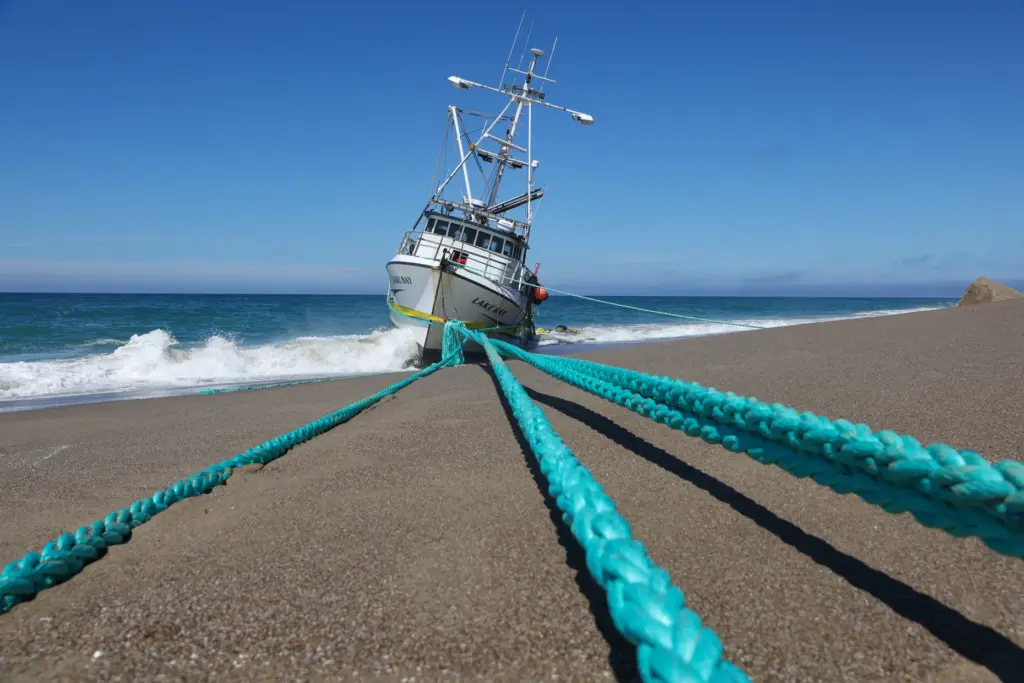 The Lake Bay sits tethered to an excavator on North Beach at Point Reyes National Seashore on Aug. 26. (Christopher Chung/The Press Democrat)
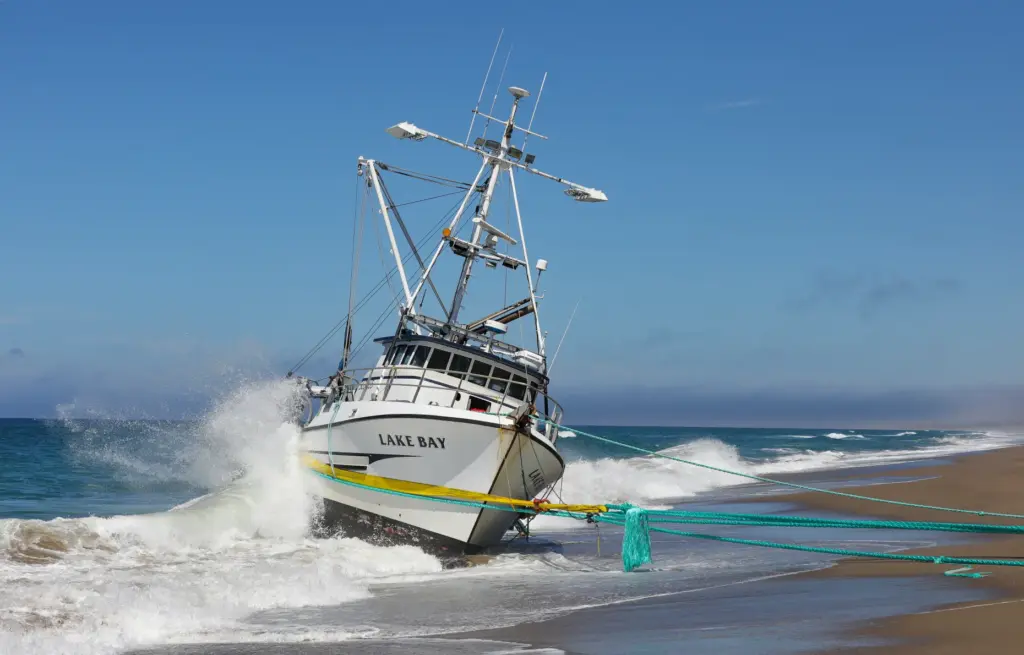 The Lake Bay sits tethered to an excavator on North Beach at Point Reyes National Seashore on Aug. 26. (Christopher Chung/The Press Democrat)
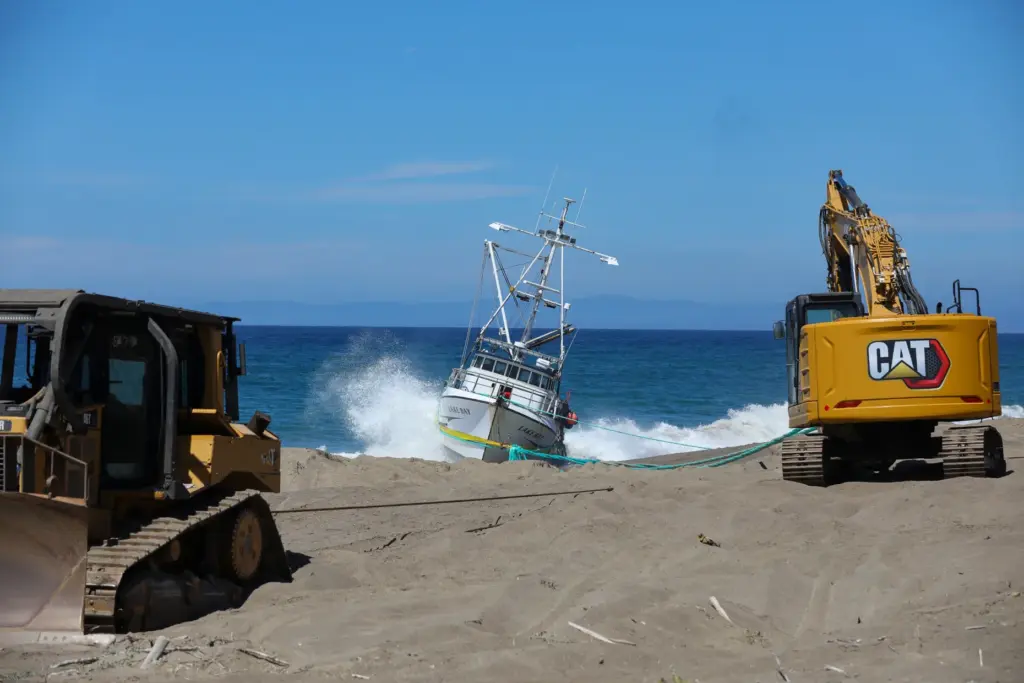 The Lake Bay sits tethered to an excavator on Point Reyes Beach North at Point Reyes National Seashore on Wednesday, August 26, 2026. (Christopher Chung/The Press Democrat)
Asked if the Coast Guard considered towing the Lake Bay back out to sea, Lt. Cmdr. Carey Lewis said on Aug. 26 that once a boat of its size runs aground, “the stability of that vessel is in question,” with no way to know “there’s no breach to the hull,” raising the possibility that the diesel fuel it was carrying “could discharge in an environmentally sensitive area.”
The coastal waters off the Point Reyes National Seashore are part of the federally protected Greater Farallones National Marine Sanctuary. Emergency crews were able to empty the Lake Bay’s fuel tanks, removing 1,400 gallons of diesel.
According to a National Park Service statement, “Salvagers examined the vessel, determined that it was not seaworthy and — with concurrence from the U.S. Coast Guard — determined that attempts to tow and refloat the vessel were not advisable and that it should be brought up on shore for removal.”
The salvage company working to get the Lake Bay off the beach is Sausalito-based Parker Diving Service, which also spearheaded the dismantling and disposal of the Aleutian Storm, a 57-ton fishing boat that foundered on a sandbar off Salmon Creek State Beach, on the Sonoma Coast, in February 2024 before being taken apart.
Maria Nunn, Parker’s salvage coordinator, said in a brief phone conversation Wednesday she’d been instructed by “unified command” — agencies responding to the Lake Bay grounding, led by the Coast Guard and National Park Service — not to speak with reporters.
‘Re-evaluate the whole process’
The Coast Guard’s decision to shut down the attempted rescue of the Lake Bay — ensuring that it would end up stranded in the surf zone, essentially sealing the vessel’s fate — angered some members of the region’s commercial fishing community.
They questioned why the Guard must so often err on the side of sacrificing fishing vessels that run aground before an effort can be made to save them.
The Lake Bay’s case has motivated some members of the fishing community to call for conversations with the Coast Guard to allow them more of a chance to save fishing vessels when they run aground.
“We need to re-evaluate the whole process,” said veteran fisherman Dick Ogg, president of the Bodega Bay Fisherman’s Marketing Association. He hopes to collaborate with the Coast Guard on ideas that will give fishing fleet members more of a window — he suggested 36 hours — to apply their deep knowledge of the North Coast’s waters to “engineer a method to get that boat off the beach.”
It can be done, he and others are convinced, without compromising the Coast Guard’s primary concerns for life-safety and environmental protection.
“Solutions are in front of us,” said Ogg, who previously owned a Delta Marine boat, and describes them as “absolute tanks.” On Thursday he questioned, again, why the Lake Bay must be demolished.
“I can’t even express the frustration I’m feeling, because I know that vessel is sound. If there are leaks, it is repairable. The fact is, it is completely salvageable. What are we doing?”
Supervisor Lynda Hopkins, whose district includes west Sonoma County and the Bodega Bay fishing community, agreed.
Like Ogg, she expressed respect and appreciation for work done by the Coast Guard. And like him, she believes more could have been done to rescue the Lake Bay.
“There was a boat, there was a tow rope and people” — the crew of the Night Wind — “willing to attempt the rescue” in the crucial moments not long after the Lake Bay foundered, before its hull had fully settled in the sand.
“Why not even try to save it?” asked Hopkins, who is meeting later this month with Ogg, Jeff Duvall, director of the county’s Emergency Management department, and Lisa Damrosch, executive director of the Pacific Coast Federation of Fisherman’s Associations.
She’s also hoping to schedule a meeting with Coast Guard officials.
Hopkins pointed out that the county has emergency plans for a wide range of incidents, from earthquakes and wildfires to tsunamis and power outages. She believes there’s room for improvement in defining and cataloging “best practices” when a fishing vessel runs aground.
She described the imminent dismantling of the Lake Bay as “environmental tragedy, a personal tragedy and an economic tragedy.”
Storm of Styrofoam
Richard James, a Marin-based environmental activist and watchdog known as the Coastodian, has spent nearly two decades hiking the shorelines of West Marin, Tomales Bay, and Point Reyes National Seashore, hauling out loads of plastic and debris.
The dismantling and destruction of vessels that run aground, often done in the name of preventing damage to the pristine coastline, ends up causing environmental harm of its own, he pointed out.
“I’ve helped pick up after probably a dozen of these big boats, and I’ve seen a pattern,” said James. “When they crush (the Lake Bay) there’s going to be a bajillion (pieces) of Styrofoam” — fragments that end up in the dunes, on the beach and in the water.
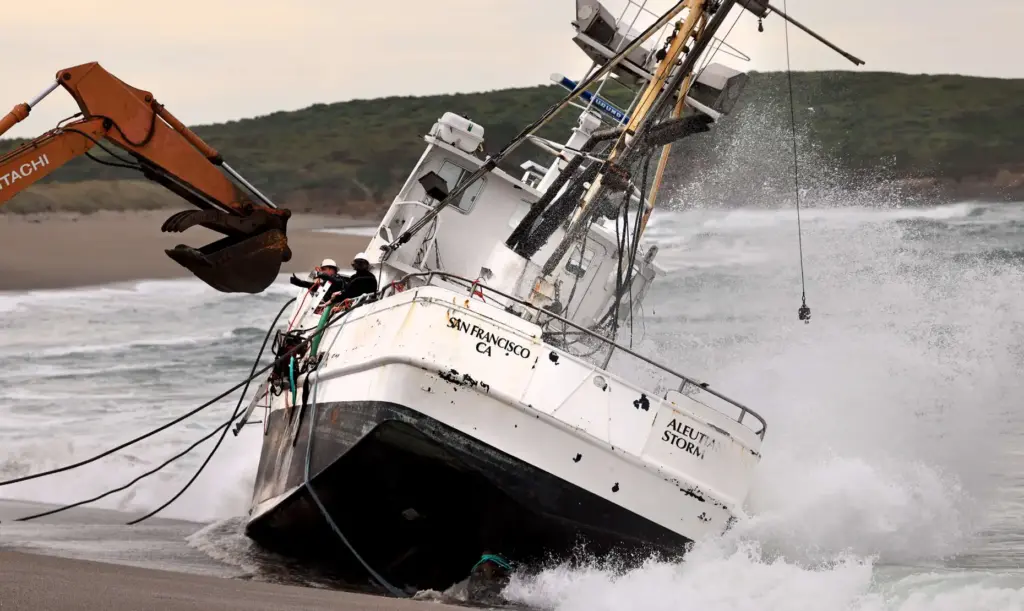 Personnel from a salvage crew wait to offload equipment from the Aleutian Storm, Friday, Feb. 16, 2024. After offloading a pump and fuel hoses, the seas became to rough to continue working on the beached vessel at south Salmon Creek State Beach, north of Bodega Bay. (Kent Porter / Press Democrat) 2024
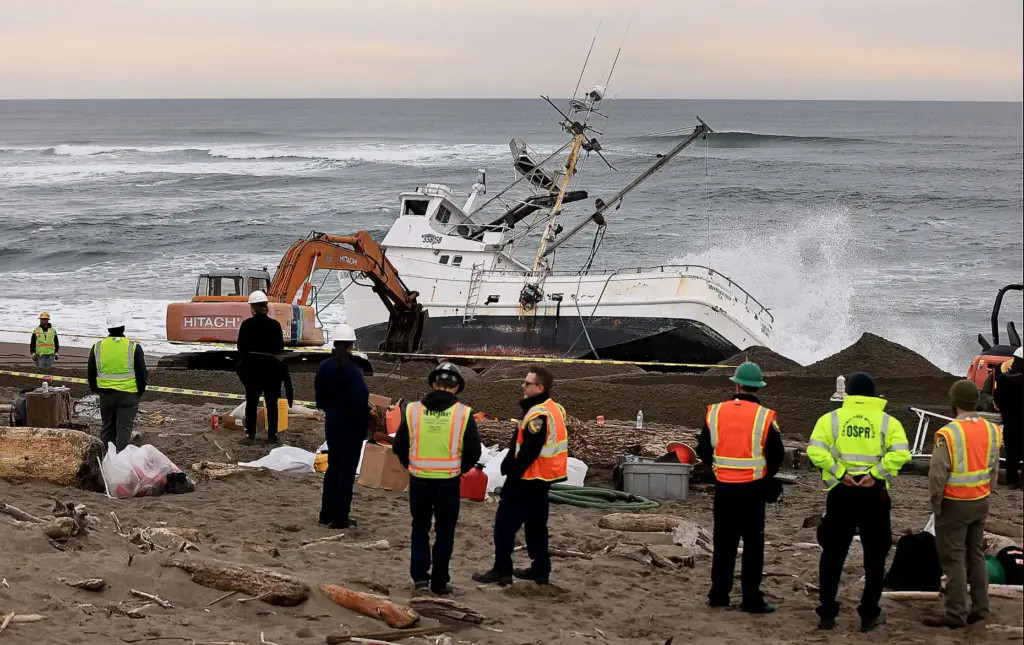 Personnel from the U.S. Coast Guard, State Parks and salvage crews watch as an excavator is used to push sand in order to pull the Aleutian Storm out of the surf, Friday, Feb. 16, 2024. After offloading a pump and fuel hoses, the seas became to rough to continue working on the beached vessel at south Salmon Creek State Beach, north of Bodega Bay. (Kent Porter / Press Democrat) 2024
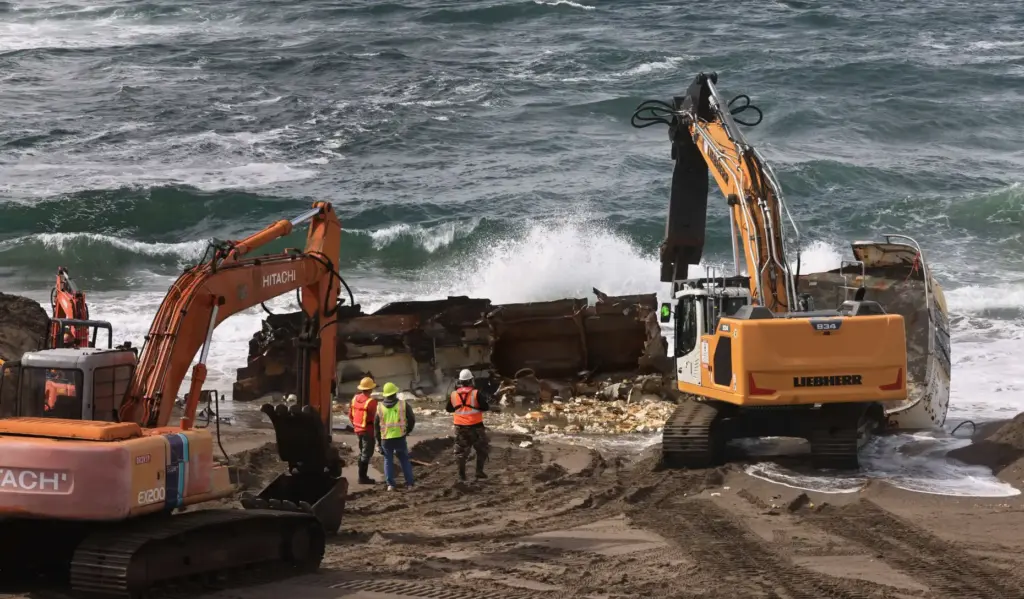 Kent Porter / The Press Democrat filePersonnel from Parker Diving of Sausalito salvage what is left from the Aleutian Storm fishing vessel on Salmon Creek State Beach south, Wednesday, March 6, 2024, north of Bodega Bay. (Kent Porter / The Press Democrat file)
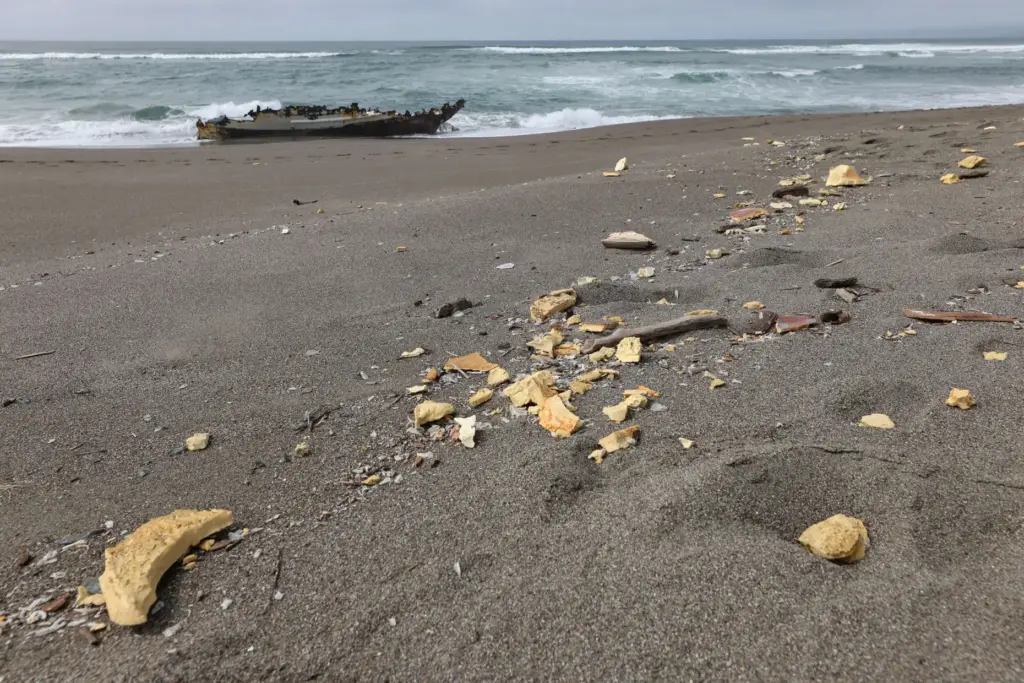 Christopher Chung / The Press DemocratPieces of foam debris from the Aleutian Storm wreckage are scattered along Salmon Creek State Beach near Bodega Bay, Monday, March 18, 2024. (Christopher Chung / The Press Democrat)
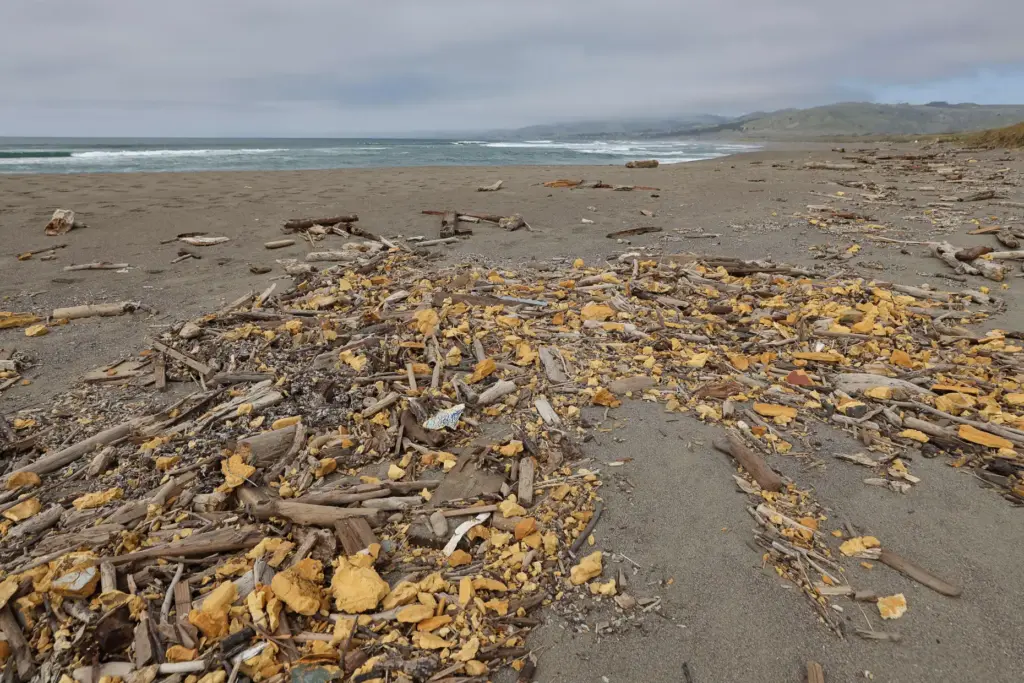 Christopher Chung / The Press DemocratPieces of foam debris from the Aleutian Storm wreckage litter Salmon Creek State Beach near Bodega Bay, Monday, March 18, 2024. (Christopher Chung / The Press Democrat)
“What troubles me,” he wrote in a follow-up email, “is that the authorities seem to think that letting a boat go to ground, then having it crushed and carted off is a preferable solution.”
Perhaps it’s easy for those in charge to take that approach, he said, “since for the most part they are not around during the crunching and do not see the millions of pieces of foam, plastic and painted wood then scattered by the wind.”
You can reach Staff Writer Austin Murphy at [email protected] or on Twitter @ausmurph88.
Read more What’s next for SF Giants’ top pick Jackson Flora after his solid pro debut?
About the Author