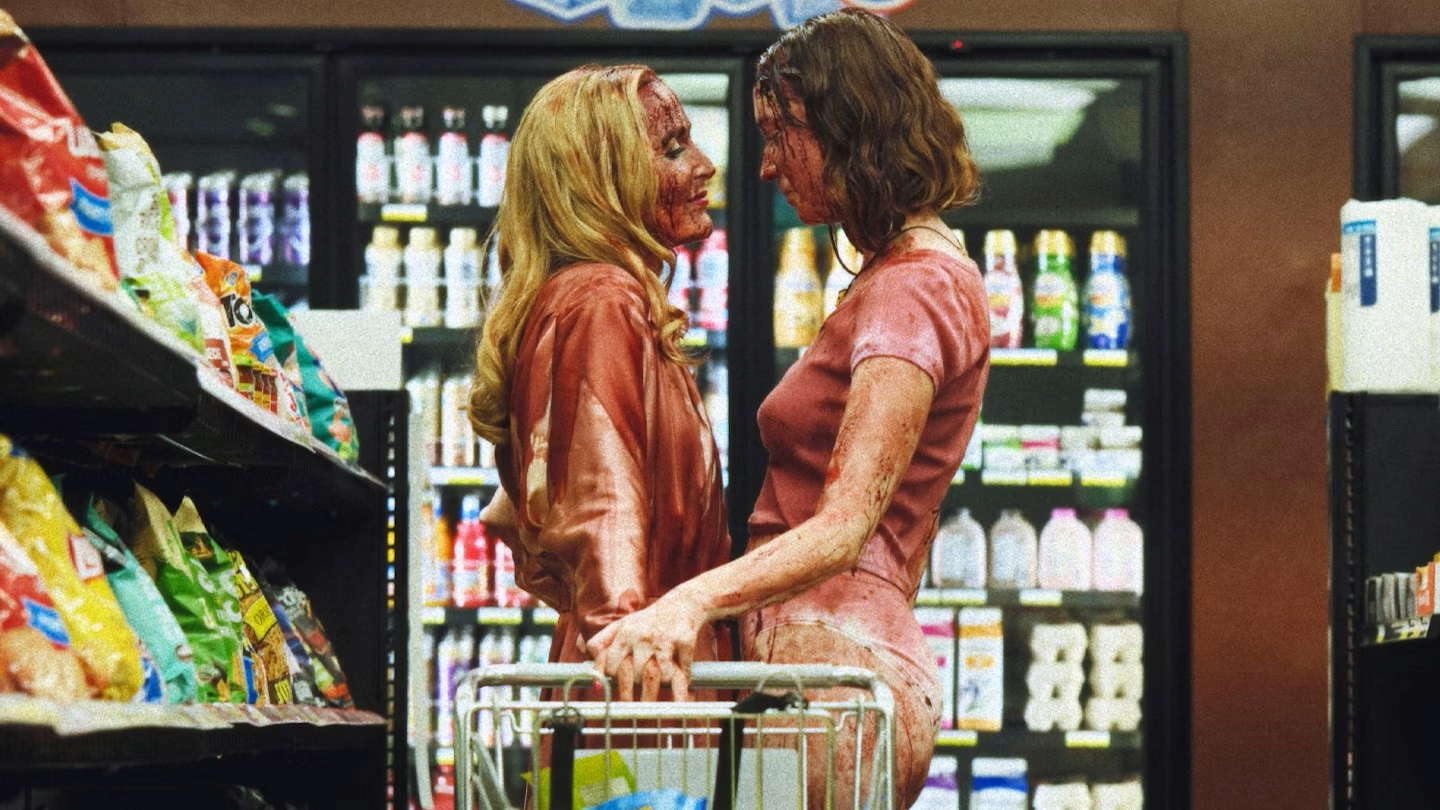
This week, we’re looking at the daring “Teenage Sex and Death at Camp Miasma and a family-friendly fantasy feature (try saying that three times fast.
Read more History San Jose eyes downtown sites such as just-bought city building
Here’s our roundup.
“Teenage Sex and Death at Camp Miasma”: Jane Schoenbrun’s latest film is a clever, blood-soaked homage to slasher films that wields a razor-sharp axe and gives 40 or so whacks to that genre’s long history of being transphobic. But this is by no means a boring and uptight diatribe; it’s an often hilarious, transcendent and visually robust film that takes us on an unpredictable road as Billy, a former final-girl actress (you know, the final victim left in a body-count horror film) and now a recluse (played sensationally by Gillian Anderson) gets presented with a hard sell pitch from queer filmmaker Kris (“Hacks’” Hannah Einbinder, showing her range) about starring in a woke reboot of the “Camp Miasma” franchise that featured a killer known as “Little Death” (a metaphor, course). Uncomfortable in her own skin, Kris becomes spellbound by the Nora Desmond-like Billy who speaks with a Southern drawl that Dolly Parton would admire and lives in the remote Pacific Northwest campground set where the first film was shot. Schoenbrun’s hypnotic, otherworldly style of filmmaking comes out to play and your realize you’re in for a creative, precisely detailed treat from the start as Schoenbrun cycles us through the success and demise of the “Little Death” franchise in the opening credits by showing all the gewgaws and headlines it generated. (The opening credit scene is so good, you just want to replay it over and over). While Billy and Kris become mesmerized again with the film series, Kris taps into her own queer erotic desires and wants, while Little Death at the bottom of the lake re-emerges. Over-the-top carnage ensues but all of it is played for snickers more than scares while a wide-ranging soundtrack selects songs you’d never imagine would go so well with what’s happening onscreen — in particular the Counting Crows “A Long December.” It’s innovative storytelling from a creative force who has the vision and the talent to pull off the unimaginable. Details: 3½ stars out of 4; opens Aug. 15 at the Alamo Drafthouse New Mission and the AMC Kabuki, San Francisco; opens Aug. 21 at the Smith Rafael Film Center in San Rafael.
“Paw Patrol: The Dino Movie”: The insufferably cute animated emergency rescuers — all puppies except for 10-year-old ringleader Ryder — have made preschoolers yip, yap and beg for more for more a decade now. And there is no sign of slowing down, with the beloved Nickelodeon series leading to two movies, including the 2023 hit “Paw Patrol: The Mighty Movie.” The secret? No duh — the stars happen to be adorable puppies, and the stories sound a constant theme, that good things come in small packages, a foolproof rallying cry that fills the hearts of its target audience. Now comes a third movie that promises to answer the critics of the previous efforts, who found them to be a bit bland and boring for adults. This third film is a legit action movie that features not only an insecure, eager-to-please Dalmatian hero named Marshall (Carter Young), and his PAW Patrol cohorts, but a greedy nincompoop Mayor Humdinger who wrecks everything, and — best of all — an island inhabited by a variety of dinosaurs. How cool is that? No kid will be able to resist; even parents will get caught up in the derring-do. Marshall and company stumble upon this island paradise after saving a wealthy family on a burning yacht. That detour plays into the hand of Mayor Humdinger who hatches a dirty rotten plan to mine the isle of its gem resources, a development that imperils all. The animation is more than just impressive, the songs — including a gem from the Backstreet Boys — are terrific and the action sequences are exciting and thrilling to behold. Director and co-screenwriter Cal Brunker keeps the 90-minute movie humming along at a fast clip, and even includes a Tough Mudder-like flashback of Marshall trying to clear a wall during his rescue training. Yup, the kids are going to lap it up. Parents, you will too. Details: 3 stars; opens Aug. 14 in theaters.
Read more Kurtenbach: Oft-injured 49ers machine faces another all-or-nothing season
“Union County”: Quiet performances that shake you to your core rarely receive the recognition they deserve. Case in point, Oscar last year passed on even nominating Joel Edgerton for his sublime work in “Train Dreams.” Hopefully that fate won’t befall Will Poulter, who gives one of the most understated yet shattering performances of the year in Adam Meeks’ caring and sensitive character-driven directorial debut. Poulter plays Cody Parsons, an addict in rural Iowa who’s struggling to steer away from drugs. He and his more gregarious foster brother Jack (Noah Centieno, showing there’s depth in his acting and executive producing range), also an addict, love each other but aren’t always at their best when they’re restless. When we first meet Cody, he is filled with uncertainty and ridden with guilt and shame. His clothes are too big for his lanky frame and he lives out of his car since there are no vacant spaces at overstrained shelters due to the opioid crisis. Cody erects impenetrable emotional walls around him that deny him from asking for help and creating community. He’s banished himself there since he realizes his past actions might never be forgiven, especially by his foster sister. It’s a setup for what you expect to be a deafeningly depressing film, but Meeks and, in turn Poulter, tap into a groundswell of compassion for all of these aching, hurting characters as they take little steps and then big ones to get back on their feet. With this lovely film, Meeks shows an assuredness as he mixes in real people who have participated in the court-mandated program featured in the film along with the people working within it. That raises the stakes and even demands that Poulter fit in with everyone we meet. He does that and more in scene after scene — from stammeringly sharing to a group the crippling guilt he feels from seeing his addiction spread to others and on to opening up ever so slowly with a woman he meets. It’s a tender performance in this sensitive beauty of a film about finding connection and inspiration from a community. It will lift you up. Details: 3½ stars; opens Aug. 14 at the Roxie, San Francisco.
“The Samurai and the Prisoner”: Throughout his illustrious career, 71-year-old filmmaker Kiyoshi Kurosawa has defied being bound and chained to any specific genre. He’s established himself as an influential horror director (“Pulse,” “Cure” and more) and gave audiences cerebral neo-noir-tinged thrillers and human dramas. Each one offers something more than what’s normally served. That holds true with his latest – a samurai epic that’s a sterling adaptation of the 2021 novel by Honobu Yonezawa. Set in 16th century Osaka and mostly within the fortress-like walls of Arioka Castle, it starts as a strategic square off between Lord Akaraki Murashige (Masahiro Motoki) – the samurai of the title – and Kodera Kanbei (Masaki Suda) – who gets tossed into prison by Murashige after he brings unwelcome news about warlord Oda making bold moves into his direction. Within the castle, hidden adversaries lurk and sometimes murderously strike out. To sleuth out who the culprits are, Murashige lends on the extra-sharp deductive skills of Kanbei, who implored for death rather than imprisonment. Kurosawa structures the film as a series of locked-room mysteries – or vignettes – as a brittle Holmes-Watson-like partnership forms. Kurosawa de-emphasizes battle sequences to concentrate more on substantial conversations about honor, compassion, redemption and strategy, infusing it with a more heady and philosophical bent than the norm, a welcome quality that extends to a gratifying, if open-for-interpretation conclusion. Details: 3½ stars; opens Aug. 14 at the Roxie, San Francisco.
Read more Woman dies in Fremont fire
About the Author