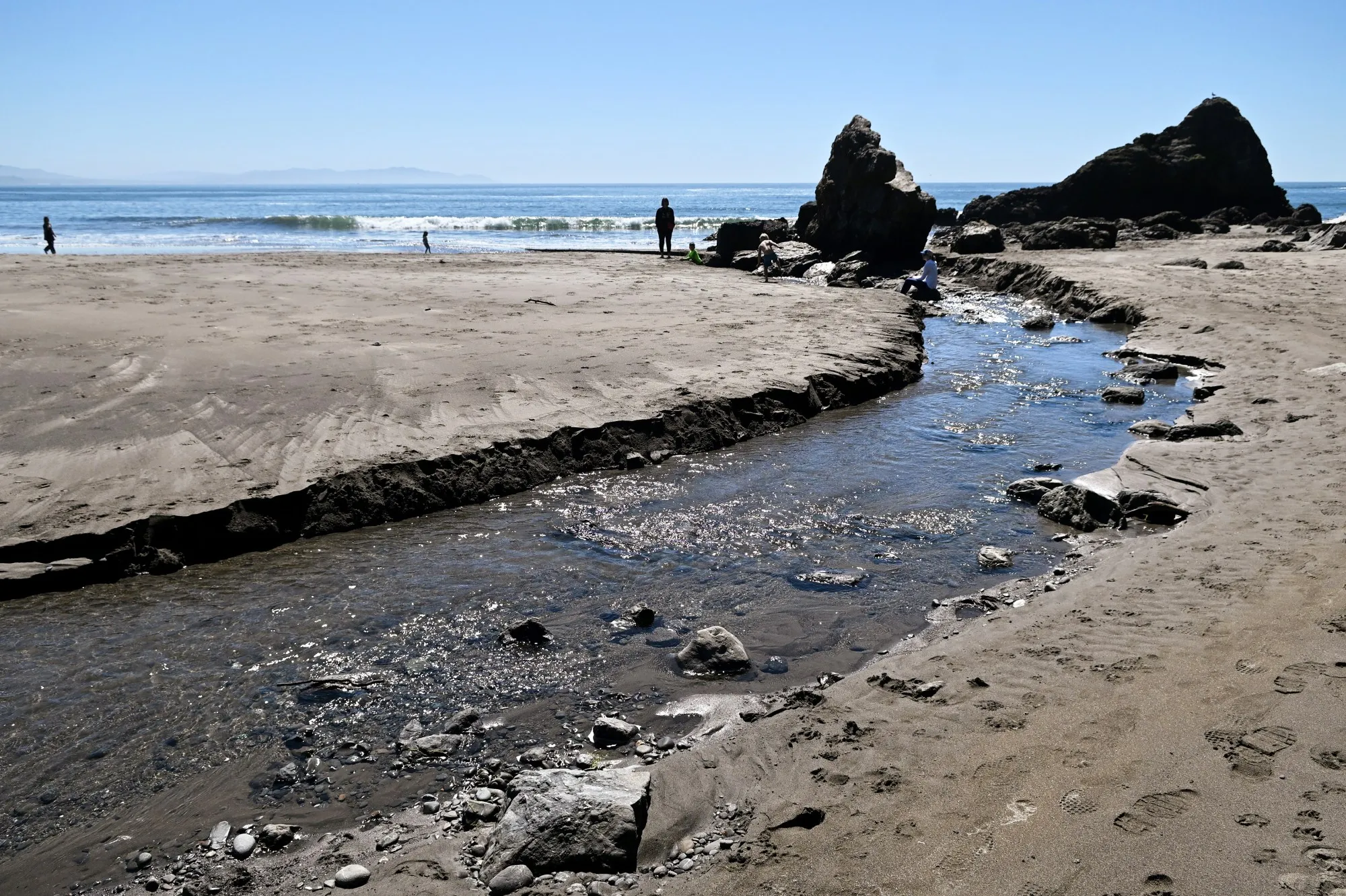
A majority of Marin beaches received top marks for water quality in an annual assessment, but a few freshwater sites have brought down the county’s average.
Read more San Francisco marine patrol finds body floating near Golden Gate Bridge
The “report card” by the nonprofit organization Heal the Bay gave an F grade to two sites along Lagunitas Creek: the Inkwells near Lagunitas and a spot near Whitehouse Pool outside Inverness. Also, a site near the Green Bridge just south of Point Reyes Station scored a D during dry summer weather.
The organization grades California beaches and some freshwater recreational sites based on fecal bacteria levels in the water. Marin only collects data for the report from April through October.
Overall, 78% of Marin sites received an A grade for dry summer weather, a drastic drop from the five-year average of 97%.
“That drop is notable because it happened during a drier-than-normal year, when we’d normally expect water quality to improve, not decline,” said Arti Kundu, project manager for the county’s Environmental Health Services Division.
Kundu said Marin received about 21 inches of rain between April 2025 and March of this year, about 8% below the 10-year average. Drier years almost always mean better water quality, because most of the bacteria measured gets flushed into creeks and the bay by rain washing over streets, storm drains and land.
“When summer dry-weather scores drop anyway, that’s a signal the elevated bacteria isn’t primarily a storm-driven, one-time event,” Kundu said. “It points toward a more persistent source: groundwater seepage, aging septic or sewer infrastructure, or wildlife inputs that doesn’t depend on rainfall to reach the water.”
Aside from the creek sites, McNears Beach in San Rafael, which received a C, was the only Marin site to not earn an A for the summer dry period.
Lower quality water in creek sites during dry periods is not uncommon, said Rebecca Schwartz Lesberg, executive director of the Marin Conservation League.
“I’m not surprised,” Schwartz Lesberg said. “In drier weather, creeks see lower flows. In a high wildlife usage area you can get a very natural accumulation of wildlife waste.”
While the grades are based on concentrations of fecal bacteria contamination such as E. coli, the analysis doesn’t go as deep to name the source.
“Additional monitoring would help us learn more,” Kundu said. “The value of collecting years of data give us the ability to track trends and see the outliers.”
Kundu said over the past year, 23 of the 31 sites the county monitors had at least one water quality advisory warning.
The most recent samplings took place the week of July 13. Chicken Ranch Ditch at Channel B, Inkwells, Green Bridge, Whitehouse Pool and Dillon Beach Ditch had advisories in effect as a result of contamination, Kundu said.
The county publishes weekly reports at bit.ly/4fmy6LK.
Despite the lower summer dry weather average, Kundu said this year’s report is an improvement.
In the report released last year, Chicken Ranch Beach at Channel B, on the west side of Tomales Bay near Inverness, received an F grade because of consistently high bacteria levels during summer and wet weather. The score earned the site a spot on the “beach bummer” list, ranking fourth among the 10 beaches with the worst water quality in the state.
Read more Wisconsin’s capital city cancels signature events, grapples with fallout from police shooting
No Marin sites were on that list this time.
“So while our share of A/B grades dropped countywide, our worst individual sites didn’t rank among the worst in the state this year,” Kundu said.
Wet weather grades for the county were just above the historical average of 84%, with 90% receiving A or B grades, likely a result of lower rainfall, the report says. The county does not monitor beaches in winter months.
There is some variance in the number of sites that qualify for the Heal the Bay report, said Naomi Meurice, water quality data specialist for the nonprofit and one of the lead authors of the report.
Meurice said a site must be monitored at least 75% of the weeks in the reporting period to qualify for a dry summer grade. A location has to have at least one wet weather sample during the reporting period. Of 27 sites reported to the state, only 18 Marin sites met the threshold for dry summer grades and 20 sites qualified for a wet weather grade.
In last year’s report, 28 sites met the threshold for dry summer grades and 30 for wet grades.
“Marin County typically has pretty good water quality, mostly A’s and B’s, and that’s great to see, especially during the summer dry period,” Meurice said.
The Environmental Action Committee of West Marin partners with the county and the Point Reyes National Seashore to collect water quality data at Drakes Beach and Drakes Estero. Neither site was included in this year’s report, but they are included in the county’s weekly monitoring site.
“This data lets visitors know when it’s safe to recreate in the water, promoting public health and informing the need for action when water quality exceedances occur,” said Ashley Eagle-Gibbs, executive director of the Environmental Action Committee of West Marin. “We also amplify local results by timely sharing water quality exceedances in West Marin on our social media platforms.”
Regarding the Heal the Bay report, Eagle-Gibbs said “the recent lower grade is concerning, as are the sewage spills that occurred during this period.”
The report says the county recorded 10 sewage spills releasing 55,000 gallons of raw sewage, including one spill in early 2026 that released 42,000 gallons.
“The collection system in the area was overwhelmed due to a combination of historic King tides, an atmospheric river, and lagoon storm water entering the neighborhood,” the report said.
“The spills were promptly reported, and appropriate measures were taken to mitigate any potential impact on the environment and public health,” county health officials said in a statement.
Schwartz Lesberg said she is heartened to see that sewage spills across the state have dropped dramatically to only about 2 million gallons, down from a combined 50 million gallons from the prior two years.
However, Marin’s number of spills underscores the fact that its “stormwater and wastewater infrastructure has to be a priority for our region,” Schwartz Lesberg said.
“MCL agrees with Heal the Bay’s assessment that aging infrastructure, aging stormwater and wastewater systems, are a problem and it’s a threat to health that leads to water quality issues,” she said. “The fact that Heal the Bay does this is such a service to the state of California and beachgoers. It’s an amazing resource, you can go back many years to see how beaches are doing.”
Read more 49ers’ GM Lynch addresses Bosa, Warner, Kittle, Aiyuk to start training camp
About the Author