SACRAMENTO — A state bill authored by an East Bay senator targeting Alameda County’s publicly funded nonprofit spending is picking up momentum as it heads to the Assembly for a vote in August. Local officials, however, continue to push back against it.
Read more Autopia: Ford applies Tremor package to best-selling Explorer
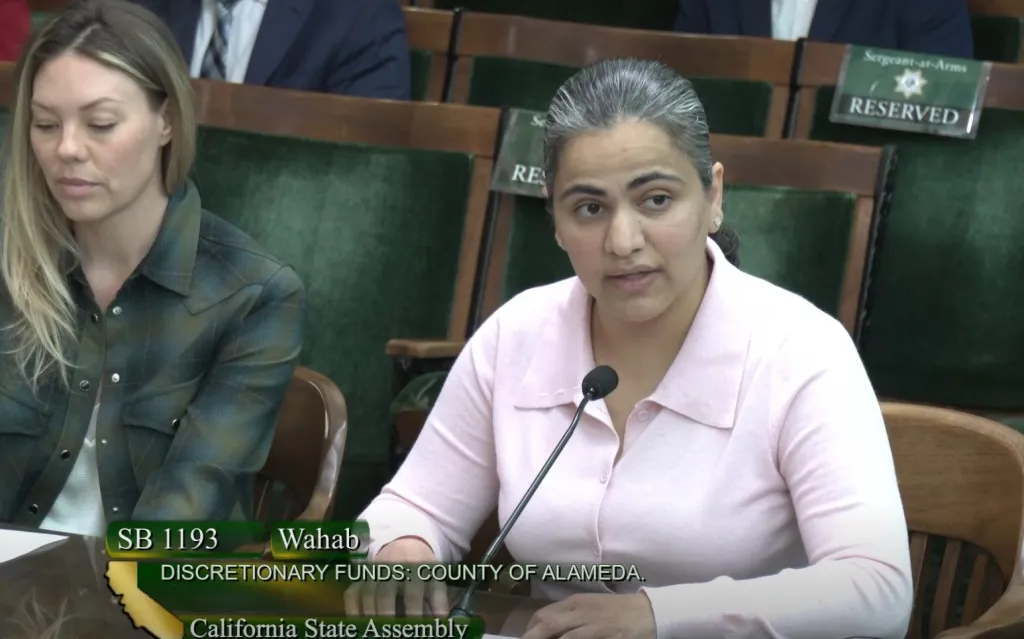
State Sen. Aisha Wahab’s Senate Bill 1193, which aims to rein in the county’s discretionary spending on nonprofit organizations, passed another hurdle Wednesday with the Assembly’s Committee on Local Government voting unanimously to move the bill for further consideration.
Should it become law, Alameda County Board of Supervisors President David Haubert has vowed to sue the state over it.
“These are not radical reforms. These are the bare minimum standards the public deserves. SB 1193 does not eliminate nonprofit funding,” Wahab said. “It protects legitimate nonprofits by ensuring that funding is visible, fair, and tied to a public purpose.”
At the committee hearing, Wahab said the bill is meant to increase transparency over the county’s discretionary funds by bolstering public oversight of the county’s money and adding new checks on how taxpayer funds get spent.
On the county board, Haubert and Supervisors Nate Miley and Elisa Marquez have publicly criticized the bill. The county recently came under public scrutiny after a recent San Francisco Chronicle report revealed that the board gave roughly $51 million in the last seven years to organizations such as the Livermore Valley Winegrowers, the Association of Realtors, and other groups.
Wahab said these awards to nonprofits should be more closely watched by the public, detailing in her bill her desire for the county to more extensively disclose what the funds would be used for, who receives them, and the public purpose the awards would serve.
“It prevents discretionary awards being rushed through special meetings or buried on consent calendars. And it documents the whistleblower process so the public and county employees know where concerns can be raised,” Wahab said.
Amy Costa, an independent consultant hired by the county, spoke in opposition of the bill at Wednesday’s hearing. She said the county has “one of the most transparent budget processes in the state.”
“Unfortunately, the definition of discretionary funds in SB 1193 is overly broad and unduly restrictive during a time when counties are struggling to maintain our safety net,” Costa said.
Wahab previously criticized the county over its improper handling of foster youth abuse investigations that led to a September 2025 state auditor report that laid out several failures by the Department of Children and Family Services.
Wahab alleges that some supervisors have repeatedly doled out significant donations to nonprofits they are politically cozy with while neglecting to give money to organizations serving the county’s most vulnerable residents, such as the homeless and foster youth.
“SB 1193 is how we prevent waste, fraud, abuse, favoritism, and conflicts of interest before they become scandals,” Wahab said. “Public money is not a favor. It is not a political prize. It is not a private account for public officials to use without meaningful oversight.”
Haubert told this news organization Wednesday that several supervisors have publicly opposed the bill because it singles out Alameda County and would not apply to any other counties throughout the rest of the state.
“It is opposed because it is an overreach by the state legislature. It violates and contradicts the state of California Constitution. I don’t believe the governor will actually sign it,” Haubert said. “Not only that, it harms nonprofit organizations.”
Read more England hands Mexico its first World Cup loss at Estadio Azteca, winning 3-2 to reach quarterfinals
Haubert also defended his continued and extensive financial support of the nonprofits he’s allocated funds to through the years, including the wine growers association.
He said the donations were important to him and “everyone in Alameda county that appreciates a robust wine region.”
“When I give money to the wine growers association, it’s to support their charities. .. The wine growers association gave money to foster youth. My money went to foster youth through the wine growers association,” Haubert said. “They’re the largest economic engine in unincorporated counties. That’s where half the money went. … They’re struggling right now”
Haubert also criticized a clause in Wahab’s bill that would bar the county from awarding any discretionary funds to nonprofits within 90 days of an election.
At the committee hearing Wednesday, Wahab was joined by a Livermore whistleblower, Kiersten Skov, who recently accused Haubert’s chief of staff, Shawn Wilson, of trying to bribe her by using nonprofit discretionary funds to help solve an issue over trash collection services.
Skov said that Wilson offered her a $1,500 donation to a nonprofit of her choice in order to repay her for over $1,000 of trash services she paid for that she was not legally required to have between 2024 and this year.
Skov, a resident of unincorporated Alameda County who lives along the rural Mines Road in Livermore, said she was one of many residents pressured by Haubert’s office to sign up for trash services with Livermore Sanitation Inc. after his office supposedly sent out a mistaken message to constituents of his district.
Haubert’s district covers unincorporated areas of the county.
“My recent experience with our District 1 chief of staff, Shawn Wilson, convinced me that this bill is not simply good policy, it’s necessary,” Skov said. “What began as my attempt to correct an issue where residents were pressured by D1 staff over threat of enforcement to pay for trash services never legally required became months of wasted time, inconsistent responses, unethical and possibly illegal behavior.”
The county recently offered Skov a settlement payment of $1,500 in exchange for Skov releasing the county of any liability in the matter.
While it is still unclear how many residents signed up for trash services, Haubert has maintained that Skov is the only resident that’s complained to his office about paying for the services.
He also said his office recently sent out a corrective email to his affected constituents.
Skov remains unhappy with the county’s offers, and has called for Haubert’s office to place Wilson on administrative leave and for the county to further investigate Haubert and his staff.
“Anyone would characterize this as a bribe, and I have escalated extensive documentation of my claims to both the district attorney and another law enforcement agency,” Skov said. “The matter remains unresolved, save for a grossly insufficient corrective email and a settlement offer from county counsel that does nothing to address the entire community.”
Read more Horoscopes July 6, 2026: Kevin Hart, explore what excites you
About the Author