APTOS — When the California Supreme Court declined last year to overturn a lower court’s decision affirming Santa Cruz County’s right to designate a 37-foot stretch of paved coastal property in Aptos for public use, county spokesperson Jason Hoppin declared: “The case is over.”
Read more Trump accuses ‘vandals’ of wrecking $16 million reflecting pool paint job
While the county believed it had prevailed when it came to the legal questions underpinning the case, the yearslong saga, evidently, had a few more chapters.
RELATED: Coastal Commission slams a group of Santa Cruz County homeowners with $4.7 million in penalties
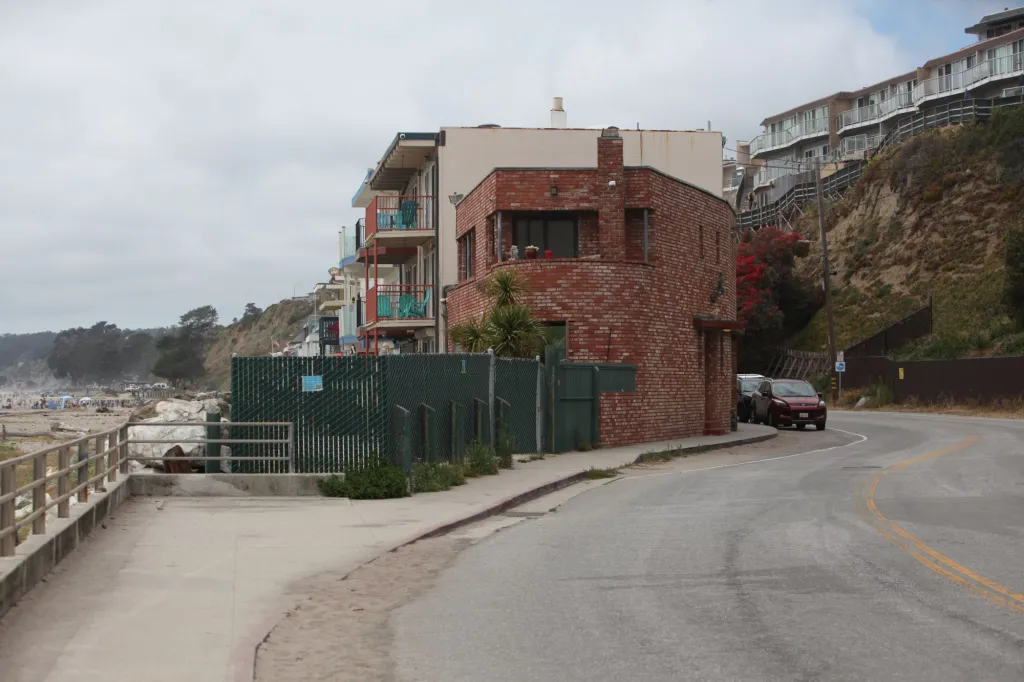
Green chain-link fencing continues to block bicyclists and pedestrians from accessing a pathway along Beach Drive in Rio Del Mar that ducks away from vehicle traffic on the street and, instead, navigates behind a row of beachfront homes to a more scenic and capacious paved area overlooking the ocean. For almost a decade, the county and the 27 owners of the coastal properties, known as the Rio Del Mar Beach Island Homeowners Association, have been locked in a legal battle about whether the land behind the homes can be claimed for public use or as private patios.
After years of arguing over planning documents and historical photos, court decisions and subsequent appeals, the state Supreme Court’s decision to not take up the case after an appellate court’s ruling came out in favor of the county appeared to close the book on the issue.
“Anyone who cares about public access and public right of way and accessibility is frustrated at the fact that, despite the California Supreme Court coming down squarely on the side of access, the fences are still up,” said Mariah Roberts, executive director of County Park Friends. “Our organization, folks who are affiliated with our organization and neighbors are rightly frustrated at the timeline.”
County Park Friends is a local nonprofit that often partners with Santa Cruz County to promote access to outdoor public spaces and signed an amicus brief in support of the county ahead of the state Supreme Court’s consideration of the topic.
So why, six months after the high court’s decision, has the fencing remained?
In March, the homeowners asked Santa Cruz County Superior Court Judge Syda Cogliati for a preliminary injunction to prevent the county from taking further action to open the walkway, citing a number of safety concerns that they fear will reemerge once the fencing comes down and gesturing at some outstanding legal questions.
The last time the county tore down the partition in 2018, several homeowners said they were subjected to a variety of safety issues. This latest Beach Island group’s injunction request, filed March 16, detailed a slew of incidents that unfolded after the fences came down eight years ago, including near misses with speeding bicycles, scooters and electric bicycles; individuals lurking in windows and on personal property; unleashed dogs; and portable fire pits burning in alarmingly close proximity to the homes.
Then Santa Cruz County Superior Court Judge Timothy Volkmann ultimately sided with the homeowners and allowed them to erect temporary fencing and then a more permanent installation in 2022 and 2024, respectively.
Now, Cogliati has concluded that concern from the homeowners about the issues resurfacing when the fences disappear again was valid and required a pause in action, which, in turn, gives the parties time to negotiate a possible settlement.
“Here, the court finds that the balance of the harms favors plaintiffs since there is evidence that public use of the 37-foot walk (‘subject area’) places the safety of plaintiff homeowners at risk,” Cogliati wrote in her April 24 judgement. “The court anticipates and intends this injunction will be short-lived and necessary only so long as the court is determining the remaining issues in this case.”
The judgement maintained the current status quo by preventing the county from removing or altering the fences at 202 Beach Drive and 300 Beach Drive that were previously allowed by prior court decision, or from advising the public that the space was available for use.
“I understand the public’s frustration with not seeing it open, but there’s a court process still underway that we have to follow,” Hoppin told the Sentinel this week. “We hope that by the end of the year this is resolved once and for all, but there’s a lot of parties involved.”
Hoppin said the county and the homeowners have a private settlement conference scheduled for June 30 but added that he was not yet aware of any specific accommodations the homeowners had requested to alleviate their concerns. Even if all the terms of the settlement were agreed to at the upcoming meeting, Hoppin explained that the agreement would likely be subject to approval from the county Board of Supervisors and possibly the California Coastal Commission, which levied more than $4.7 million in fines against the homeowners in 2023 for public access, plant maintenance and revetment violations.
“The case is in the court’s hands,” said Hoppin. “We’re just hoping for a fair and equitable resolution as soon as possible.”
In 2022, Volkmann was persuaded by the homeowners’ contention that while the county may now be fighting for the public’s right to the coastal land, it had neglected the property and even tried to distance itself from it for almost 90 years. Then, in September 2025, California’s Sixth Appellate District Court determined the county did, in fact, have a right to claim the esplanade for public ownership and threw out Volkmann’s judgement on grounds that it was based on an “erroneous ruling” and unsound legal reasoning. That decision was appealed to the California Supreme Court which declined to reopen the case and sent it back to the trial court to resolve outstanding issues.
Nossaman LLP, the law firm representing the homeowners, suggested in a statement to the Sentinel Thursday that there is more to argue over than safety issues.
“The Court of Appeal decision addressed some legal issues and homeowner claims, but not others, and clearly stated the need for further proceedings in the trial court. During the prior 2022 seven-day trial, substantial evidence established that the County issued building permits for structures within the various patio areas over several decades and assessed and collected property taxes for the area that it now seeks to use as a new sidewalk,” said John Erskine, counsel for the homeowners. “The Court of Appeal’s decision did not alter the factual findings of the Superior Court. While the homeowners cannot publicly discuss the upcoming mediation or legal proceedings, they are supportive of a cooperative approach that could lead to community access improvements for some of the neglected infrastructure in the Rio Del Mar area. We look forward to these discussions.”
Roberts, from County Park Friends, said virtually everyone she has talked with about the fence issue believes the California Supreme Court’s decision settled the case and that the homeowners’ continued legal challenges only serve as delay tactics. She insisted the question is not if the fences will come down, but when and how.
Roberts also explained that the homeowners‘ effort to keep the property behind their homes private spoils a uniquely accessible coastal area for the county and region. According to Roberts, the more than 85 parking spaces near the Rio Del Mar roundabout, which are only a few hundred feet from the row of homes in question, are free and open to the public. That’s unusual given the lot’s proximity to Seacliff State Beach, she added.
But as the thin walkway currently being utilized continues eastward down the beach, it is further cramped by parked vehicles and garbage cans. It’s hard enough for able-bodied people to navigate the section, said Roberts, but it can easily become impassable for wheelchair users. The issue is made worse because access to the coast for people who use wheelchairs is already a pressing need, which makes closure of the pathway a doubly painful missed opportunity.
“It’s a very special place and it’s a very unique resource that, when we take it away, we are denying people access to one of the most wonderful resources we all enjoy about living here at Monterey Bay,” said Roberts.
Because Erskine’s statement raised the prospect of continued legal challenges in the aftermath of the Sixth Appellate Court’s decision, the Sentinel shared the comments with the county. Hoppin responded to again urge patience as proceedings continue in the coming weeks.
“I know it can be frustrating to the public that we are still litigating a case that the appellate court has already weighed in on,” he wrote in a statement, “but it’s important that we let the judicial process play out.”
Read more Uber-backed electric bike firm lime seeks $180.9 million in IPO
About the Author