Both the Bay Area and California lost jobs in April, but the South Bay remained a bright spot as the region wrestles with ongoing layoffs in the technology industry.
Read more Letters: Unused spaces offer an answer for homelessness
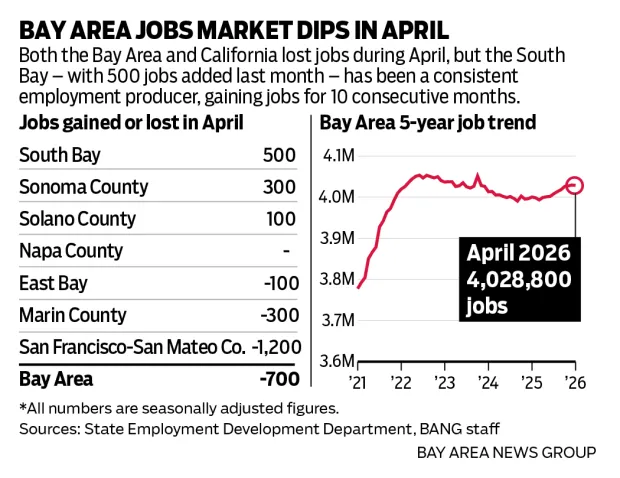
Adjusted for seasonal volatility, the Bay Area shed 700 jobs last month, according to the latest figures from the state Employment Development Department.
RELATED: Intuit and subsidiary Credit Karma to cut more than 600 Bay Area jobs
Scott Anderson, chief U.S. economist for BMO Capital Markets, said the region is likely to see similar turmoil for the foreseeable future.
“Rising inflation and economic uncertainty are expected to keep Bay Area job growth on a choppy path this year,” said Anderson.
The regional hiring setbacks were most severe in the San Francisco-San Mateo area, which lost 1,200 jobs. The East Bay lost 100 jobs.
But the South Bay added 500 jobs in April, the EDD report shows, its 10th consecutive month of gains.
“South Bay resilience stood out last month as strong capital expenditure and AI investment spending kept the region’s labor market afloat, while many other parts of the Bay Area suffered modest job losses,” Anderson said.
Over a longer-term period, the South Bay job market is outperforming the Bay Area, the region’s major metro areas, California and the U.S., according to a review of statistics posted by federal and state labor agencies.
During the one-year period that ended in April, employment totals grew by 1.2% in the South Bay, compared to increases of 0.7% in the Bay Area and the San Francisco-San Mateo region, 0.6% in California, and 0.2% in the East Bay and U.S. over the same 12 months.
In the North Bay, Sonoma County added 300 jobs in April and Solano County gained 100. Napa County’s job totals remained unchanged, while Marin County lost 300, according to the EDD report.
“The take-away here is that we’re basically sitting on a plateau,” said Russell Hancock, president of Joint Venture Silicon Valley, a San Jose-based think tank. “We’ve been on that plateau since the pandemic, which is starting to feel like a long time ago.”
California lost 3,300 jobs in April, continuing an uneven year for the state after it gained jobs in January, lost some in February, and then bounced back with gains in March.
“Statewide job performance was anemic,” said Michael Bernick, an employment attorney with law firm Duane Morris and a former director of the EDD. “Outside of health care, which has been the main driver of job gains throughout the post-pandemic period, the other sectors continued to show minimal job gains at best, and mainly job losses.”
Even with some monthly losses, California has produced a net gain of 97,200 jobs in 2026.
RELATED: Meta slashes 8,000 jobs, or 10% of its workforce
The statewide unemployment rate for April was unchanged at 5.3%, tied with Nevada and Delaware for the highest unemployment rates in the country, according to the U.S. Bureau of Labor Statistics.
In a hopeful sign for the Bay Area, officials issued a revision for March.
The EDD had originally calculated a loss of 3,500 jobs. The latest estimate, however, shows there was a gain of 1,900.
Read more Recruiting roundup: The top offensive targets for Pac-12 legacy schools
The tech industry remains an area of concern, as companies continue to disclose plans for layoffs.
So far, though, major industry layoff announcements have not yet led to a measurable increase in California or the Bay Area’s unemployment rate, suggesting the overall labor market is stable, Anderson said.
According to seasonally adjusted estimates from Beacon Economics that the company derived from the official EDD report, the Bay Area lost 1,400 tech jobs in April, primarily due to a decline of 900 tech jobs in the San Francisco-San Mateo metro area.
Beacon estimated that tech job losses totaled 300 in the East Bay, 100 in the South Bay and another 100 in Solano County.
The artificial intelligence push has prevented the industry from producing consistent job growth, some experts believe.
“We continue to see any gains in AI-related employment being neutralized by layoffs within tech firms,” said Jeff Bellisario, executive director of the Bay Area Council Economic Institute.
Some analysts warn that AI disruptions have barely begun to affect the Bay Area economy.
“The long-feared AI-related layoffs have started happening,” Hancock said. “So far they’re being offset by growth in other key sectors. It doesn’t help that our high housing costs make it more appealing for tech companies to expand outside the region.”
Beacon estimates show Bay Area hotels and restaurants appeared to refrain from hiring during April, even after two major sporting events took place in February and March in the region.
The sector cut 900 jobs in April, led by a loss of 400 in the South Bay and another 300 in the San Francisco-San Mateo region, Beacon Economics reported.
The South Bay’s strongest industry in April was the administrative support sector, which added 700 jobs, Beacon calculated. That figure includes positions such as routine office functions, clerical work, building maintenance, and janitorial services.
The fallout from the Iran conflict is poised to overshadow the economy for months to come, some analysts warn, further affecting industries particularly sensitive to shocks from the cost of oil and gasoline.
“Concern is likely now spreading to smaller, consumer-facing businesses, which have more competition for consumer wallet share from rising energy prices,” Bellisario said.
The outlook for the Bay Area is uncertain at best, he said.
“The California and Bay Area economies have entered a bit of a holding pattern,” Bellisario said. “With no relief on oil prices or interest rates in sight this year, we would project the remainder of 2026 to produce very slow or no job growth going forward.”
Read more Matt Ortega, California congressional candidate, answers Bay Area News Group’s primary questionnaire
About the Author