A new network of artificial intelligence-powered thermal cameras is watching Bay Area waters for gray whales who have started using the San Francisco Bay as feeding grounds, aiming to warn ship captains and avert deadly collisions in one of the region’s busiest waterways.
Read more Arellano: How a fast food taco showed us who Steve Hilton really is
The new network, launched this week with the installation of two thermal cameras, can locate whales around the clock and in poor visibility, including fog and darkness, then alert boat captains with enough time for them to change course and avoid ships strikes — one contributor to high numbers of whale deaths in the bay in recent years.
“We’re in San Francisco Bay, a place known for technology, science and maritime innovation, and this project brings all of those communities together around a shared goal: reducing the risk of a vessel strike while maintaining navigational safety,” said Kathi George, director of Cetacean Conservation Biology at the Marine Mammal Center. “That’s incredibly powerful, and it has the potential to serve as a model for ports and waterways around the world.”
Scientists began seeing gray whales swim into San Francisco Bay around 2018, George said. In 2025, they documented 36 gray whales in the bay, with each spending an average of about three weeks there. This year, they have documented 16.
But foraging for food in the Bay comes with its own dangers: the waterway is one of the busiest in the country, putting the mammals at high risk of colliding with ships, McCauley added.
In 2025, 21 gray whales were found dead in and around the San Francisco Bay, with 40% of the whale carcasses showing evidence of injuries from boat strikes, Rhodes said.
Gray whales usually “forage, feed and pack on the pounds in the Arctic” before embarking on “one of the largest mammal migrations on the planet” down to Mexico, where their breeding grounds are located, said Douglas McCauley, director of the Benioff Ocean Science Laboratory. But in recent years, climate-driven changes in the Arctic have reduced food availability, forcing some gray whales to stop for food along their migration route before continuing north. The species currently has its lowest population numbers in 55 years, with only between 12,000 and 13,000 whales — about half of what it was 10 years ago.
“When they used to depart on that migration, they would be leaving with, you might say, a full tank of gas or a three-quarter tank full of gas, and they can make it all the way down on this remarkable migration, they can make it all the way back up with their energy reserves,” McCauley said. “With these recent changes to the Arctic, best consensus in the scientific community … is that they’re effectively running out of fuel now, because they’re leaving now instead of with a full tank, something more like a half tank of gas. Less food, less energy reserves, less blubber.”
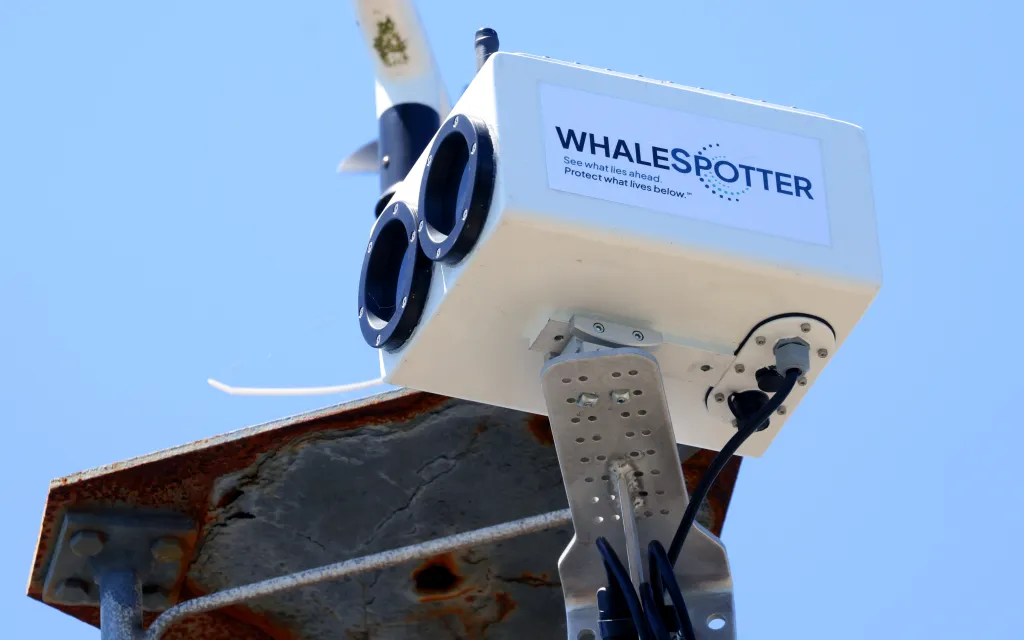
The program, developed by the Benioff Ocean Science Laboratory in collaboration with the Marine Mammal Center and U.S. Coast Guard’s Vessel Traffic Service, uses thermal WhaleSpotter cameras to detect the heat signature of whale blows as they surface in the bay, scientists said.
Those sightings are then confirmed by marine mammal specialists and mapped on the Whale Safe website. That information is then shared with boaters through the website or by the Coast Guard, which can share the information with boat captains in radio calls they already make to point out hazards in the bay, said Rachel Rhodes, the scientist leading the project at Benioff Ocean Science Laboratory.
“If captains and crews know where whales have recently been spotted along their route, they can be on high alert, slowing down or rerouting when possible, which really helps reduce the risk of ship strike,” Rhodes said.
Read more Walters: Gavin Newsom’s last budget still would leave California’s finances wobbly
The first two cameras were installed on Angel Island and on the MV Lyra, a passenger ferry running between downtown San Francisco and Vallejo, Rhodes said. Both installations target areas that see a high number of whale sightings and a lot of ship traffic.
The whale spotting technology has been under development for more than a decade and focuses on detecting the difference in temperature between the body of water and the whale’s spout, said Daniel Zitterbart, co-founder and chief scientist at WhaleSpotter. The AI has been trained on hundreds of thousands of examples and can “very reliably” detect the whales. The device has two thermal cameras, a computer and a cell modem built into it. It also has a color camera that can take photos of whales to be used for species identification.
“We want to have this technology on boats or on land, to be able to detect whales far enough ahead of a vessel, or early enough, to give mariners enough warnings so that they can take action,” Zitterbart said.
Unlike human observers, the cameras can detect whales around the clock and in poor visibility, including fog, George said.
“It gives us eyes on the water 24 hours a day,” George said. “Whales don’t disappear at night or in the fog. This camera helps close that gap. It allows us to detect whales where we previously couldn’t, and that could change how we protect whales in complex urban waterways like San Francisco Bay.”
In the first two hours after its installation, the Angel Island camera reported 180 whale detections, Zitterbart said.
Last month, U.S. Rep. Sam Liccardo introduced a bill, dubbed the “Save Willy Act,” that would implement a “whale desk” at the U.S. Coast Guard’s San Francisco station. The desk would track the movements of whales through the bay and warn marine vessel operators of their locations to avoid collisions.
Scientists hope to install additional cameras throughout the bay in the future, in locations such as the Golden Gate Bridge, on Alcatraz or on other ferries, Rhodes said. Eventually, they hope to install enough infrastructure to be able to track individual gray whales, McCauley added.
“Then we can actually … (interpolate) across our different sensor networks to effectively track a whale as it moves back and forth across the bay, as it stops to feed, as it rests, as it travels, so we could see whales as they move across this busy working space the same way you can track a bus as you’re waiting at the bus station with its approach, the arrival of your Amazon delivery truck, your Waymo,” he said. “If we could do it for Amazon delivery trucks, we ought to be able to do it for, arguably, a more important use case.”
Read more Horoscopes May 22, 2026: Naomi Campbell, you’ll surpass your expectations
About the Author