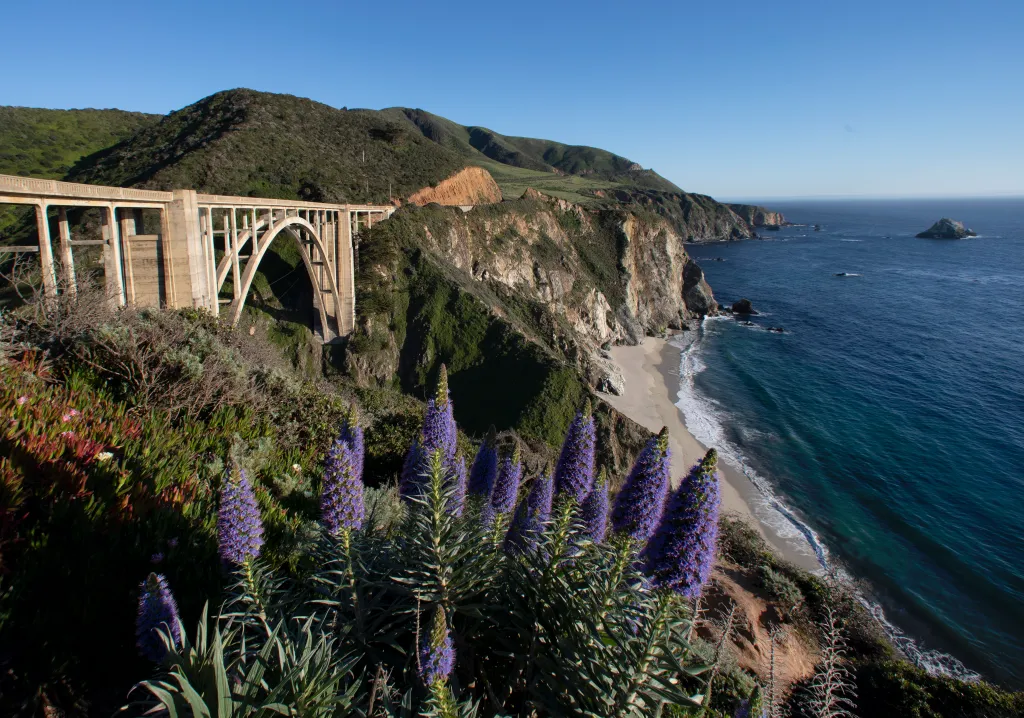
For nearly 100 years, generations of visitors to Big Sur have driven along the scenic curves and cliffs of Highway 1, stopping to take a vacation photo of Bixby Bridge.
Read more Magid: My phone & AI became part of my hospital care team
But now, pulling off to the side of the road next to the elegant concrete arch bridge, built in 1932, framed by picturesque hills and crashing ocean waves, and featured in countless commercials, movies and TV shows, might soon become illegal.
Saying that one of California’s most-photographed landmarks is becoming a dangerous mess of traffic jams and bad behavior, Monterey County Supervisors voted Tuesday to move forward with an emergency 1-year moratorium on all parking next to the bridge.
“I want to take this opportunity to re-train folks that Bixby Bridge is a trip, not a destination,” said Kate Daniels, the county supervisor whose district includes Carmel and Big Sur.
“Summer is right around the corner,” she said after introducing the measure. “We got a good flavor for what it’s going to be like over spring break. It was unlike anything we’ve ever seen.”
Every year, roughly 4 million people from around the world visit Big Sur, the bulk of them during summer months. Social media, the reopening of Highway 1 after repairs to major landslides, and the bridge being featured in the opening of HBO’s hit series “Big Little Lies” have all contributed to too much visitation at the bridge, Daniels said.
Some local residents agreed.
“Pedestrians often fail to move out of the roadway and seem oblivious to road traffic,” said Laura Shulkin, a Big Sur resident and member of the Mid Coast Fire Brigade. “They are even slow to move when we are on call with sirens and lights activated. We anticipate this is only going to get worse this summer.”
Others were skeptical.
“The so-called emergency at Bixby Bridge is a manufactured crisis pushed by a small clique of entitled Big Sur residents who believe the scenic highway exists for their personal convenience and uninterrupted passage,” said Steve Knovick of Carmel. “This is not about safety. It is the opening move in a deliberate campaign to restrict public access to Big Sur and turn it into a private preserve for a favored few.”
Knovick predicted if access to Bixby Bridge was blocked, county officials and local residents would try to do the same thing at other Highway 1 turnouts, including near Garrapata State Park and farther north at Point Lobos.
“Visitors should not be treated as intruders for wanting to stop safely for a few moments to take in the view,” he said.
Daniels said originally that she hoped to have no parking signs up by Memorial Day weekend.
But county staff members said such a quick turnaround isn’t possible. Caltrans must first issue the county a permit. It owns Highway 1, Bixby Bridge and the shoulders along both sides of the famed road where thousands of people pull off to the side every day.
County staff members also said they must draw up a specific ordinance that can pass muster with the California Coastal Commission and be approved at a later meeting by the supervisors before it can be enforced. All of that could take until July, Randy Ishii, Monterey County’s director of public works estimated. Who will enforce it also remained unanswered.
Read more Buster Posey defends SF Giants’ plans for Eldridge, bullpen in tense KNBR interview
Some supervisors raised questions about whether a parking ban will cause even more problems.
“I’m struggling with this idea of ‘let’s block it off, let’s just tell people no.’” said supervisor Chris Lopez, who also is a member of the coastal commission board. “What you are going to end up with is even worse behavior. I think people are just going to block the road completely. They have traveled halfway around the world to see this place. They aren’t going to just say ‘It says closed. I’m done.’ They are going to get as close as they can to the shoulder, throw it in park, get out and create even more issues.”
Another supervisor, Luis Alejo, of Salinas, said he was concerned about limiting access.
“It’s an important value that we make sure our coast is as accessible to as many people as possible in as many ways as possible,” Alejo said. “One of my favorite photos is where me and all of my siblings were able to take a photo in that very location. We know that people come from all over and everyone wants to take a photo there. It’s one of the most beautiful areas of our county and one of the most beautiful places in California.”
In March when Daniels first began raising the issue, the California Coastal Commission sent Monterey County a letter saying its preference was not to allow a parking ban.
The road shoulder could be widened in some locations, with more formalized diagonal parking established on the ocean side of the road to improve safety, wrote Breylen Ammen, a planner with the Coastal Commission’s Santa Cruz office. Paved parking on the Coast Road, a dirt road that turns inland at the north end of the bridge, also could work, as could a pedestrian undercrossing under the road, he wrote.
“We are concerned that the closure of all parking near the bridge – even for a temporary period – would be too blunt of a response and would result in significant adverse impacts to public coastal access,” Ammen wrote.
Seeking to avoid a battle with the commission, the supervisors voted 3-0, with Alejo and Lopez abstaining, to tell the county staff to draw up an emergency coastal development permit to move ahead with the ban.
Typically, such emergency permits are used in storms when large sections of the coast or beaches erode away and houses are at risk of falling in the ocean. They do not require approval from the coastal commission.
On Thursday, coastal commission officials said they are not likely to begin enforcement proceedings against the county if it passes a temporary 1-year parking moratorium that includes a deadline, and then works on a permanent plan that will require commission approval.
“The coastal commission understands why the county has chosen to limit access to Bixby Bridge,” said Joshua Emerson Smith, a spokesman for the coastal commission. “We hope they will continue to explore creative alternatives that allow folks to responsibly enjoy this iconic location.”
Some residents said they aren’t sure what the ultimate solution is.
“It’s become a big thing because of social media,” said Holly Fassett, whose family has owned the Nepenthe restaurant in Big Sur since her parents bought the land from Orson Welles and Rita Hayworth in 1947. “Before, people would stop to take pictures. But it was never like now. It’s so crazy. It’s really bad and out of control. But I don’t know what they can do. It’s like herding cats. How are you going to do you stop it?”
Read more South Bay tech company buys foreclosed San Jose office building
About the Author