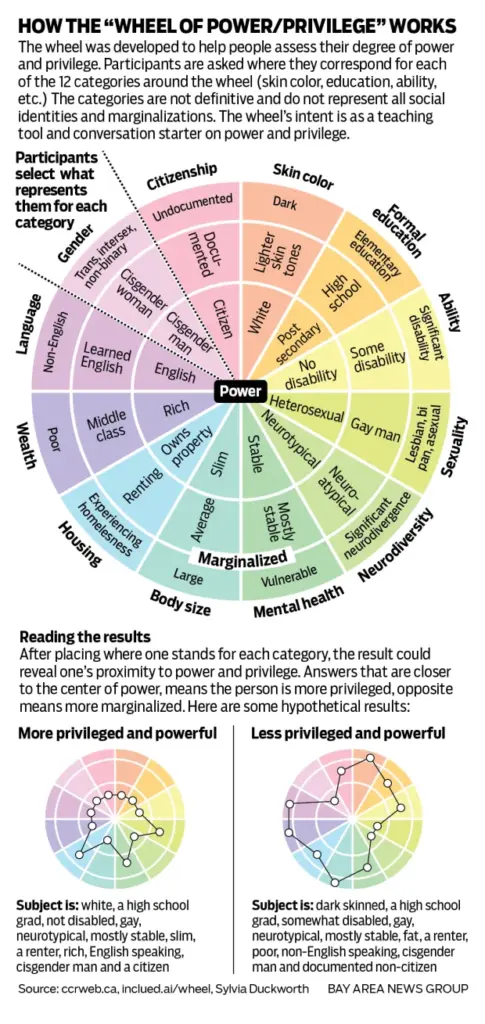
The U.S. Department of Education announced investigations into Palo Alto, San Francisco and North Monterey County school districts Monday for allegedly violating parental rights laws by requiring students to participate in “Wheel of Power/Privilege” and “Mapping My Identities” activities.
Read more Kash’s sister released from jail after allegedly killing the Bay Area reality star by accident
The department’s probe alleges that the districts required students to reveal “intimate” details about themselves and their families in ethnic studies courses — classes examining the history of race and ethnicity in the United States with an emphasis on the experiences of people of color. The department alleges the activities ask students to identify personal information, including their sexual orientations, gender identities, mental and physical health conditions, family economic status and race.
In a statement Monday, Palo Alto Unified Superintendent Jason Glass said the district’s high schools do not ask students to complete the “Wheel of Power/Privilege” activity and it is a teacher example used for class reference.
Palo Alto Unified’s ethnic studies course syllabus is posted online. students study “structural power” in Week 7 and a sample homework assignment tasks them with connecting a reading to “White privilege” and the “Wheel of Privilege.”
The sample assignment asks students to reflect on areas of their identity where they have and have not experienced privilege and how that has impacted their lives.
“You can make a personal connection, reflect on the degree of privilege you’ve experienced, areas in your life where you experience privilege versus marginalization, etc,” the sample homework assignment reads.
The syllabus links to an example of the “Wheel of Power,” which notes “Teacher example used for class reference. Students are not asked to complete this activity.”
Glass said the district received a letter from the department Friday about the probe and will cooperate fully with the investigation.
“Parents have a right to know what their children are learning and to make decisions about sensitive personal matters,” Glass said. “We take that seriously, along with our responsibility to teach ethnic studies well. Those commitments are not in conflict.”
Glass said the district is reviewing how the lessons named in the letter were taught across classrooms, including whether any personal disclosure was required and how parent requests to review materials were handled. He said the ethnic studies course description and materials are also available online and parents can request to review any instructional materials by contacting their child’s teacher or school principal.
Read more Monday Morning Lights: Even in defeat, St. Ignatius’ QB had his ‘best game’
“If we find something that should be done differently, we will fix it,” Glass said.
California lawmakers required high schools to begin offering ethnic studies in the 2025-26 school year, but implementation remains contingent on state funding that has not been provided.
The department’s investigations are the latest in over two dozen investigations into California universities, public K-12 schools and the California Department of Education. Since his return to office in 2025, President Donald Trump has sought to make major changes across K-12 and higher education, targeting transgender athletes in female sports, diversity, equity and inclusion efforts and pro-Palestine student protests seen as antisemitic.
The department alleges students were asked to determine their “privilege status” based on the information they provided and districts were not responsive to parental requests to review the course curriculum or only allowed parents to review parts of it.
San Francisco Unified and North Monterey County Unified school districts did not immediately respond to a request for comment.
The investigations center around whether the three districts violated the Protection of Pupil Rights Amendment — a federal law passed in 1978 that requires schools to notify parents and obtain their written consent or allow them to opt out before surveying students on topics that would reveal protected information, including political affiliations, mental health history, “sex behavior or attitudes,” religious beliefs and income.
The department said Monday that violations of the Protection of Pupil Rights Amendment can lead to enforcement actions and potential loss of federal funding.
“Schools in California seem to be collecting a myriad of protected and private information on students without involving parents, raising serious concerns that they deliberately keep parents in the dark about the most sensitive information pertaining to their children,” said Frank Miller, director of the Student Privacy Policy Office. “Students should not be pressured into identifying intimate details about themselves and their families without parental awareness and consent. Education leaders in California must stop undermining parental rights and we will work with these Districts to bring them into full compliance with federal laws.”
About the Author