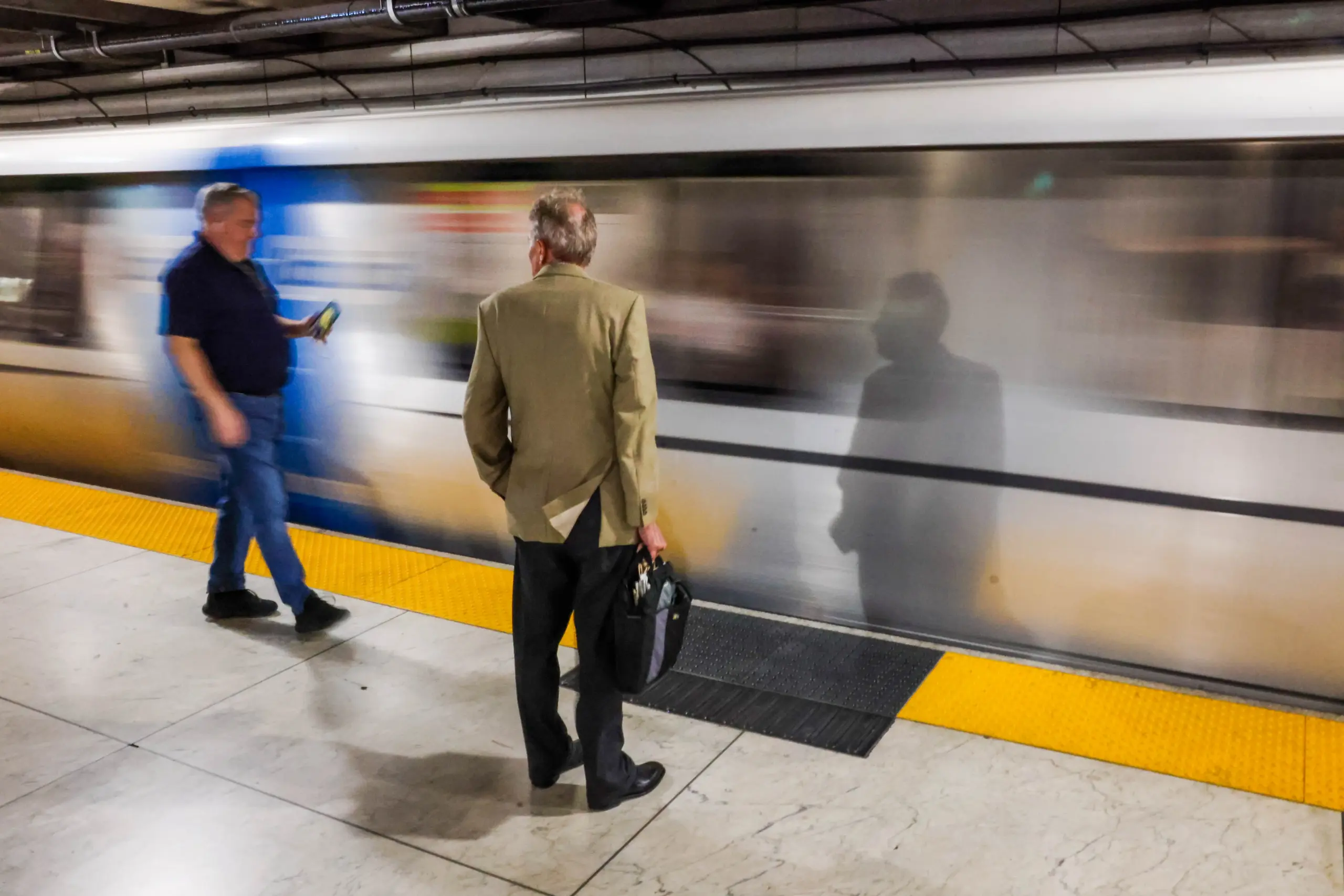
The Bay Area’s largest transit providers are victims of their own success.
As the backbones of the region’s economy and lifelines for those who depend on them, they must now adapt their funding and service models from ones that worked well before the pandemic to new circumstances. That will likely require that they collect a larger share of their revenues from taxes instead of fares and that they serve more passengers outside of traditional peak commute hours.
Read more Woman dies after falling onto Peninsula freeway during police pursuit
Given its ridership, budgetary and safety challenges today, it may seem odd to applaud Bay Area transit. However, before the pandemic, its major agencies, including BART, Muni and Caltrain, were national exemplars of resilient ridership and self-funding.
Today, some of those trends have shifted, but public transport remains as vital as ever to the region.
With budgets at a precipice, riders should not be punished because the revenue models that once worked well for them no longer suffice.
Last decade, large Bay Area transit systems held their ridership and fare revenues relatively steady, as systems elsewhere saw patronage drop steeply. In fact, during California’s prior period of rising public transport use, just a single type of trip, transbay BART rides, accounted for almost half of the region’s — and a third of the entire state’s — ridership growth.
Most U.S. transit agencies’ budgets look more like a library’s than a for-profit company’s — with substantial subsidies justified by transit’s public service role.
Uniquely unsubsidized
But the biggest Bay Area systems paid for much of their operational costs without relying on government subsidies. Instead, passenger fares and other revenues such as parking and advertising covered a substantial share — and in some cases the majority — of their day-to-day expenses.
The press, bond markets and the Transportation Research Board all praised this model as an example of strong self-sufficiency and internal budgetary control.
But of course, the pandemic upended daily commuting, for reasons far beyond the control of transit managers.
Depending on how you measure it, Bay Area cities have had some of the weakest return-to-office recovery rates in the country. Transit agencies have clawed back ridership by responding as best they can, shifting service patterns more towards non-commute hours and routes, implementing nation-leading homelessness responses, and addressing fare evasion through stronger infrastructure.
With these management steps, BART and Muni Metro now sit solidly in the middle of the pack of U.S. subway and light rail providers, respectively, when ranked on how cost-efficiently they supply each hour of vehicle service.
But transit systems cannot move their rail tracks, cannot make companies change their remote work policies and cannot fix the region’s dire housing crisis. They cannot even manage toll rates or gas taxes or many other key factors behind mobility choices.
Even with limited policy levels and lower ridership today, public transport remains essential. Bay Area buses, trains, vans and ferries carry millions of unique riders every month and hundreds of millions of trips every year, often on routes that are faster than driving. Many would have otherwise been made by car, on congested highways. Many other trips are made by those without the physical or financial means to drive.
Without funding to adapt to a post-pandemic world — the type of funding that agencies elsewhere less reliant on fares already get — transit could face a “death spiral.” Cuts to service will make it harder to use transit reliably: pushing riders away, depressing fare revenues and then forcing further cuts.
Those without other mobility options will see their employment, educational and social access slashed. Nearly half a million people in the region will lose access to nearby rail, and riders on Muni alone making , according to recent estimates.
Read more Miss Manners: She knits on the dais, and I find it rude
Cutbacks and closures recently projected by Bay Area agencies are in line with what transit systems that have gone over the “fiscal cliff,” like in Philadelphia, had to do.
Yet down in Los Angeles, local sales taxes have largely allowed transit systems to weather COVID-19 and federal funding cuts. As the region prepares for the Olympics, its rail network continues to grow, and ridership is at or near pre-pandemic levels across different routes.
Magical thinking
Critics of that dedicated-funding model assert that money for transit could materialize from somewhere else.
But most money in transit budgets is not fungible, meaning that money saved scaling back a transit extension cannot lawfully be used to run regular service instead.
Even if somehow possible, diverting funds from large, deferred maintenance projects to daily operations risks travel disruptions and safety incidents.
Similarly, every cap-and-trade dollar shifted to keep Bay Area transit running means fewer critical green infrastructure projects and programs — from water system improvements to wildfire prevention to utility bill credits to transit-adjacent affordable housing across the region.
And another implausible idea, taking from California’s high-speed rail project, is not just robbing Peter to pay Paul. It’s expecting the money in Peter’s wallet to pay Paul’s salary indefinitely, all while Peter is being protected by supporters across the state.
So too, critiques of transit tax funding centered on the industry’s labor and construction issues miss the mark. Transit agencies have faced severe labor shortages in the wake of the pandemic, with wages for bus and train operators essentially stagnant for over a decade.
Systems needed to raise wages simply to compete and keep people on the job. Far from a zero-sum game of labor costs versus service, better pay helped riders by preventing canceled trips, as happened when there were not enough workers available.
Likewise, U.S. public works, not just public transport but highways and airports, too often blow past budgets and schedules and later fail to meet their projected use. In tackling those challenges, we should learn from other parts of the world where environmental and labor protections are just as strong but projects are built faster and cheaper.
But reforms to correct structural contracting and permitting issues are no excuse to deny transit agencies lifeline operating funds to address completely different problems, changing travel and revenue patterns.
Bay Area transit is like a boat that once traveled fast and efficiently. A storm blew it away from the waters it was designed for, but its crew is now patching leaks and avoiding worse ones.
New funding sources and service plans can right the ship.
Jacob L. Wasserman leads the UCLA Institute of Transportation Studies’ Public Transit research program.
Read more Dear Abby: I finally realized what my husband had done. His parents think I should stand by him.
About the Author