Housing for living among the dead is a growing commodity, as inhabitable buildings within burial grounds are coming on the market. New residents report that the environs are surprisingly uplifting.
Read more Anthropic CEO Dario Amodei says AI industry needs to slow down for safety
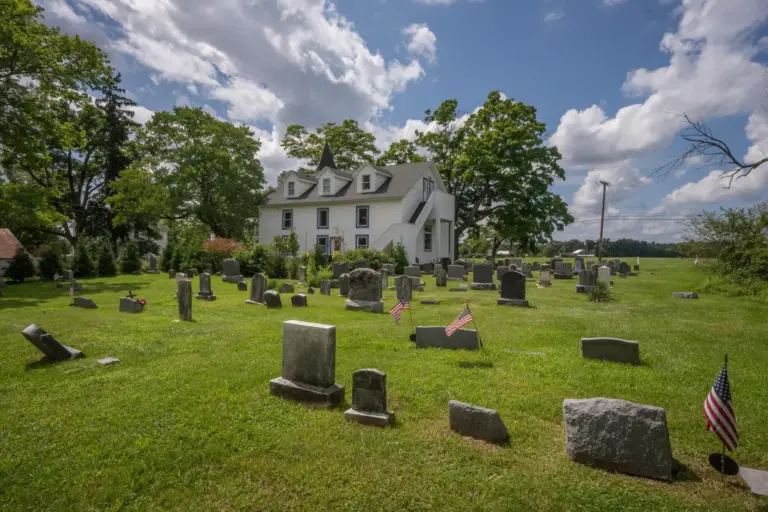
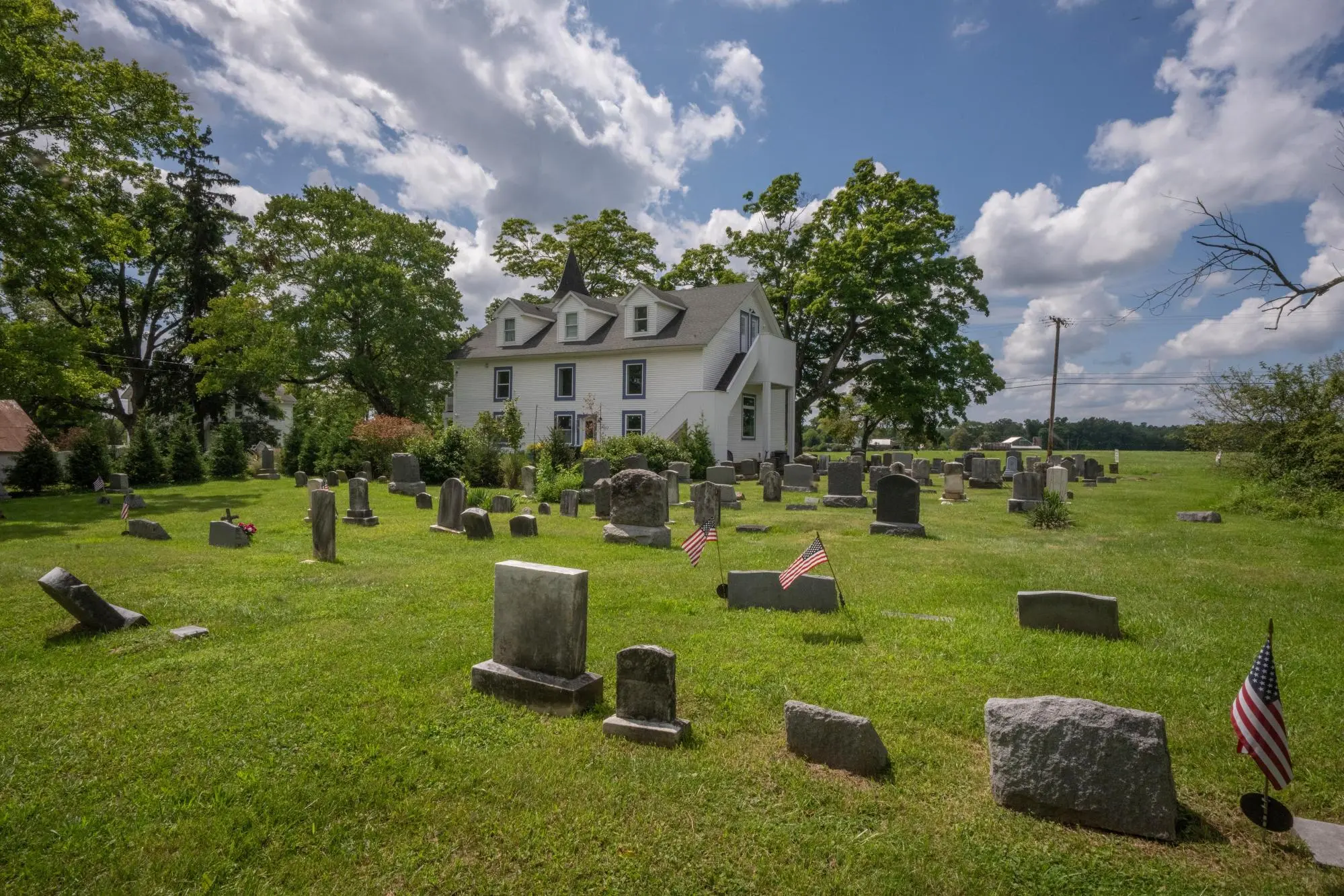
Waking up to views of gravestone rows can be a reminder to “live this day fully,” said Leah Guadagnoli, a culinary artist and farmer-florist in Hillsdale, New York. She and her fiancé, Tim Sengenberger, and a tabby cat named Señor Tuna share a gabled 19th-century former church, adjoining the final resting places of about 170 people. Guadagnoli has been told, “All the spirits here are peaceful.”
Lichens and mosses have sculpted the gray obelisks and slabs. “The stones become a part of nature,” Guadagnoli said.
She has hosted banquets on the grounds, which are maintained by descendants of the deceased, and is planning the couple’s wedding there. She has harvested local flora for her recipes, she explained. “Who doesn’t love a graveyard violet cocktail?”
Sarah Gundle, a psychologist in New York City, said she found a sense of “calm and peacefulness” at her former church in western New Jersey on an acre of burial grounds. The eroded headstones bear inscriptions as poignant as “Infant Son.” As she wrote in an essay for Salon, living among grave sites can inspire compassion for “all things broken,” including oneself.
Gundle said she hesitated to approach mourners on the property — perhaps they preferred to grieve in silence? — but she has found that “mostly, they want to chat.” She and her family have added pine groves, flower beds and handmade fairy cottages to the landscape. One visitor, who had buried many relatives there, dropped off a note thanking the new occupants for “respectful & neat caretaking.”
When the property was for sale a few years ago, it made headlines as a “house to die for,” with a “heavenly makeover” and some “grave surprises.” Such press and public attention, complete with puns, has become a trope for cemetery dwellers.
“We’re in an actually famous house,” said Kat Momenzadeh, a high school teacher in Bellefonte, Pennsylvania. In 2025, she and her husband, Ed Choma, bought a 19th-century building, trimmed in gingerbread and arched over a driveway, that formerly served as a cemetery gatehouse. It is widely known, Momenzadeh said, as “the one with the hole in the middle.”
The building had also been used as a haunted house attraction, with a simulated guillotine in a bathroom.
The interior had deteriorated to the point that, Momenzadeh said, “The stairs were a little like taking your life in your hands.” HGTV ranked it as “the scariest house in America” and gave it a $150,000 makeover.
When the couple and their two children have explored the forested burial grounds, their usual routes have passed a stone angel, marking the grave of a newborn named Gladys Dietz. “We always stop and say hi to Gladys,” Momenzadeh said. At night, scattered lights illuminate some headstones. “It looks like stars,” she said.
Cemetery living has even begun sparking entrepreneurship. Tombstone Honey is a new small-batch foodstuff harvested at Paddington Old Cemetery in London, from a half-dozen beehives tended by Nicholas Horowitz, a co-founder of Founders Makers, a brand-building consultancy. He and his wife, Sophia Tran-Thomson, a journalist, and their son live at the cemetery’s entryway in a Gothic former vicarage, renovated and expanded by the London architecture firm Studio Hallett Ike.
In a neighborhood dense with row houses, the couple’s home has “a monastic-y style of calm,” as if “the city dropped away,” Horowitz said. One past occupant was a rock band guitarist, suited to a spot where, Tran-Thomson noted, “you don’t have any neighbors to complain about the noise.”
Owls and foxes thrive among the graves for celebrities including Michael Bond, the creator of Paddington Bear (“Please look after this bear” is the epitaph). The house has pointed arch windows, raw timber beams and textured plaster walls. “We like that imperfect wobbly feel,” Tran-Thomson said. The couple installed a bathroom mirror, with sinuously eroded edges, that was found entombed in the yard.
Read more Liberty completes stunning 24-point second-half comeback to beat El Cerrito
Establishing temporary quarters in cemeteries has a long history, as Allison C. Meier, a writer whose specialties include grave sites and burial rituals, pointed out. Gilded Age mausoleums were furnished with tables, chairs, rugs and chandeliers.
“They were extensions of people’s houses,” Meier said. In one extreme example from around 1900, a Brooklyn widower spent his days inside his wife’s tomb, stocked with her favorite housewares down to the cutlery.
The supply of graveside residences is increasing not only because religious and secular entities are selling off cemetery facilities, but also because homeowners are rediscovering the venerable practice of burying loved ones on their own properties. Within a generation those sites can be engulfed in weeds, and the tombstones may come as surprises to subsequent purchasers.
“History has shown us that these places just get lost,” said Ryan M. Seidemann, the executive director of the North American Death Care Regulators Association and the author of “Cemetery Protections in Urban Environments.”
Some longtime graveyard stewards have prepared to leave permanent traces of their work. “The Cemetery Lady, An Advocate for the Dead” is inscribed on the marker for Helen A. Sclair at Bohemian National Cemetery in Chicago, near the caretaker’s cottage that she long rented. Sclair was a researcher, lecturer and tour guide focused on death and funeral rituals (her collection of related publications, manuscripts and ephemera now belongs to the Newberry Library).
“Her house was a museum,” said her daughter, Lu Sclair, a nurse practitioner in Indiana, who has inherited mementos, such as a wicker casket used for corpses in transit. She enjoyed visiting the cemetery cottage, surrounded by “beautiful statuary of all sorts.” She added, “Some of the best sleep I ever had was on mother’s couch.”
Marion Duckworth Smith, who since the 1980s has tended the Lent-Riker-Smith Homestead in Queens, built in the 1650s, combats vines creeping up the backyard tombstones for early Dutch settlers. She has memorized the inscriptions, along the lines of “weep not for me my friends all dear, I am not dead but sleeping here.” Her own relatives sleep there, under 21st-century markers carved with bouquets.
She first saw the property in 1979, when her future husband, Michael Smith (who is now interred on-site), asked her during a date, “How would you like to see my cemetery?” She immediately felt as if the site “had been waiting for me,” she said.
Among her companions these days is a litter of kittens, rescued from under a mourners’ bench carved with angels. Her team of volunteer maintainers includes an undertaker — he has assured her that “he would consider it an honor if he did my cremation,” Duckworth Smith said. She added that she planned to safeguard the homestead posthumously from the position of a grave marked by a weeping angel. “I’m going to haunt anybody that comes along and undoes my good deeds.”
Among her neighborhood’s kindred spirits is James Sheehan, who has spent seven decades tending a walled enclosure of tombs dating from 1703. The markers range from a creamy angel with fist defiantly raised to a brown slab that warns, “Reader! Art thou prepared to follow.” Until poor health recently deterred him, he said, he pruned and mowed so meticulously that “everything was sparkling.”
His relatives pitch in — two great-grandsons have taken up raking and bagging leaves. Girl Scouts have carted away dozens of bags of leaves in a single day. Sheehan’s daughter, Debbie Sheehan Collins, said that over the years, family members had occasionally dressed as a ghost or Dracula. But no one behaved disrespectfully amid the graves. “We knew the significance,” she said.
Her father said that he has overheard visitors scolding ancestors at the tombstones: “You damn fool, you should have taken my advice.”
As for Sheehan’s own final resting place? “Anywhere they put me,” he said, “I’m satisfied.”
Read more Valkyries’ Gabby Williams leads France past Germany 86-64 to reach women’s FIBA World Cup final
This article originally appeared in The New York Times.
About the Author