California’s lieutenant governors shape higher education, economic development and environmental policies, though often behind the scenes.
Read more Skelton: Three ballot measures on housing, medical research but only one no-brainer
As presidents of the Senate, they break ties. They frequently chair the State Lands Commission, and they serve on the boards governing public colleges and universities. Also, they become acting governors whenever governors are absent from the state, and, crucially, they assume the office permanently if governors die, resign or are removed.
Which begs the question:
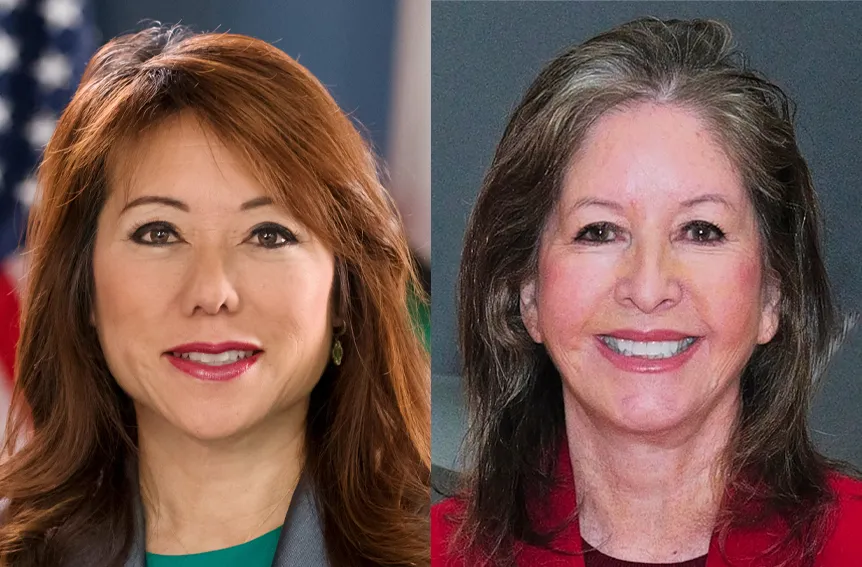
Among the two candidates left on the Nov. 3 ballot — Fiona Ma, a Democrat, and Gloria Romero, a Republican — who could lead this state’s 40 million people and oversee its $4 trillion economy?
Ma is the only answer.
Ma — who emerged first in the 16-way June primary with 19.1% — has already held one of the most consequential, stressful jobs in California in what may well have been the most turbulent years the state has seen in recent decades.
State treasurer since January 2019, Ma has been serving as California’s primary banker and lead asset manager, overseeing an investment portfolio worth more than $160 billion and processing $3 trillion of banking transactions per year amid a pandemic, global supply disruptions, price spikes, trade wars and, now, energy crises.
Money is the ultimate constraint on the aspirations of the Legislature, and it’s fallen to her to assess what can be financed and how.
In an interview with this editorial board, the 60-year-old San Francisco-based CPA discussed her main priorities if elected: building more affordable housing units on and around state colleges; protecting coastlines and waterways from pollution; and protecting and expanding access to health care.
What convinces us that Ma can actually move the needle on her agenda items is the fact that she has already been knee-deep advancing them in a senior executive capacity. As state treasurer, she has chaired the bond finance committees which determine how to pay for new housing, new schools and environmental protection programs, among several other core state priorities.
Getting anything done in Sacramento, particularly as lieutenant governor — a position lacking the direct executive powers of other statewide offices, such as attorney general or insurance commissioner — requires knowing how to navigate every lever of the state.
Eleni Kounalakis, the current lieutenant governor now running for Ma’s job, leveraged her partnership with Gov. Gavin Newsom to expand the office’s relevance, particularly over economic policy.
Ma told this editorial board that she largely sees herself continuing the legacy of her ally, Kounalakis, but Ma also said she would use the office’s position as president of the state Senate to exert greater influence over legislation.
Read more Opinion: A Paramount-Warner merger will hurt Hollywood and people of color
That might ring hollow but for the fact Ma understands the Legislature intimately. She authored 60 bills, which were signed into law, when she served in the state Assembly, representing San Francisco between 2006 and 2012. (Ma’s resume also includes serving on the San Francisco Board of Supervisors between 2002 and 2006 and on the California Board of Equalization between 2015 and 2019.)
For her part, Ma’s rival, Gloria Romero, does not lack for relevant experience.
That is not her weakness.
Romero — who placed second in June with 17.8% — represented Los Angeles in the state Legislature between 1998 and 2010, including as the Democrats’ Senate majority leader. During her time in Sacramento, the former Cal State Los Angeles professor was an undeniably successful legislator who championed transparency in government and charter schools.
However, in recent years, Romero, 71, pivoted from moderate Democrat to MAGA Republican.
In 2024, Romero formally switched parties, endorsed Donald Trump’s reelection and called RFK Jr. her “personal hero.” In her interview with this editorial board in April, Romero praised President Trump’s second-term performance, lauded RFK Jr.’s vaccine skepticism, minimized the seriousness of climate change and appeared woefully out of step with the environmental, academic and economic priorities of most Californians.
Romero’s election to this office would expose California’s coasts to oil drilling and its universities to Trump’s sweeping agenda to rewrite their curricula.
California could use change, but not Romero’s version.
Unfortunately, Ma comes with controversies: a state-paid $350,000 harassment settlement with a former state employee and a scandal regarding a Chinese boarding school whose founder contributed to Ma’s campaign. (In the harassment case, a court dismissed most of the allegations, and Ma denied the allegations against her. In the school scandal, an audit found no misconduct by Ma.)
While these issues should not be ignored, let there be no doubt, especially given the sole alternative: Ma is Californians’ only conscionable choice.
The state is entering a period of constraint and uncertainty. Budget shortfalls. Federal tensions. Declining enrollment. Energy shocks. And who knows what is next.
The next lieutenant governor must be as capable of navigating these uncharted waters as the governor whom she might need to replace at a moment’s notice.
Read more Asking Eric: My husband’s school board candidacy is strange. I don’t think he even likes kids.
Vote Fiona Ma.
About the Author