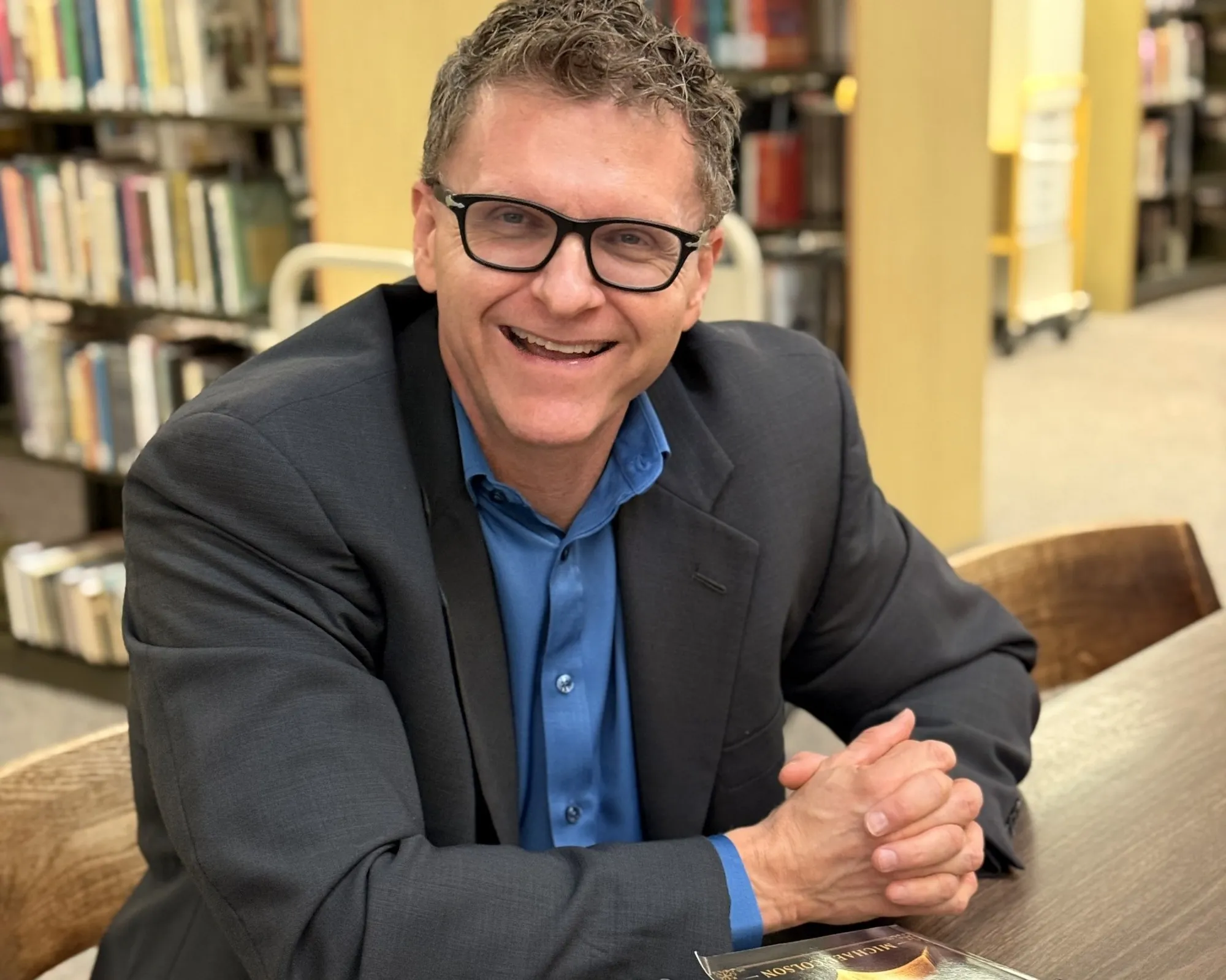
Colson has drawn on more than 30 years of teaching experience, 11 of them as an English instructor at Diablo Valley College’s San Ramon campus, as well as his own struggles as a college student to write two books: “Writing = Thinking: Academic Writing for Different Minds” and “Watching = Thinking: Film and Literature” (released Aug. 10).
Read more ‘Big Short’ investor leads fight against 25 homes on Saratoga hillside
His books grew out of questions Colson says he has considered throughout his teaching career: How can students become more confident and independent thinkers? How can instructors recognize that students may approach reading and writing differently? And how can academic work become an opportunity for discovery rather than simply following rules?
Colson, who was born in Phoenix, Arizona, and spent parts of his childhood in Los Angeles, Monterey and Salinas, said growing up in diverse communities influenced how he understands the world. He says his students, however, have had an even greater impact on his approach to teaching.
“The students I’ve worked with have had a significant influence on how my thinking about writing, neurodiversity and teaching has developed,” he said.
Colson said “Writing = Thinking” grew partly from his own experiences as a college student.
“I constantly felt like an outsider who wasn’t acquainted with the unspoken rules and norms that everyone else seemed to know,” Colson said.
Throughout his decades of teaching college writing, Colson recognized similar struggles among his students. He says traditional writing instruction often relies on formulas, templates and a “one size fits all” approach but that students do not all develop ideas in the same way.
“Students don’t gather ideas and write by only one approach,” Colson said.
Instead, he encourages students to view writing as a process of discovery. Colson suggest that rather than immediately formulating a thesis and fitting ideas into a predetermined structure, students can begin by observing something that interests or puzzles them, asking questions and following those questions.
“When students see writing as thinking, their writing becomes a process of discovery rather than merely following a formula,” he said.
That process can look different for different students. A linear thinker may begin with an outline, while a neurodivergent or bottom-up thinker could notice seemingly unrelated details and discover connections through writing.
“The goal is a well-developed academic essay, but students have more than one path for arrival,” Colson said.
That philosophy is central to Colson’s neuro-affirming approach to education. He said a neuro-affirming classroom — one that also benefits students with autism, attention-deficit/hyperactivity disorder (ADHD), dyslexia or other learning differences — begins with recognizing that students’ minds work differently and that these differences do not necessarily indicate a deficit.
Some students may understand a reading by beginning with a small detail and working toward a larger idea. Others may need the big picture first. Some may think through discussion, visual mapping, movement or annotation before their ideas become an essay. Colson says the approach can can benefit all students, including those who are neurodivergent.
“When we design courses around human diversity rather than an imagined ‘typical’ learner, students spend less energy trying to imitate someone else’s way of thinking and more energy developing their own,” he said.
Read more Two people die in seven-vehicle collision in East Palo Alto
Colson also challenges the idea that academic rigor requires every student to follow the same process.
“Academic rigor shouldn’t be confused with compliance and conformity,” he said.
For him, rigor should be measured by the quality of students’ thinking, analysis, evidence and communication — not whether they followed identical steps. Artificial intelligence has added another layer to how students approach writing.
Colson said AI can be useful when it helps students overcome barriers to getting started, organize ideas, clarify difficult concepts or consider alternative perspectives. He worries about what students lose, though, when AI does the mental work for them.
“Artificial intelligence makes critical thinking more important, not less,” he said.
Writing, he said, requires students to struggle with questions, make false starts, reconsider ideas and revise their thinking. Those experiences are part of learning. He encourages students to ask themselves when using AI: “Is this tool helping me think or is it thinking for me?”
Colson’s second book, “Watching = Thinking,” extends his philosophy beyond traditional written texts into film and visual storytelling. He argues that watching a film attentively requires many of the same interpretive skills used in literary study. Filmmakers make choices about perspective, imagery, sound, editing, pacing, performance and composition, just as writers make choices about language, characterization and narrative.
For students intimidated by traditional academic reading, Colson says film can provide an accessible entry point into critical thinking, noting that a student may begin by noticing a camera angle, a character’s expression, a change in music or a recurring image. He says asking why those details matter helps the student practice observation, interpretation, analysis and evidence-based argument.
Colson said film can also help students recognize that they may already possess sophisticated interpretive abilities, even if they do not see themselves as strong academic readers or writers. Ultimately, Colson’s goal extends beyond teaching students how to write stronger essays. He says he wants them to get comfortable asking questions, examining evidence, challenging assumptions and changing their minds when evidence points somewhere unexpected.
“Thinking differently doesn’t imply that they’re thinking incorrectly,” he said, adding that an independent thinker is not someone who simply remembers textbook answers.
Colson says his own students helped lead him to that philosophy and that over time, he became less interested in following established textbooks and more interested in helping students discover how their individual minds work.
“Different minds take different routes,” he said.
That belief seems to form the foundation of both books. Colson says he hopes students leave his classroom with more than improved reading and writing skills.
“I hope my students develop curiosity, intellectual independence and confidence in their own thinking,” he said. “Those abilities will be valuable beyond college life.”
Colson’s books can be found on Amazon online at bayareane.ws/michaelcolson.
Reach Diablo Valley College journalism professor and freelance writer Charleen Earley at [email protected] or 925-383-3072.
Read more Miss Manners: My yard sign led to an awkward situation with my neighbor
About the Author