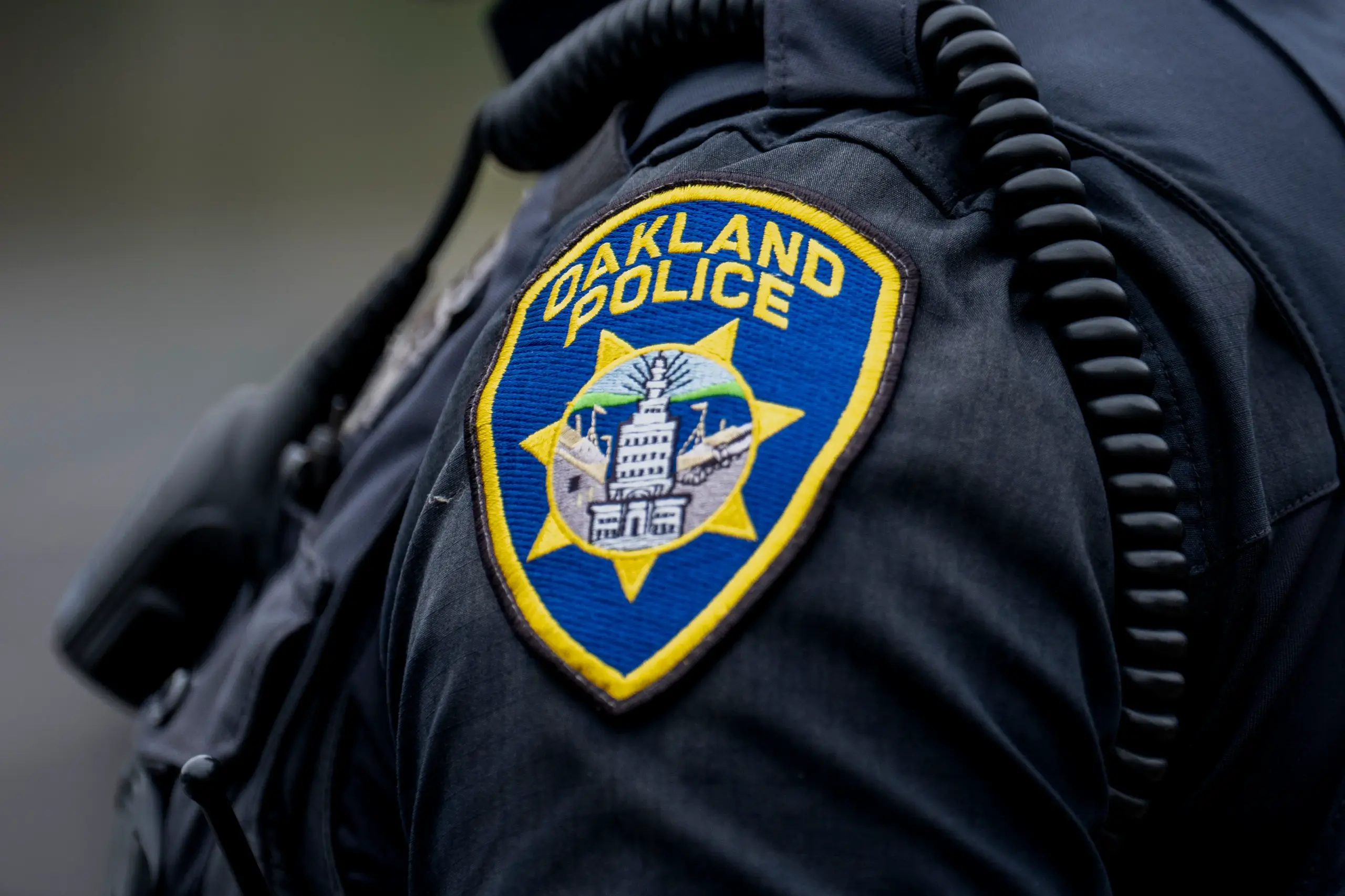
Ahead of a critical court hearing Tuesday afternoon, the two attorneys who fought for Oakland’s police force to be overseen by federal judge for the last 23 years say they want that oversight to continue — albeit, with a significant catch.
Read more Three people shot at Pittsburg BART station
The attorneys, John Burris and Jim Chanin, formally asked a federal judge to continue overseeing the Oakland Police Department for one more year in a new, still-to-be-determined model. Critically, however, Burris and Chanin said the department has improved so much from the early-2000s Riders police brutality scandal that the two attorneys would have “no future role in the case,” and instead leave that oversight to the court’s whims.
The suggestion — outlined last week in a letter to the court by the two longtime civil rights attorneys — comes ahead of a key hearing Tuesday before U.S. District Court Judge William Orrick, who must decide whether to extend his oversight of the department or relinquish control to Oakland’s city leaders for the first time since 2003.
At the most recent hearing in May, Orrick expressed optimism that the city could finally end 20-plus years of oversight at this week’s hearing. In the process, he personally lauded Mayor Barbara Lee by saying no prior city leaders had “demonstrated an awareness and holistic understanding of what we need to do.”
Yet a potential complication emerged earlier this month when the department’s federal monitor, Robert Warshaw, said the agency had once again fallen out of compliance on a key benchmark for investigating complaints against its officers.
During the first three months of 2026, the most recent term available, the department completed 83% of its most serious internal affairs investigations within the required six-month timeframe, Warshaw reported. The mark — signifying 77 completed cases out of 93 tracked by the monitor — was a couple percentage points shy of the 85% rate mandated by the landmark Riders consent decree that has controlled the agency since 2003.
In their letter last week, Chanin and Burris called the slip-up “incomprehensible and bitterly disappointing,” adding that the city “could and should have marshalled every available resource” to show it could remain in compliance. “Their inability to do so while everyone is paying attention and rooting for their success is an enormous let down,” the attorneys wrote.
Even so, the attorneys said that “command staff at OPD have worked aggressively to attain compliance,” and that “OPD today bears virtually no resemblance to the OPD prior to 2000.”
As a result, Chanin and Burris suggested the current court-monitored consent decree — known as the Negotiated Settlement Agreement — “end in its present form,” with the two attorneys bowing out of the proceedings.
In its place, the court could “retain jurisdiction for one year,” during which OPD and the Oakland Police Commission would report to Orrick “to the extent the court wishes.” At the end of that year, the police commission would issue a report to Orrick that includes “whatever information the parties and the court would deem appropriate,” after which time court oversight would end.
In their own statement to the court, the Oakland City Attorney Ryan Richardson and Special Counsel Brigid S. Martin struck back at the proposal — flatly calling it “not workable.” Doing so, they argued, “creates a framework that no longer resembles litigation.”
Read more San Jose’s PWHL expansion franchise to play its first game at SAP Center on Dec. 5
Instead, the city’s attorneys asked Orrick to simply end court oversight Tuesday, without any new conditions.
“Recognizing that constitutional policing is a daily obligation rather than a single milestone, the city remains committed to ongoing work to sustain and build on the foundation it has create,” they wrote.
The proposal comes at a perilous time for Oakland, which has been working for decades to emerge from under federal court oversight in the wake of the notorious Riders scandal. Four officers were accused of going rogue, beating West Oakland residents and planting drugs on them, all while filing falsified police reports. In 2003, a class-action lawsuit resulted in a $10.9 million payout to scores of people who claimed abuse at the hands of those Oakland cops.
Since then, a federal judge has overseen the department through an appointed monitor, Warshaw, who has long drawn the ire of a rotating cast of mayors and police chiefs who questioned his financial motivations for staying on the case. All of them fought unsuccessfully to end the oversight arrangement — coming close in 2016 and 2022, only to watch the department once again become embroiled in scandal.
Opinions vary on whether the court oversight should end.
In a letter to Orrick, the advocacy group Coalition for Police Accountability argued either for the current oversight arrangement to either continue, or for “a stipulation by the parties that sufficient funding will be made available for effective independent civilian oversight.”
In doing so, the group chastised the police department for having recently backslid on its obligations, highlighting how “OPD did not bother to prioritize compliance at such a critical juncture,” while suggesting that “it seems naively optimistic to expect more energetic efforts if they are left to answer to no one.”
“At the bare minimum, maintaining jurisdiction enables intervention if necessary,” the group argued in its letter, signed by Millie Cleveland, chair of its steering committee, and Larry C. White, who helped author Measures LL and S1.
Conversely, a group calling itself Safe Oakland penned its own letter pushing Orrick to end his oversight altogether, suggesting that the agency’s reforms have become a part of its very fabric. The group’s leaders include Cynthia Adams, president of the NAACP Oakland Branch; LeRonne Armstrong, a former Oakland police chief; and Carl Chan, chair of the Chinatown Chamber of Commerce Foundation.
“For twenty-three years, a federal court has held Oakland to the standard of constitutional policing,” the group said in its letter. “The time has come for Oakland to hold itself to that standard, and for the community to share in that responsibility.”
Jakob Rodgers is a senior breaking news reporter. Call, text or send him an encrypted message via Signal at 510-390-2351, or email him at [email protected].
Read more One of the biggest bands in the world is playing Golden Gate Park in 2027
About the Author