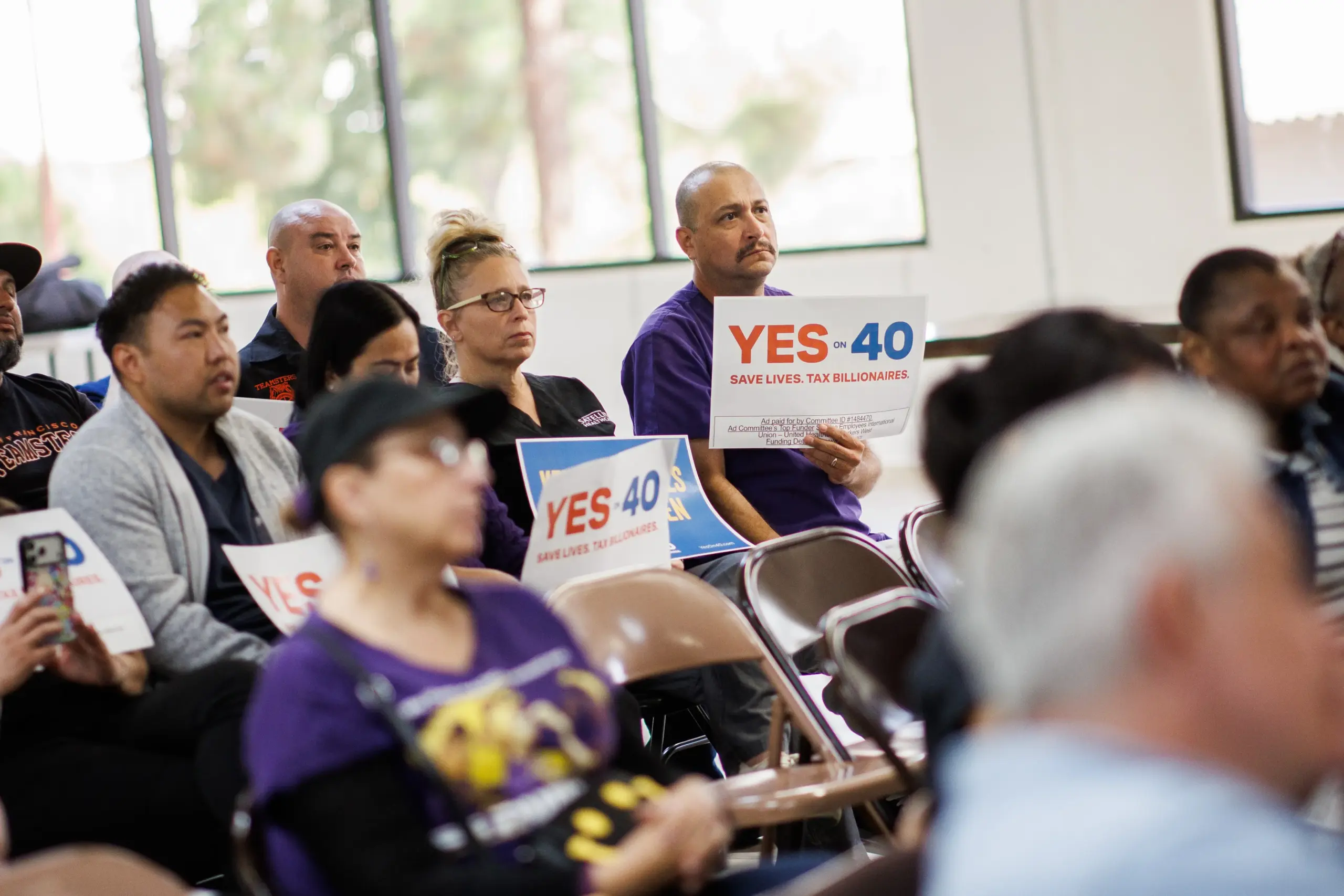
California voters will decide in November whether to approve a first-in-the-nation wealth tax, but the fate of the contentious ballot measure will rest on how much support two competing initiatives receive.
Read more Granderson: The cruel politics that pit struggling Americans against each other
Proposition 40 — a one-time, 5% levy on the state’s more than 200 billionaires — was proposed by SEIU United Healthcare Workers West last year as a way to address the state’s lost revenue from federal cuts, with 90% of the dollars raised going to healthcare and 10% to food assistance or education-related programs.
The initiative has roiled California politics for months, dividing state leaders and labor unions. The measure’s backers say the tax is necessary to prevent hospitals and clinics from closing and low-income residents from losing coverage from Medi-Cal, California’s Medicaid program, while critics argue it will drive wealthy residents out of the state and inflict long-term damage to the state’s economy.
But winning a simple majority might not be enough for Prop. 40 to take effect. Propositions 41 and 42 have provisions that could void the wealth tax if either also passes and receives more yes votes.
Prop. 41 would require the state auditor to review proposed special taxes before they’re placed on the ballot and invalidate taxes that don’t comply with the state spending limit, while Prop. 42 would prohibit new state personal property taxes.
Thad Kousser, a professor of political science at the University of California, San Diego, said it poses a “triple challenge” for the proponents of Prop. 40.
“They don’t know where the end zone is,” he said. “They’re going to have to both make an argument for a wealth tax that has split the progressive coalition, but also make an argument against two other initiatives that may be appealing to voters who see them probably for the first time when they open their ballots.”
The latest statewide survey from the Public Policy Institute of California, a nonpartisan research group in San Francisco, found that Prop. 40 had the support of 52% of likely voters. Support stood at 51% for Prop. 41 and 54% for Prop. 42. The poll had a margin of error of 3.8 percentage points.
Prop. 40
Prop. 40 would levy a 5% tax on individuals with more than $1 billion in net worth. Real estate and some pensions and retirement accounts, however, would be excluded. The tax would only apply to billionaires living in California as of Jan. 1, 2026, and those subject to the tax have the option of either paying it in full in 2027 or making annual payments for the next five years, which would have added interest.
The initiative was proposed as a solution to the looming budget crisis facing the state following President Donald Trump’s “Big, Beautiful Bill” that makes major cuts to healthcare and food assistance. California could lose at least $30 billion in annual federal funding as a result, according to the California Budget and Policy Center.
The estimates of just how much money the tax will bring into California’s coffers vary. Proponents claim that it will raise $100 billion. The nonpartisan Legislative Analyst’s Office estimates its yield at “tens of billions of dollars,” but said it could also reduce ongoing state income tax revenues by less than $1 billion per year if billionaires decided to leave.
Without a way to fill the budget gaps, the measure’s backers warn that some Californians on Medi-Cal could lose their coverage. Hospitals and community clinics that rely on federal revenues targeted by the cuts could also face closures, they argue.
Dave Regan, the president of SEIU United Healthcare Workers West and the architect of the tax, said in an interview that the tax will prevent a “healthcare catastrophe” in California.
“We’re either going to watch this train wreck or we’re going to pass Proposition 40,” he said. “It’s a solution to a problem that was put in all of our laps.”
But opponents of the billionaires tax argue that the money will only temporarily stem the budgetary bleeding. The No on Prop. 40 coalition, which includes the California Medical Association, the California Teachers Association, the California Chamber of Commerce and Planned Parenthood Affiliates of California, positions the initiative on its website as a “flawed, reckless tax.”
Francisco Silva, the president and CEO of the California Primary Care Association, called Prop. 40 a “gimmicky solution that doesn’t really address the core issues in healthcare.”
“It creates temporary revenues that don’t really allow us to build the infrastructure to sustain it,” he said.
Silva also raised concerns about the measure’s “safeguards and accountability.” The tax revenue would be deposited into a reserve fund, but there is no specificity as to how the money will be spent beyond it being used for “health care funding” and “education-related and food assistance expenditures.” The measure, however, does note that the money can’t be used to replace existing state funds for healthcare, education or food assistance.
Other opponents of the tax, like Gov. Gavin Newsom, have raised concerns about Prop. 40 driving billionaires out of the state, which they said would hurt the state’s tax base. The top 1% of California earners pay nearly 40% of the state’s personal income tax, and . The governor, who is eyeing a potential presidential bid, recently called for a national wealth tax instead.
“Wealth is movable, and it shops for the state with the lowest taxes,” Newsom wrote in a June Substack post. “The fight belongs at the federal level, where this broken system was created in the first place.”
Read more Horoscopes September 23, 2026: Bruce Springsteen, show your worth
Regan, however, argues that it will give California five years to “figure out a long-term solution” for healthcare funding. The labor leader also brushed off the claims it would push wealthy residents and businesses out of California, calling it a “disingenuous argument.”
“A one-time tax creates no incentive for billionaires to leave the state and we felt that was important,” Regan said. “We wanted to take that issue away to the extent we control it. It doesn’t stop them from making a dishonest argument, but it’s not true.”
Google co-founders Larry Page and Sergey Brin are among the billionaires who moved out of the state last year as talk of the billionaires tax grew. Brin has shelled out more than $100 million to Building a Better California, a newly formed group that’s opposing Prop. 40 and supporting Props. 41 and 42.
The billionaires tax has been endorsed by Rep. Ro Khanna, Sen. Bernie Sanders, I-Vermont; the California Democratic Party and the California Federation of Labor Unions. Nvidia CEO Jensen Huang has also voiced his support, recently saying he’s “perfectly fine” with having to pay more in taxes. Forbes estimates that Huang is worth $198 billion.
Prop. 41 and Prop. 42
Prop. 41 would require the state auditor to review any proposed special tax before it goes in front of voters by auditing each program that would receive funding. The audit would include an analysis of whether each program is maximizing the dollars it’s currently spending, whether it’s achieving its intended goals and recommendations for how it could save at least 10% annually. The initiative would also prohibit any new tax that excludes its revenues from a state spending limit.
Tracy Hernandez, the co-founder and CEO of the New California Coalition that was an early supporter of the measure, said the initiative is about “accountability and transparency” and will ensure that voters are “better armed with information” about new proposed taxes.
“A lot of people find that we’re a little short on the proof points of how much more money we’re spending and that’s taxpayer money that all of us are contributing,” she said.
The Legislative Analyst’s Office said the fiscal impact of the measure is currently unknown. The state auditor is likely to see increased costs to implement the new rules; however there could be possible savings by implementing recommendations from the audits, according to the office.
The initiative has been endorsed by the California Chamber of Commerce, former state Controller Steve Westly and the California Taxpayers Association.
Prop. 42 would prohibit new taxes on personal property, including those on retirement accounts and assets.
Rob Gutierrez, the president and CEO of the California Taxpayers Association, said in an interview that the measure will help residents plan for their retirement and “protect California’s business climate.” He said that while the state has the right to change tax policy, it shouldn’t be able to move the “goalposts” after people have already earned income and saved for retirement.
“It really comes down to certainty,” he said. “What does the future look like, how do you plan, and how do you make decisions so that you know you can stay in California.”
Prop. 42 is also being backed by the State Building & Construction Trades Council of California, the Peace Officers Research Association of California and the California Chamber of Commerce.
SEIU United Healthcare Workers West opposes both Props. 41 and 42, and Regan, the union president, said that they were “drafted specifically to confuse voters and intended as poison pills to Prop. 40.”
“Prop 40 can only affect 250 people — nobody else,” Regan said, noting the estimated number of billionaires in California. “Props. 41 and 42 if they ever got effectuated would undermine existing funding streams for things like public education.”
Responding to Regan’s criticism, Hernandez said the billionaires tax “motivated really talented people to get Prop. 41 written and pulled together,” while Gutierrez attributed Prop. 42 to “efforts to go after retirement or go after wealth.”
With a little over a month until Election Day, Kousser, the political science professor, expects the three measures will trigger a massive amount of spending that will blanket the airwaves and fill voters’ mailboxes. While the opposition to the billionaires tax, funded largely by billionaires like Brin, will almost certainly outspend the yes campaign, Kousser said it gives the tax’s supporters an opportunity to make a David versus Goliath argument.
But the outcome at the ballot box for Prop. 40 could also have impacts that reverberate long past Election Day.
“Many of the progressives who’ve been uneasy about Prop. 40 have said we simply need to do this on the national level, and so one reaction could be if it fails to push for it where it could be most effective at the national level,” Kousser said. “But my hunch is that if this fails in progressive California, it slows down the momentum for this as a policy nationwide.”
Read more Harriette Cole: I never imagined my friend would treat me this way
About the Author