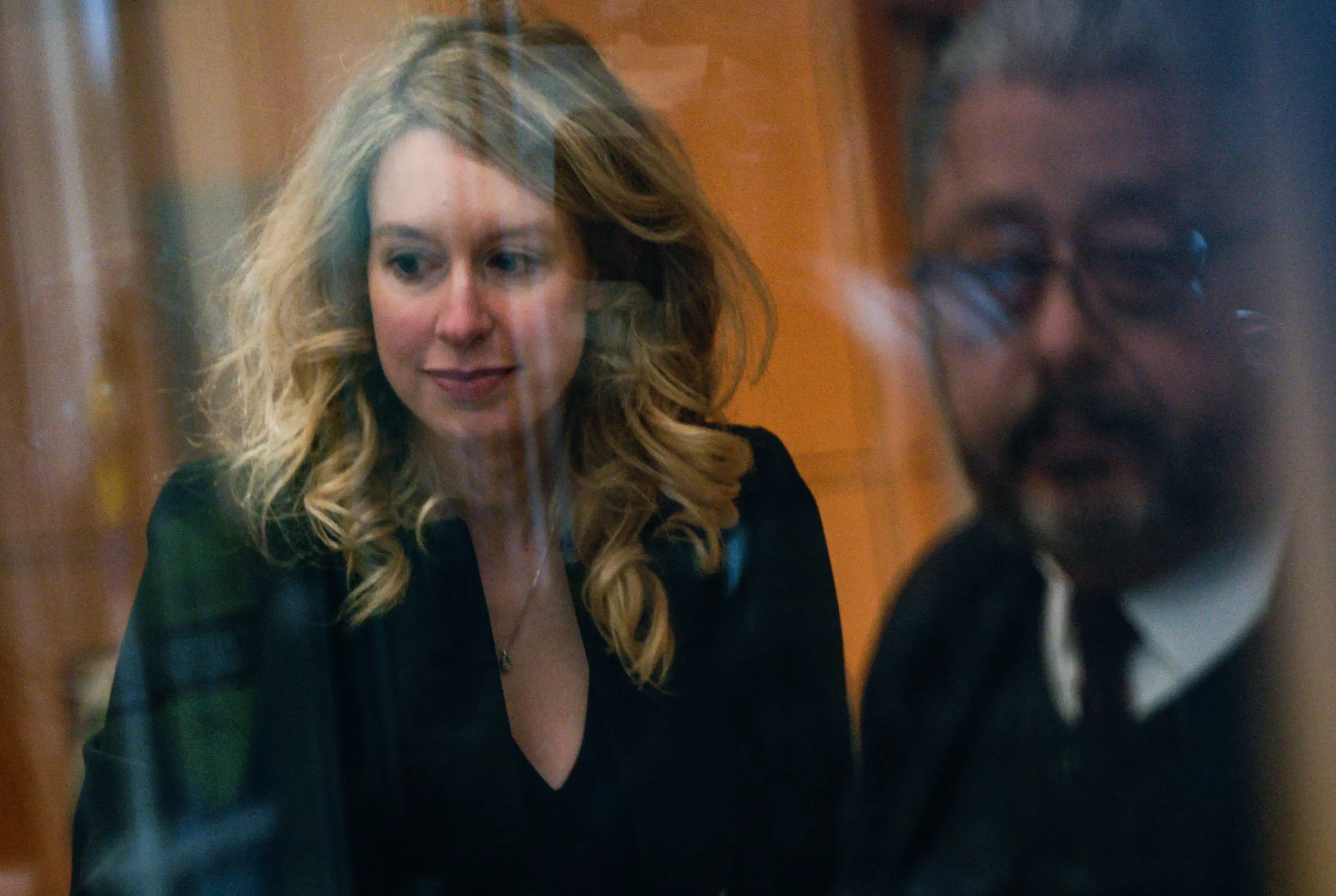
From an X account maintained on her behalf in federal prison, convicted Theranos fraudster Elizabeth Holmes is promoting a secretly made, nearly three-hour documentary about her final days of freedom — and her attempt to convince the world it got her all wrong.
Read more Golden State Warriors star making appearance at Valley Fair store
The documentary, which astonished critics at its surprise world premiere Sunday night at the Telluride Film Festival, could upend how the public sees her. Though not necessarily in the way Holmes might have intended, early reviews suggest.
As “You Can See Everything” reveals, Holmes was looking to clear her name in the weeks before she reported to prison in May 2023 to begin her 11-year sentence for defrauding investors in her defunct Palo Alto blood-testing startup.
So she invited a camera crew into the San Diego-area beach house she rented with her partner, Billy Evans, and their two young children, offering transparency. The filmmakers began recording 34 days before Holmes entered prison and continued following the family over three years.
The film will make its theatrical debut Oct. 16.
Holmes placed her story in some decidedly unusual hands. One co-director is Lance Oppenheim, the acclaimed documentary filmmakers whose forthcoming feature “Primetime,” about the reality TV show “To Catch a Predator,” is expected to make a splash this awards season.
The other is Canadian comedian Nathan Fielder, known for his absurdist take on reality in shows such as “Nathan for You” and “The Rehearsal.” He serves as Holmes’ main interrogator.
Fielder initially planned to remain behind the camera with Oppenheim. But his interactions with Holmes and Evans became so “strange and unnerving” that he wound up taking a central role in the film, he said after the Telluride screening, according to the New York Times.
The documentary also contains another jaw-dropping revelation: Holmes and Evans discuss plans “to launch a new and improved Theranos,” the Times reported.
In the hands of Fielder and Oppenheim, “You Can See Everything” isn’t really a “pure” documentary, Variety’s veteran critic Owen Gleiberman wrote. Instead, “it’s a one-of-a-kind, reality-TV-as-hangout-movie psychodrama circus.” Yet it has also “been made with a spirit of true inquiry,” driven by Fielder’s quizzical personality, Gleiberman added.
The film features long, intense conversations between Fielder and Holmes, often shown in extreme close-up. The comedian appears less interested in relitigating Holmes’ guilt than in trying to understand her.
“He wants to know what made her tick,” Gleiberman wrote.
One of those conversations is highlighted in the trailer Holmes is promoting.
I’m always being real. pic.twitter.com/4C95rfFNCl
— Elizabeth Holmes (@ElizabethHolmes) September 7, 2026
An incredulous-looking Fielder stares at Holmes as the Stanford dropout and former billionaire tells him, “I’m not that person, I can promise you that.”
In the tight close-up, Holmes bears little resemblance to the polished, black-turtleneck-wearing entrepreneur who once presented herself as Silicon Valley’s next great visionary. But there is a hint of the signature deep voice she was widely reported to have adopted to project authority.
“I don’t have anything to deceive you on. I’m engaging with you as a human being,” Holmes continues, punctuating her promise with a smile and nod.
“You’re being real right now?” Fielder asks, sounding less than convinced.
“I’m always being real,” Holmes says.
During the exchange, the sound of a fussing infant can be heard. An ominous, pulsating soundtrack begins to play as the camera pulls away to reveal the living room of the beachside home and the infant in a bouncy chair.
That is Holmes and Evans’ daughter, Invicta, who was born a couple of months before her mother reported to prison. The couple’s son, William, then 20 months old, was also living in the home.
Read more Michael J. Fox’s Parkinson’s battle has ‘gotten harder,’ but he’s hopeful
Making the movie was “a top-secret” endeavor, and Sunday night’s screening was similarly shrouded in secrecy reported Deadline critic Pete Hammond who suggested criticis were asked to not reveal some of the film’s “astonishing twists and turns and jaw-dropping surprises.”
But critics have described the astonishing level of access Fielder and Oppenheim gained to a Silicon Valley figure who has generated years of fascination in popular culture, largely as a cautionary tale. Fielding moved into the home and was there for moments “many would consider off limits,” the New York Times’ Nicole Sperling wrote.
“It is unlike any I have ever seen in terms of pure access. These people appear to hide nothing,” Hammond wrote.
Fielder lets the camera frequently capture his incredulous and hilarious facial expressions as he grills Holmes and Evans with challenging questions. At one point, viewers see Evans shower for reasons not yet disclosed. Gleiberman described Evans, an heir to a luxury hotel chain, as an “aggro control freak” with “a dark side.”
Holmes continues to maintain her innocence in the film and denies that Theranos was anything but a legitimate enterprise, Hammond wrote. Gleiberman said she comes across as believing her version of reality, with “a wall of denial” and “an indifference to the harm she might have caused, that borders on the sociopathic.”
Theranos collapsed after the Wall Street Journal exposed deceptive claims about its blood-testing technology in 2015. A federal jury in San Jose convicted Holmes in 2022 of three counts of wire fraud and one count of conspiracy for bilking investors out of hundreds of millions of dollars.
Holmes lost an appeal last year but continues to maintain her innocence, both in the documentary and through her unlikely social media presence.
Holmes is not permitted to access the internet or social media from the minimum-security Federal Prison Camp in Bryan, Texas, according to the U.S. Bureau of Prisons. Her X account describes its posts as “Mostly my words, posted by others.” Evans took over the account after Holmes entered prison, according to the Los Angeles Times.
Holmes is no stranger to having her life and her persona as a supposedly brilliant female tech wunderkind dissected by others. Her story has been the subject of bestselling books, podcasts, documentaries and the limited series “The Dropout,” which won Amanda Seyfried an Emmy for portraying Holmes, complete with her signature Steve Jobs-inspired black turtleneck.
But Holmes never participated in any of these projects. Ahead of her sentencing, she sat for an interview with the New York Times. Then she invited Fielder, Oppenheim and the rest of their crew into the home she shared with Evans.
Neither Holmes nor Evans has seen the finished documentary, according to the Los Angeles Times.
Fielder said that even after three years immersed in their world, he still does not know what to make of Holmes or how much of what she says can be believed.
“I really am struggling to this day to understand exactly what I experienced in this,” he said after the Telluride screening, according to the Los Angeles Times. “I don’t quite know what I went through.”
Read more Coroner calls San Jose girl’s death at center of child welfare probe homicide, cites medical neglect
About the Author