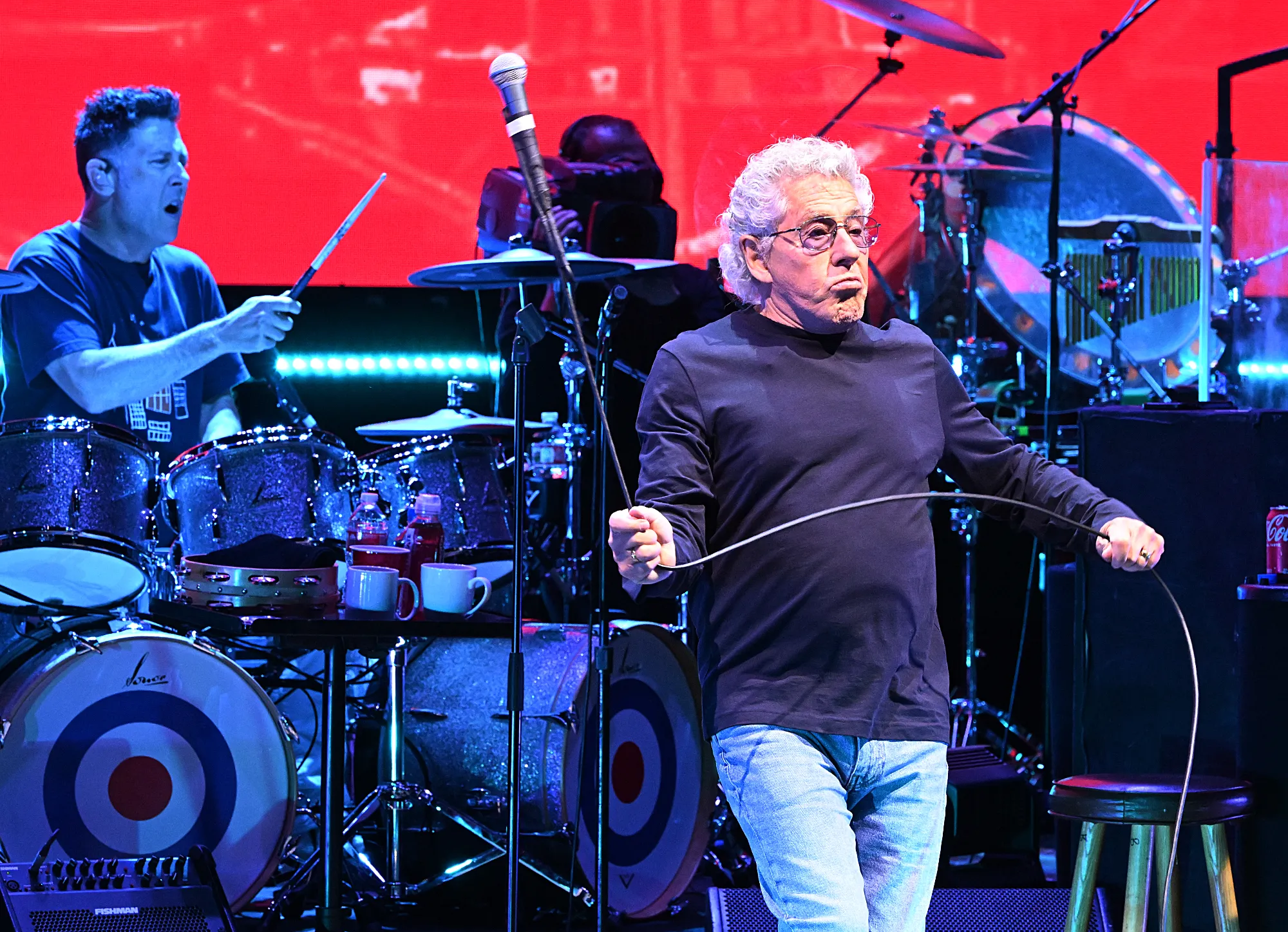
When The Who brought its North American farewell tour to Shoreline Amphitheatre at Mountain View last September, many fans likely assumed it would be their last chance to watch vocalist Roger Daltrey perform in the Bay Area.
Read more Firefighters are trying to stop a fast-moving Nevada wildfire from spreading to homes in Reno
Well — surprise! — the 82-year-old rock legend is heading back our way with a solo trek that touches down at the Mountain Winery in Saratoga on Sept. 2.
Showtime is 7:30 p.m. and tickets start at $69.91; mountainwinery.com.
Daltrey will be performing from the multiplatinum-selling songbook of The Who, the Rock and Roll Hall of Fame act that he co-founded with guitarist-songwriter Pete Townshend and late-great bassist John Entwistle in 1964 and soon also included drummer Keith Moon (who died in 1978).
Yet, the singer will also be drawing from his extensive solo catalog, built from 10 albums released from 1973 to 2018.
I recently had the chance to chat over Zoom with Daltrey, who was at his home in Sussex and busy packing for the North American tour at the time.
And there was plenty to talk about, including the fact that Daltrey received his knighthood this past December from the Prince of Wales at Windsor Castle. The honor came in recognition of his decades making music as well as for raising millions for the charities Teenage Cancer Trust and Teen Cancer America.
Q: First off, let me address you by your correct title and name — Sir Roger Daltrey. Have you gotten use to being called that yet?
A: No. I mean, it’s an honor and I don’t belittle it. But I count the honor more for everybody who’s helped me with the charity — to do what we’ve done in the last 35 years. That’s what it means to me. The honor goes to the work that we do and I carry it with pride.
But I don’t use it. I’m Roger Daltrey.
If you want to use (the title), it doesn’t bother me. But I don’t.
It doesn’t put your bum on a better seat, let’s put it that way.
Q: Oh, wow, I kind of assumed it would. But, as an American, I’m not sure I can fully understand the significance of being knighted.
A: Well, it goes back centuries. But it’s not a ladder I’ve ever really cared about climbing. I’m glad I’ve kind of made the top rung. I’m not ashamed of that, but it wasn’t what drove me.
What drove me was the work I was doing for the Teenage Cancer Trust and Teen Cancer America. It was the purpose of what I was doing. And that’s where having that kind of honor attached to your name and the charity can open doors and then that becomes very useful for fundraising.
Q: For those who’ve seen you with The Who, but have not yet experienced your solo act, how do the two shows differ? Besides the obvious, of course — no Pete.
A: It’s a totally different gig. I have a band that consists of a harmonica player (Steve Weston), a squeezebox and keyboard player (Geraint Watkins), a percussionist (Jody Linscott), a guitarist (Doug Boyle), a bass player (John Hogg), a mandolin player (Billy Nicholls) and Simon Townshend on guitar as well.
We do a lot of very different songs. I do quite a few of my solo songs and I try to re-present some of the really well-known Who songs like “Won’t Get Fooled Again” and “Baba O’Riley.” I do them without the tape loops, without the synthesizers and without all the electronics. We do them on instruments, so it’s a whole different noise.
And I try to get the audience to join in. I’ve given up trying to do the scream on “Won’t Get Fooled Again” in my solo show. Instead, I get the audience to do it — now you suffer.
Q: That’s hilarious. I actually have in my interview notes to ask you if you ever got tired of doing that signature huge “Won’t Get Fooled Again” scream — because it’s got to be so taxing.
A: Well, that’s what it’s like with The Who. But now I just make the audience sing it and I say, “You can go on with the sore throats.”
Q: Were there some nights back with The Who when you felt like you’d really nailed that scream and then others when you felt like you didn’t quite get there?
A: You go for it every night. The intention is everything.
That’s the one thing I’m proud of with The Who — there was never any cheating.
You can’t cheat The Who show.
It’s foot to the floor, pedal to the metal and full-on rock. There’s no cheat in it at all.
It’ll catch you out every time if you try.
Q: Your solo catalog lives in the massive shadow of all of The Who’s mighty accomplishments and, thus, hasn’t gotten the attention that maybe it should have. How satisfying is it to you to get to spotlight that work in concert and maybe introduce some of your solo music to people?
A: I’m just having a great time. And the main reason I’m doing it is that — here I am at 82-years old and suddenly I’m singing better than I’ve ever sung in my life.
I can still hit a D — the top D. I mean, it’s ridiculous.
That’s two above Pavarotti’s, you know, note for the (1990) World Cup. (Laughs)
So, I’m thinking, I was given this gift, I should be out there and just use it.
Q: Absolutely. Plus, this tour allows people to know you better as a solo artist. And I think some fans might be surprised to learn that you’ve put out 10 solo albums, dating back to 1973.
A: My solo career was really always a hobby. But, of course, you sign a record deal and all of a sudden you’ve got to produce stuff and that became a problem.
But it was just something to do when The Who wasn’t doing anything else and it was born out of boredom, basically.
Q: I took my daughter to her first Who concert last year at Shoreline Amphitheatre — thus introducing yet another generation to the band. Why do you think the music of The Who has remained relevant and important to fans generation after generation?
A: It’s very difficult to be precise about that, but my feelings are that it speaks to them — it doesn’t shout at them. That’s what I feel. It connects, it doesn’t just scream at them.
There’s more going on. Musically — Townshend — you can’t take it away from him. Those early songs and some of that stuff was so courageous, so good.
Q: Well, you definitely sounded great at that Shoreline show we saw last year. What’s been your trick — your secret — to keeping your voice in tip-top shape?
A: My vocals, well, I got lucky with them. Because I did have a pre-cancer that pulled my vocals down between 2005, 2010, when it was getting raspy and it was not good at all — you know, the kind of Rod Stewart syndrome.
Sorry, Rod.
But I managed to find a genius surgeon who fixed me up, and, like I say, I’ve been singing better and better and better ever since. But, equally, it also had a lot to do with that I suddenly realized that all my life I’ve been quite deaf from (working at) the sheet metalwork factory.
So, all of sudden, I had these in-ear monitors and, for the first time ever, I could (expletive) hear what I was singing, and that makes quite a difference.
Q: And what did you think upon truly hearing your singing voice for the first time?
A: Well, it made life so easy. You know, there’s nothing worse than screaming your head off and hearing nothing, which was happening. All through all through the ‘70s, we had very little monitoring. So, you’re just singing blind and you’re just hoping you’re in the right key.
But, fortunately, I do have perfect pitch and I was in the right key and we got away with it.
Q: What was the experience like last year of being on The Who’s farewell tour and saying goodbye to all the fans?
A: It was kind of bittersweet, but something that I’m proud that we did in the way we did it.
And we were very clear at the time that this wouldn’t be the end of shows in America, we might decide to do a couple of one-off shows, but we’re not gonna do any tours.
Touring America is incredibly wearing on the body, especially for the singer. It’s brutal, so it has to end sooner or later. And it feels like the right time because we’re still pretty much at the top of our game.
Pete’s playing guitar — you know, no one plays like Townshend. It’s brilliant. I don’t think anyone else sings like I sing. So, we’re still at the top of that game and it was time to stop. Best to stop on top, not when you’re at the bottom.
And that’s what we’ve done. But we might be back for a one-off show. We’re always there for you. America’s been very good to us.
Q: Have you thought about doing a residency at the Sphere in Las Vegas? Then you’re not doing the traveling — the fans are.
A: So many people coming in there getting stiff necks? No, it wouldn’t be for me. I’ll never say never, but I don’t think it’s our kind of venue, is it? I haven’t seen it, so I can’t comment.
But it doesn’t feel like a Who gig to me. It feels like something else that isn’t quite us.
Q: So, we’ve had the last Who tour of North America. And now I’m reading in your press release that this could be your final solo tour here as well. Do you really feel that way? That this could indeed be the last time?
A: I think it is. I don’t know. I can’t tell you till it’s over. And you never say never because this might be the start of something big, you never know.
Although I’m 82, so it can’t be that big, But I’m just enjoying my life and I love to sing.
Musicians are having a hard time at the moment. I’m employing nine of them in my band, so that’ll keep them fed for the year. That’s all that matters to me.
Q: So when fans bring up the topic of the powerhouse rock quartets — in terms of the quality of the musicianship in the band — the talk often comes down to either The Who or Led Zeppelin ranking in at No. 1. So, I’m wondering what’s your call — The Who or Led Zeppelin? Which one was better?
A: Well, it’s like it’s comparing chalk and cheese.
Character wise, you’d have to give it to The Who, wouldn’t you? You had Moon. I mean John Bonham was a lunatic. But he didn’t have quite the personality as Moon, did he?
And I don’t think that their music carries quite the weight of Townshend’s music either.
I mean, I think it’s very good in its bracket — and I don’t dislike them. But you can’t really compare the two. It’s just stupid.
Q: But the fans sure love to do it.
A: Yeah, well they just like to cause trouble.
Q: Speaking of causing trouble, I just wanted to tell you about a time The Who almost got me into trouble back when I was like 12-years old. I was jumping up and down on my childhood bed, doing guitar windmills and trying to be like Pete, while listening to “Who Are You” on top volume — and I ended up breaking the bed frame. I would spend weeks sleeping on a broken bed because I was too nervous to tell my parents what happened. So, by my score, you owe me a new bed frame.
A: No, I think you owe yourself learning how to fix a bed. Cause, I mean, if that had been me, I would have been straight down the road for some Cascamite (wood glue) and a clamp and I would have fixed it. But then I was brought up on a bomb site and we had to repair everything. That’s what we did.
Read more Officials warn wildland firefighters about the risks of using a supplement for smoke exposure
About the Author