People tend to have the same question when they learn that Catherine Breed is swimming the length of California, 900 miles in the open ocean from the Oregon border down to Mexico:
Read more High school football 2026 preview: PAL Ocean Division
What about sharks?
Breed, a Mill Valley resident and one of the world’s top open-water swimmers, knows there are great whites in the water with her. She isn’t especially concerned.
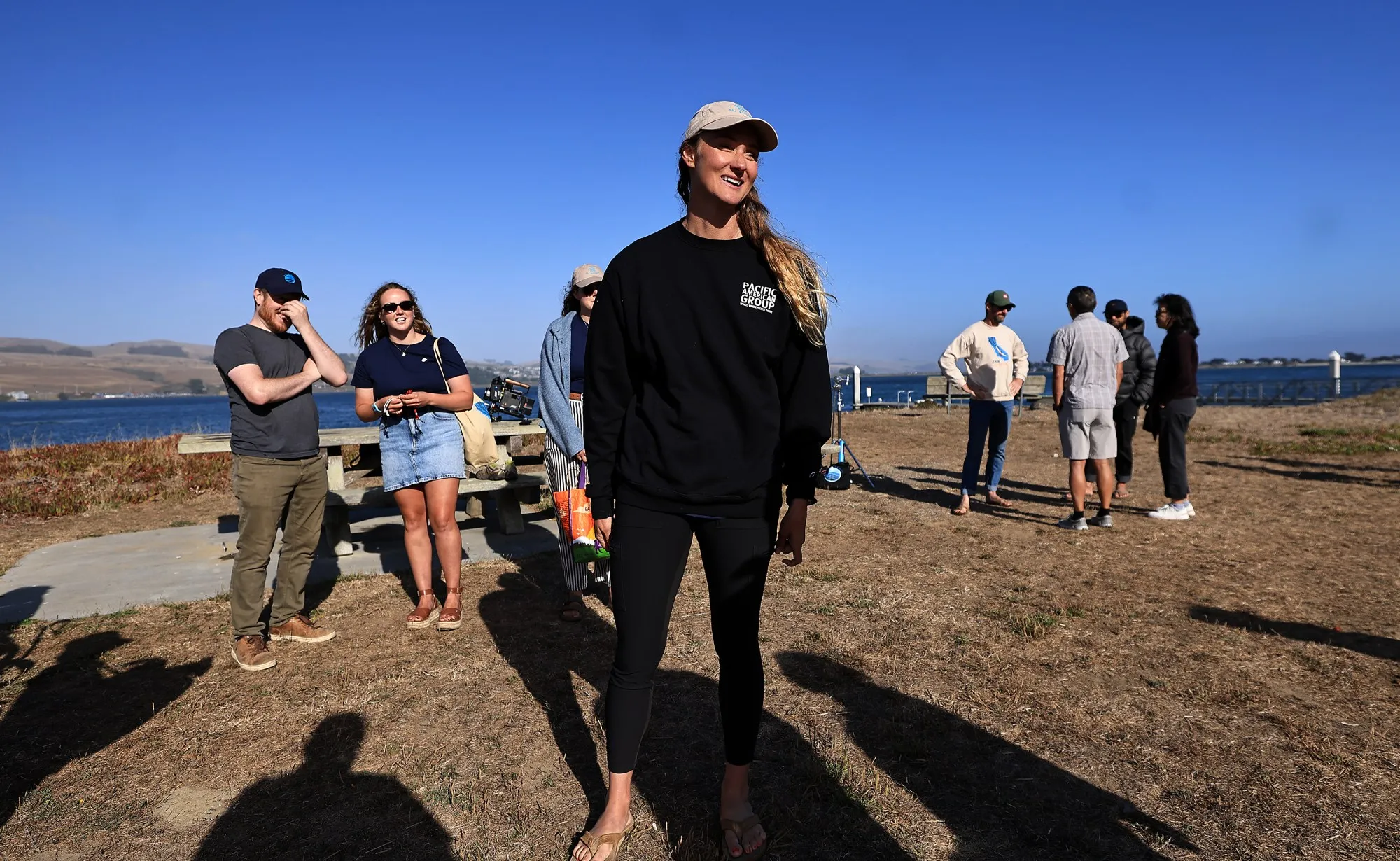
“They are there. They are fish,” said the 33-year-old aquanaut on Sunday afternoon, having emerged from the Pacific long enough to share an update on her quest — never before attempted — with the 200 enthusiastic supporters who gathered at Westside Regional Park overlooking Bodega Harbor.
“The reality is, I’ve got a 52-foot sailboat that I’m one to two meters from, and another boat on the other side of me,” said Breed, a former NCAA champion at UC Berkeley who holds multiple open water records, including her historic swim of the length of Lake Tahoe, and a 30-mile ultramarathon from the Farallon Islands to the Golden Gate Bridge.
“So I am tucked in between two very large, noisy vessels that any fish is going to try to avoid.”
While Carcharodon carcharias are a consideration, they’re not as high on her list of concerns as boat propellers, she allowed, “and fear of failure — fear of not making it to San Diego, especially when I have so publicly put myself out there.”
Despite plenty of rough days full of big swells and uncooperative currents, Breed is slightly ahead of schedule with Swim California, the expedition’s formal name. As of Sunday, she’d covered 314 miles in her first 40 days.
Beyond the black line
Before discussing how the adventure is going, Breed talked about why she undertook it in the first place — a story that begins with the end of her collegiate swimming career in 2015.
“I still loved swimming. But I did not want to look at that black line anymore.”
Finished with pool racing, but not with racing, she joined the famed San Francisco-based Dolphin Club, whose members train in Aquatic Park Cove. When Breed started winning events, her clubmates started urging her to swim the English Channel.
As a warmup to that iconic crossing, she swam the length of Lake Tahoe, 21.3 miles from Camp Richardson on the south shore to Incline Village, Nev., on the north shore, in the process breaking a 40-year-old record. A year later she swam the iconic, 21-mile strait between England and France in 9 hours, 50 minutes, sans wetsuit.
In 2019, Breed plunged into the chill Irish Sea to freestyle her way across the notoriously churlish North Channel between Ireland and Scotland. Conditions were rough: winds from the north at 10-plus knots, water temperatures hovering just above 50 degrees, lion’s mane jellyfish all about.
Breed went into the swim hoping to set a Guinness World Record, but finished “very far from that,” she recalled.
“What I learned on that swim is that you cannot take hubris into the ocean. And so I started kind of surrendering to these marathon swims — realizing I’m not in a pool anymore. I can’t set a time goal and just think I’m going to get it.”
Last year, as a tune-up for “this monster,” said Breed, referring to her 900-mile odyssey, she tackled the treacherous 30.2-mile swim from the Farallon Islands to the Golden Gate Bridge.
While shark-free, despite the profusion of great whites known to inhabit those seal-rich waters, that epic didn’t lack for drama. Breed spent four hours in the middle of the night powering through a dense “bait ball” of sardines, jellyfish and seabirds. Two miles from the bridge, her core temperature dipping after more than 12 hours in the water without a wetsuit, she told the crew she wanted to stop. With their encouragement, Breed kept going, and broke the record by three minutes.
Water as sanctuary
While she may be an Aries, astrologically speaking, Breed is a piscine creature, very much at home in the water. Growing up in Pleasanton, her family undertook sailing excursions in French Polynesia, New Zealand and Baja, Mexico.
“I grew up in these waters. I surf these beaches,” she told her audience Sunday. “I spearfish. I love sailing. I come here to trail run, to bike.
“Why I’m swimming the coast is, I love this place so much.”
A goal this ambitious, she added, requires “a bigger why.”
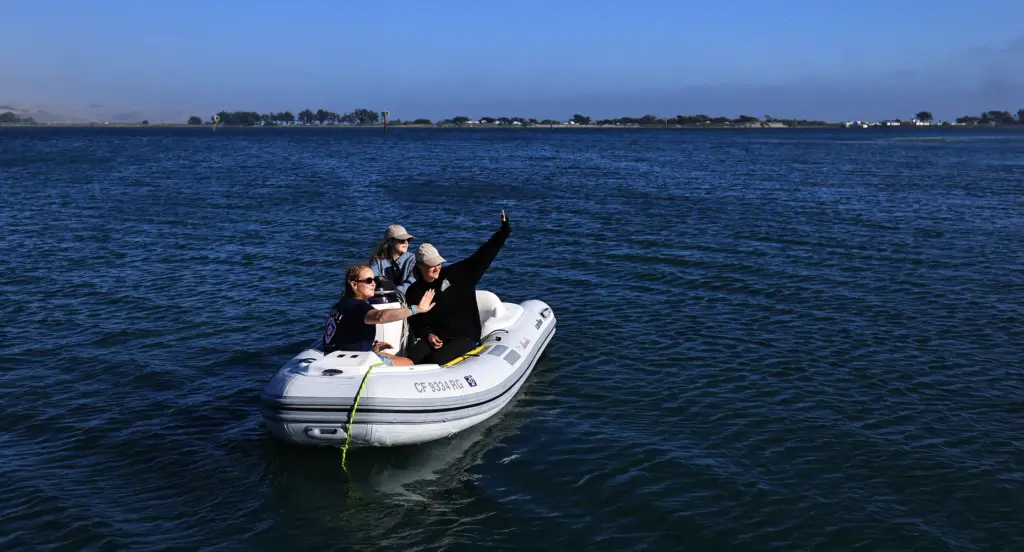 Ultra endurance swimmer Catherine Breed right with crew members Heather Hitchcock, left, and Maisie Bristow head for shelter in Bodega Bay, Sunday, August 9, 2026, after a stop to greet friends and family during her historic 900 mile swim down the California coast. Kent Porter / The Press Democrat)
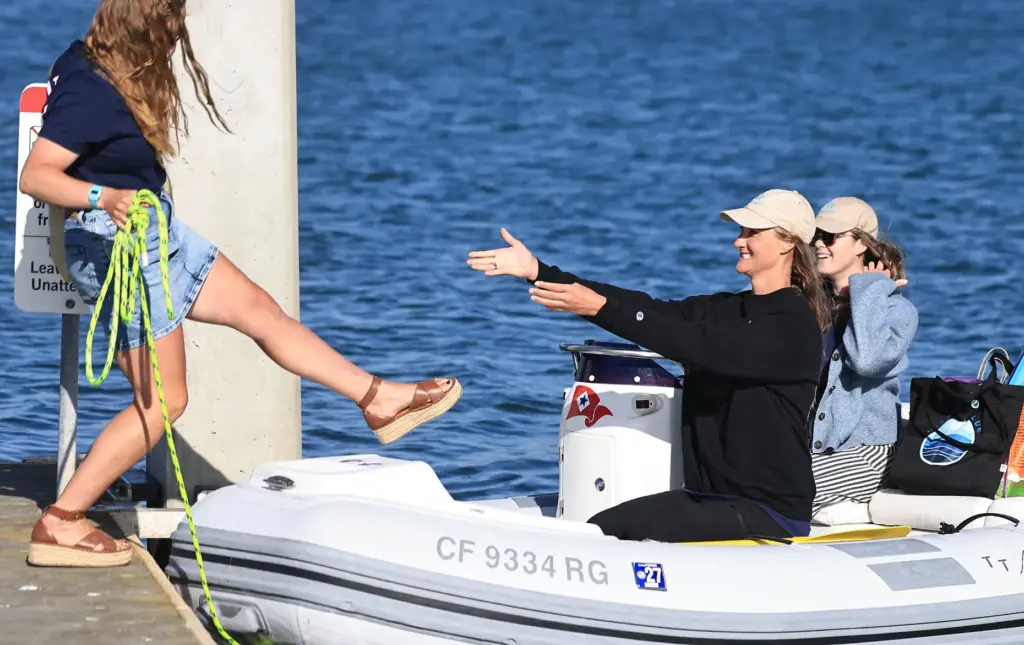 Ultra endurance swimmer Catherine Breed offers a helping hand to crew member Heather Hitchcock, left, as Breed and Maisie Bristow head for shelter in Bodega Bay, Sunday, August 9, 2026, after a stop to greet friends and family during her historic 900 mile swim down the California coast. Kent Porter / The Press Democrat)
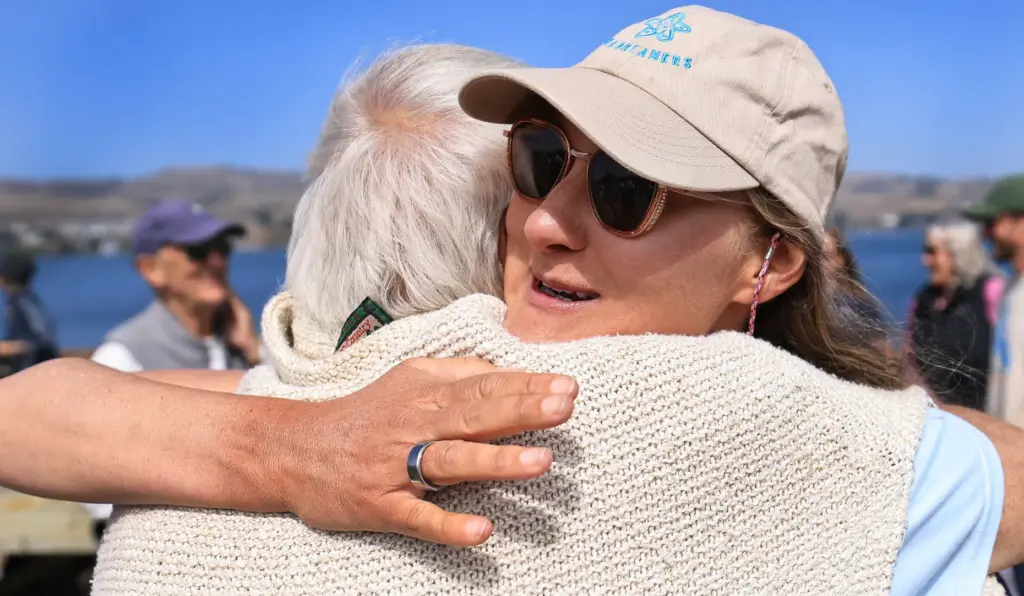 Catherine Breed greets her grandfather Leonardo Vacchina during a stop on her historic 900 mile open water swim off the coast of California for a meet and greet with family and friends at Westside Regional Park and Campground, Sunday, August 9, 2026, in Bodega Bay. (Kent Porter / The Press Democrat)
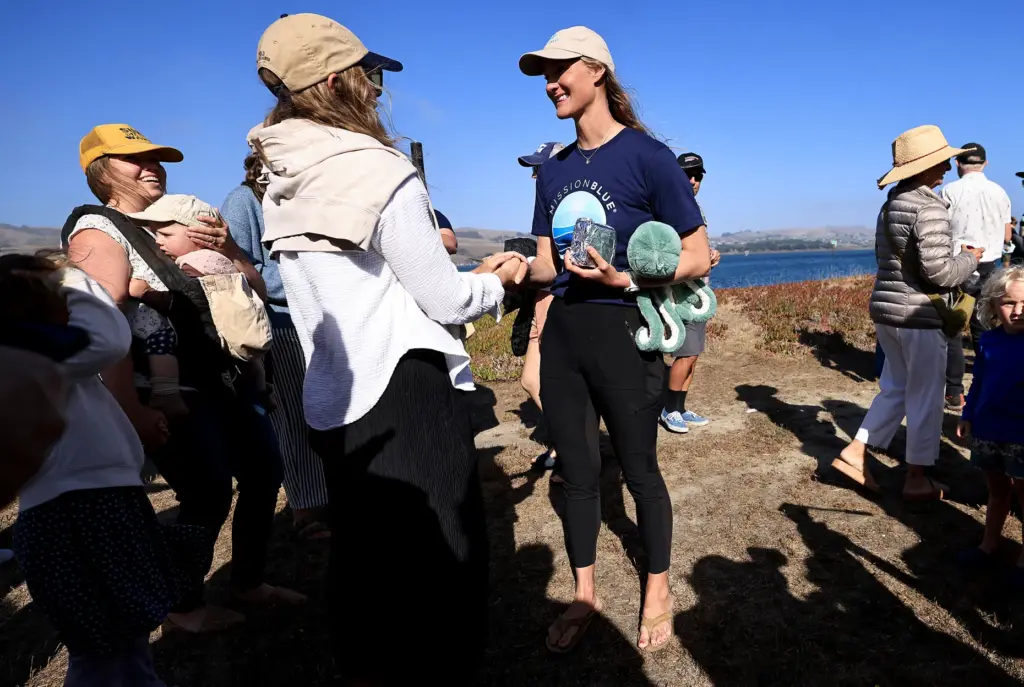 About one-third of the way through her historic 900 mile open water swim off the coast of California, distance swimmer Catherine Breed holds a meet and greet at Westside Regional Park and Campground, Sunday, August 9, 2026, in Bodega Bay. (Kent Porter / The Press Democrat)
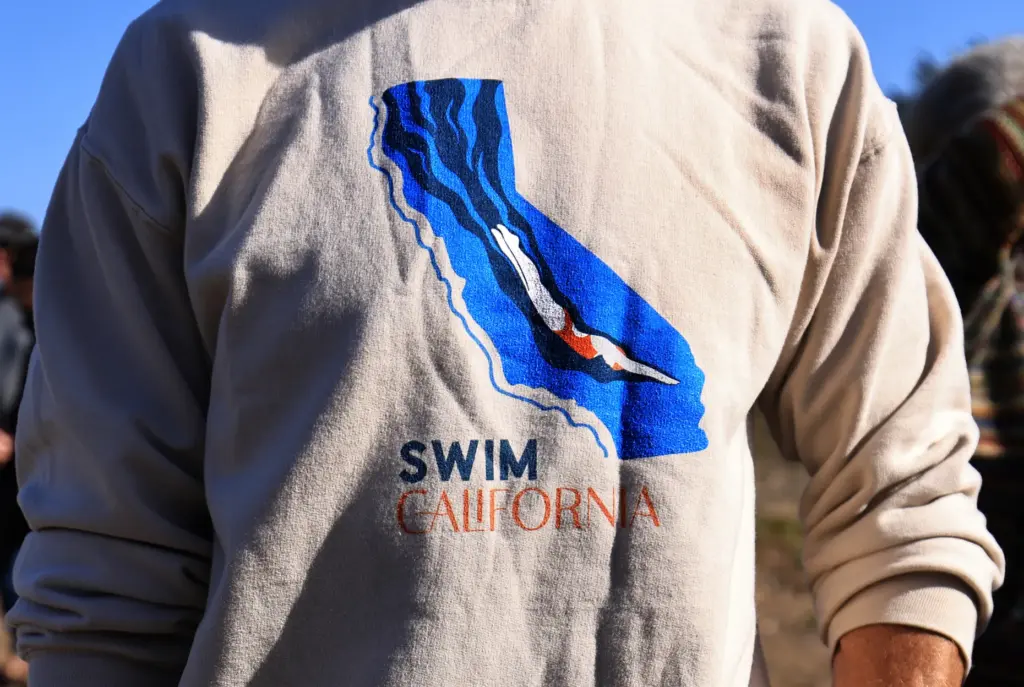 A friend of Catherine Breed wears sweatshirt supporting the ultra endurance swimmer Breed, as she holds a meet and greet at Westside Regional Park and Campground, Sunday, August 9, 2026, in Bodega Bay. (Kent Porter / The Press Democrat)
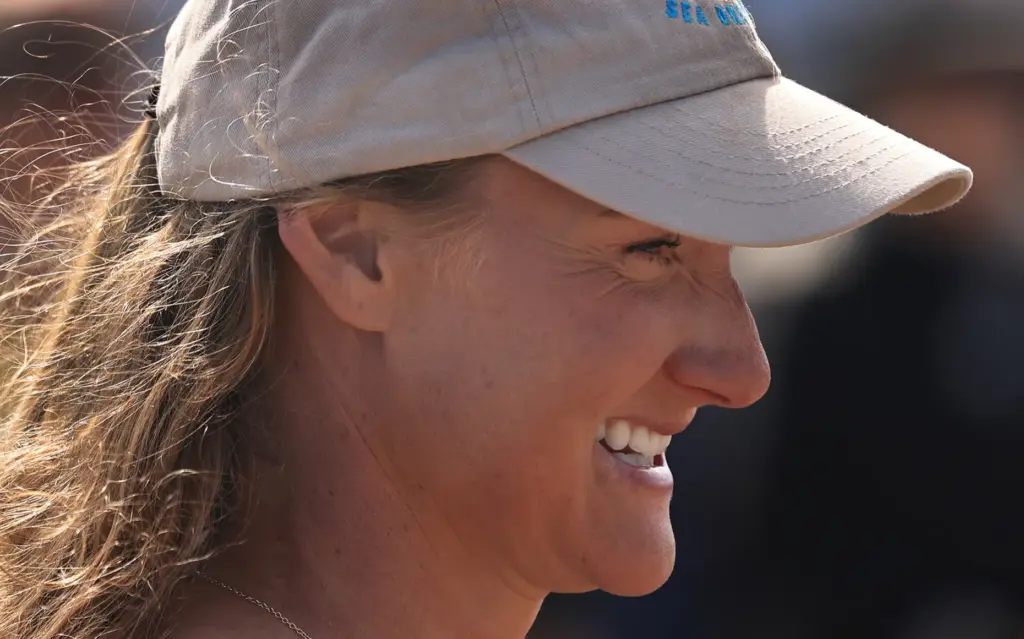 About one-third of the way through her historic 900 mile open water swim off the coast of California, distance swimmer Catherine Breed holds a meet and greet at Westside Regional Park and Campground, Sunday, August 9, 2026, in Bodega Bay. (Kent Porter / The Press Democrat)
To power through periodically miserable interludes, such as Day 39, “you need something bigger than yourself to keep going.”
That something, in this case, is “to tell a story of the coast, the people the places, the problems.”
As she makes her inexorable way south at an average of 66 strokes per minute, 2.6 miles per hour, Breed is shining a spotlight on the groups and people protecting that coastline.
Visitors who might’ve come to Bodega Harbor to see a world-class athlete were also the beneficiaries of a crash course, conducted by Maria Brown, vice president of the Greater Farallones Association, on how an extreme marine heat wave starting in 2013 led to an epidemic of sea star wasting disease. The resulting explosion in the population of purple urchins, in turn, wreaked havoc on the kelp forests that are the “foundation of our ecosystem here,” Brown said.
“We lost more than 90% of our bull kelp in Sonoma and Mendocino County,” she said.
Read more Dry lightning looms as threat with unstable air hitting Bay Area
The state’s prized, fragile abalone fishery — reliant on those forests for food — has been closed ever since. Kelp, Brown explained, “feeds our fish and our wildlife, and provides shelter. When there is a thriving kelp ecosystem, the whole ocean is more resilient.”
Brown then explained how the association, working with scientists at the Greater Farallones and Cordell Bank National Marine Sanctuaries, tribes and the commercial fishing industry, have worked to turn the marine disaster into “a story of recovery.”
In the past year, she added, “we have measured a tenfold increase in kelp canopy cover in one of our restoration sites.”
‘Swimming in an aquarium’
Following Brown to the microphone was Shannon McIntyre Rake, a program manager for the nonprofit Mission Blue, founded in 2009 by the renowned oceanographer and marine biologist Dr. Sylvia Earle, formerly chief scientist of the National Oceanic and Atmospheric Administration.
“Our mission is simple yet urgent,” said McIntyre Rake, “to protect the ocean as if our lives depend on it. Because they do.”
The organization has designated 170 Hope Spots around the globe. Breed’s swim down the California coast will take her through five of them.
“Swimming out here,” she told her audience at Bodega Harbor, “you look at the fog and you look at the dark, murky water, and you think, ‘Oh, there’s nothing there.’
“But it is so the opposite. You guys, this is like swimming in an aquarium out there.”
The postcard backdrop for Sunday’s event — gulls wheeling overhead as pleasure craft plied the placid harbor — belied the conditions Breed has braved many mornings.
After sleeping in her berth on the Catalyst, the mothership for Swim California, she is usually in the water around sunrise, before winds whip up big waves.
Some days she’s had no choice but to take on those swells.
“When I’m swimming in 20 knots of wind and seven-foot seas,” she said, “that means I’m swimming up a seven-foot wave, and then down a seven-foot wave, and sometimes the wind and the waves and the current are all going the wrong direction.”
Matthew Sessions, skipper of the 52-foot Catalyst, said that “getting around Cape Mendocino” and down the Lost Coast was especially difficult.
“We were looking at models, looking at weather forecasts, and then we go out in the morning and the water’s going the wrong way.”
Life will get easier, for Breed and her team, the further south she swims.
Sessions said the team had broken the expedition into three “legs.” The first of those segments, from the Oregon border to the Golden Gate Bridge, accounted for 60% of the “stress level,” he said.
The second leg, from the Golden Gate to Santa Barbara, represented 35%, by his estimate.
The final 200 miles, from Santa Barbara south, should be the smoothest sailing.
“She could do backstroke from Santa Barbara the rest of the way,” he joked.
Breed isn’t getting lonely in the water. Asked by a young girl to name a favorite animal she’s witnessed during her swim, she said it was a “a tie” between the whale that passed beneath her in the early days of the trip (the team has since spotted well over 100 whales), the dolphins that helped her celebrate reaching the 200-mile mark, and “the mola mola I saw the other day.”
A mola mola, she further explained, is a giant sunfish, a “derpy-looking” creature “with big eyes and silly little mouths, and a fin that looks a little like a shark fin when you see it from far away.”
After 40 days at sea, speaking of sharks, the team had seen only two. Both were salmon sharks, which resemble miniature great whites but aren’t known to attack humans. One was three feet, one six feet, said Breed, who described the sightings as “extremely uneventful.”
Rather than worrying about sharks, Breed and the experts around her Sunday worry for them. McIntyre Rake, with Mission Blue, spoke of the importance of protecting sharks, apex predators who are “critical to the health of the ocean.”
The movie “Jaws,” “really hurt the sharks,” she lamented.
“But they don’t want to eat us. We’re not on their menu.”
You can reach Staff Writer Austin Murphy at [email protected] or on Twitter @ausmurph88.
Read more High school football 2026 preview: PAL El Camino Division
About the Author