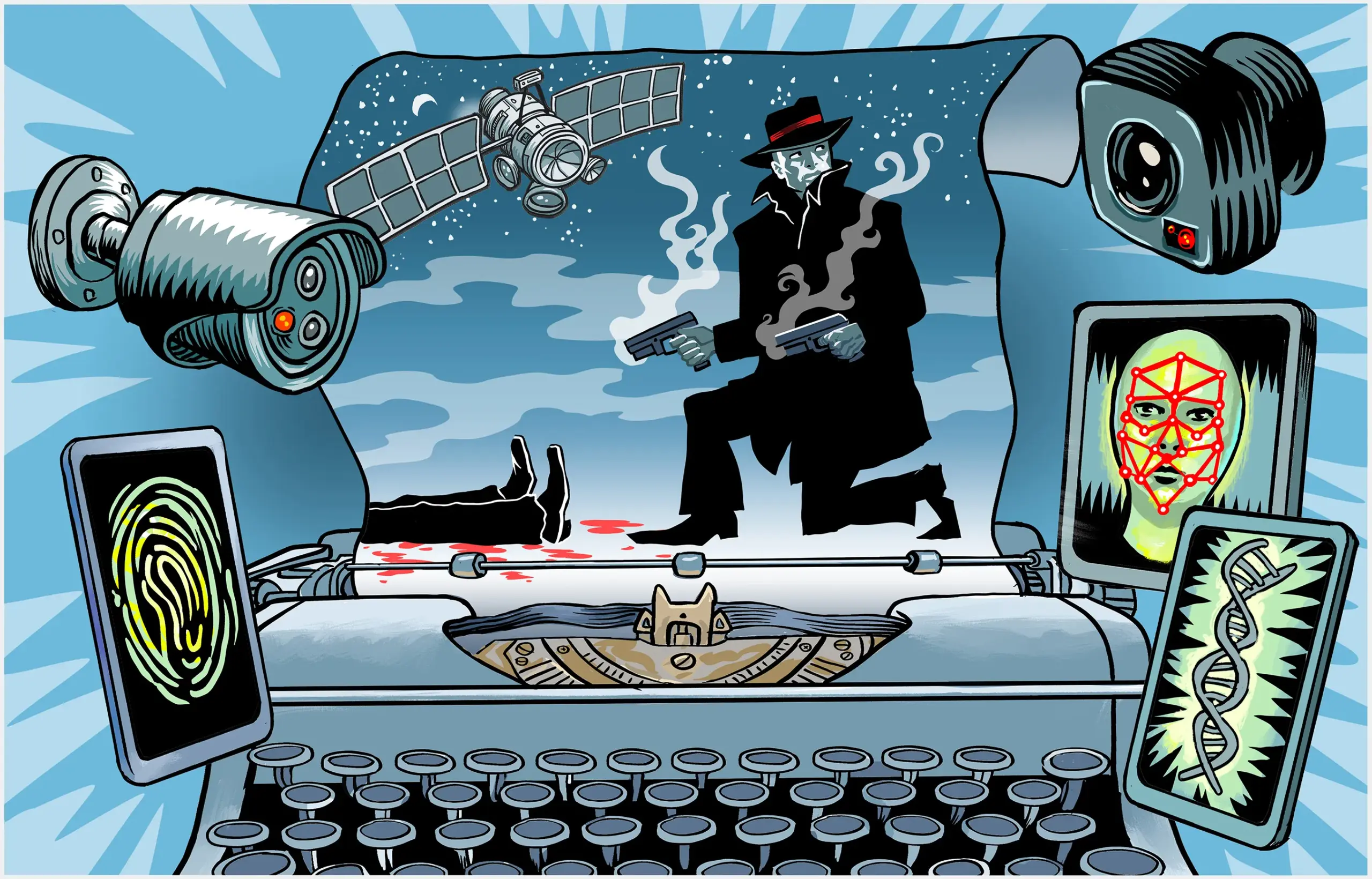
For generations, crime writers could send a killer into the night with little more than gloves, a disguise and a getaway car. Today, the fictional villain must also leave the phone behind, hide the license plate, and dodge doorbell cameras, Teslas and an expanding web of digital surveillance.
Read more Photos: Welcome back! First day of school in Walnut Creek elicits smiles and high-fives
The cameras and data trails helping police solve real crimes have created a new complication for authors of mysteries and thrillers: How do you write a crime story in which the perpetrator can plausibly get away?
Virtually anywhere a person goes, digital eyes watch. Doorbell cameras capture people on sidewalks. License plate cameras track drivers. Closed-circuit TV records patrons inside and outside stores. Bay Area parking lots and roads are full of Teslas, Waymos and delivery robots equipped with cameras that capture their surroundings. Law enforcement drones add eyes in the sky.
For police, this panopticon is a treasure trove. Often, the answer to “whodunit?” is right there on the video.
“Crimes are being solved in real time,” said San Jose Police Department Lt. Todd Jennings, who oversees a special unit with access to images from thousands of cameras throughout the city.
People committing crimes may now run a surveillance gauntlet to and from the scene, leaving a digital trail that can identify them much like fingerprints.
In her latest book, “Too Old for This,” bestselling Bay Area thriller writer Samantha Downing has Lottie Jones, a 75-year-old serial killer, cover her license plate to avoid tracking by automated license plate cameras that have proliferated across the U.S.
“When she’s going to go do something bad, she leaves her phone — she has a little note: ‘Leave phone,’” Downing said. “Because she’s 75 and she forgets.”
Writers who tell tales without accounting for the omnipresence of digital eyes and data trails do so at their peril.
“Readers will not let you get away with it,” said Downing, of Novato. “If you’re writing a story that has a murder mystery, you have to consider all that. I try to use it to my advantage. It would be easier if it didn’t exist.”
Civil-liberties advocates warn that collecting, retaining and sharing images and data about people not suspected of crimes creates opportunities for misuse, including targeting immigrants and perceived political opponents. The Washington Post this month reported that at least 50 officers across the U.S. have been accused by authorities of improperly using license plate camera systems, including to stalk women.
Despite those worries, cameras in doorbells, vehicles and buildings continue to multiply. Police in San Jose and other cities can tap networks of cameras aimed at public spaces, while departments throughout the region routinely request footage from residents and businesses.
Law enforcement agencies can also obtain digital information through search warrants, court orders, subpoenas and emergency requests to technology companies. Police can purchase some location information from data brokers. Depending on the source and legal process, the evidence can include phone-location data, internet search histories and chatbot prompts.
Detective fiction author Mark Coggins, formerly a software engineer and executive at Netscape, Hewlett-Packard, Mozilla and other Silicon Valley technology companies, sets most of his books in the valley. His private-eye protagonist, August Riordan, sometimes needs to travel incognito by road.
“I have him borrow license plates from somebody else and put them on his car, and/or smear mud on the license plate to obscure numbers so they can’t be read by a (license-plate) reader or CCTV cameras,” Coggins said.
Fiction authors can also weaponize technology. In one book, Coggins had “this tech bro killing another tech bro and framing a third party for the murder using AI to create phony footage.” The plot centered on smart glasses capable of recording video.
The burgeoning surveillance, Coggins said, raises the prospect of misuse against people exercising their free-speech rights, including protesters. He expects police eventually to combine smart glasses with facial recognition, and can imagine his private eye taking on a case to exonerate someone falsely identified by the technologies.
“You sort of feel,” Coggins said, “that the noose is tightening with all this stuff.”
No comprehensive count exists of arrests or convictions aided by the expanding surveillance network. Bay Area police frequently tout license plate cameras’ role in identifying and arresting suspects, and departments around the region often solicit imagery from the public — including footage captured by parked Teslas using Sentry Mode — that may show suspects or others connected to crimes.
“DNA still is the greatest invention ever for solving crime, but video evidence from cameras is No. 2,” San Mateo County District Attorney Stephen Wagstaffe said.
His office uses imagery from doorbell cameras, CCTV, license plate cameras and Teslas. Wagstaffe credits Flock license plate cameras with playing a crucial role in three murder investigations and helping secure convictions.
In April, killer John Caisiano Thompson of East Palo Alto was sentenced to 40 years to life for murdering his tenant, Breanna Labat, who has never been found. A license plate camera near Stockton captured Thompson’s pickup truck with what appeared to be a tarp-wrapped body in the back, providing “crucial evidence for the jury” that convicted him, Wagstaffe said.
San Jose police Lt. Jennings said video footage provided by the owner of a parked Tesla was critical to the identification and prosecution of Peter Karasev, who was sentenced last year to 10 years in federal prison for bombing PG&E electrical transformers in San Jose in 2022 and 2023.
Jennings heads the San Jose Police Department’s Real Time Intelligence Center, where officers and analysts track suspects moment by moment using nearly 500 Flock license plate cameras and 1,100 city intersection cameras. Owners of nearly 1,500 residential security cameras have agreed to provide access to the department for investigations.
“All this stuff … ties up a case and puts kind of a bow on it for the D.A.’s office,” Jennings said.
Bay Area literary agent Kimberley Cameron likens today’s surveillance network to George Orwell’s “1984,” in which the government uses two-way video “telescreens” to watch and control citizens.
“That fiction is real today,” said Cameron, owner of Kimberley Cameron & Associates in Tiburon.
Cameron said crime writers should incorporate the technology into their stories, and not merely for veracity’s sake.
“That’s what writing is, it’s a testament to what’s going on in the world,” she said.
To keep fictional villains from falling victim to the surveillance web, some crime writers set stories “in a historical time, where electronic devices aren’t a common thing,” said James L’Etoile, a thriller author, executive vice president of Mystery Writers of America and former director of parole operations for California’s prison system.
“Remote, isolated locations are another option to avoid getting caught up in the electronic dragnet.”
While it’s impossible to be fully “invisible,” said Pacifica computer-crimes investigator and author Robin Stuart, “there’s always a blind spot” in the surveillance.
Because disappearing is much harder in the age of mass surveillance, crime writers often turn to deception, said Stuart, a contributor to the Cyber Detectives exhibit at San Jose’s The Tech Interactive museum. A character identified by cameras might seek out a broker who supplies false identities, she said.
“They have fake documents, passports, credit cards,” Stuart said.
Writers such as Stuart, who spoke in July as an author and cybercrime expert at the Book Passage Mystery Writers Conference in Corte Madera, are key resources for crime writers trying to keep pace with fast-evolving surveillance technologies, said Tim Maleeny, who sets most of his private-eye novels in San Francisco.
“You need, as a writer, to do enough homework, and talk to an expert,” Maleeny said.
In a recent museum-heist book, Maleeny had a character travel through an underground sewer tunnel to avoid the cameras above ground.
Criminals also look for ways to defeat surveillance innovations.
“Every time some technology gets developed, the crooks work on some way to get around it,” District Attorney Wagstaffe said.
When courts impose constitutional boundaries on surveillance — as when the U.S. Supreme Court ruled in June that obtaining blanket cellphone-location data identifying people near a crime scene constitutes a Fourth Amendment search — law enforcement may seek other tools, said UC Berkeley law school professor Jonathan Simon.
The ruling represented a “very significant potential step back, away from the total-surveillance society,” Simon said. But he expects law enforcement to respond by expanding camera networks to “create an ability to track people that’s almost as strong as the cell phone model.”
Simon pointed to a growing market for surveillance systems developed by U.S. companies including Axon, Genetec and Motorola, and Israeli firms including Cognyte and High Lander.
Short of reaching the “precrime” enforcement system imagined in Philip K. Dick’s “The Minority Report” and the blockbuster film it inspired, where police can arrest people for offenses they’re destined to commit, fictional villains “can still act faster than law enforcement,” said Utah mystery and thriller writer Mettie Ivie. But the prevalence of cameras makes it harder for a criminal to remain on the run for long, forcing authors to rethink the pace of their stories.
“It does compress the timeline,” Ivie said.
And, she added, “It makes for more interesting villains — they have to be more sophisticated.”
Read more Crab Omelets and Drunken Spaghetti: Thai-style brunch comes to Concord
About the Author