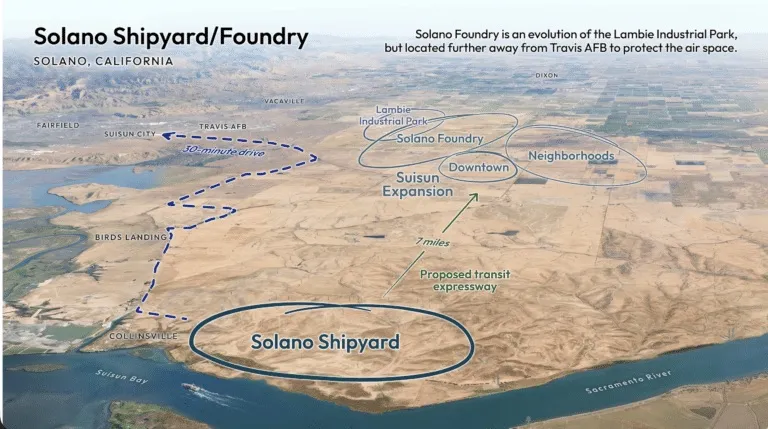
California Forever cannot afford to follow through on its promises to bring jobs with its Solano Shipyard and Solano Foundry proposals if the residential elements of its unpopular Suisun Expansion Specific Plan are not streamlined and permitted, according to a blog post released by the company Tuesday afternoon.
Read more The Bay Area’s largest music festival adds even more acts to lineup
“Some elected officials have voiced support for a faster permitting pathway for the Solano Shipyard and the existing Lambie Industrial Park, but not for the Suisun Expansion,” the blog post reads. “The Suisun Expansion includes the Solano Foundry, an evolution of Lambie Industrial Park, located further away from Travis AFB to protect its airspace, as well as new neighborhoods, homes, shops, schools, and parks. This is a mistake. Narrow legislation that excludes the Suisun Expansion will not bring major employers to the county.”
RELATED: $3.2 billion shipyard project chooses Texas over California Forever
Approval of a “shipyard and foundry only” plan would not be a compromise, the company said, but “a guarantee that these employment centers are approved on paper but never get built.”
Unlike other states, the company wrote, the state of California has not offered public funds for the water, wastewater and other infrastructure that the Shipyard would require.
“This infrastructure can be financed privately, but only if these facilities are part of a larger development,” the blog post reads.
The post makes clear that further private funding could become contingent on governmental willingness to streamline around the standard permitting process for not only the shipyard and foundry, but also the residential component.
“Approving a bigger project allows private capital to step in and fund the infrastructure that makes an employment-generating industrial site viable,” the post reads.
The blog post references data from the Federal Reserve Bank, which illustrates that Solano County has built less than 1,000 housing units on average each year for nearly two decades— a number California Forever claims is well below demand.
“No company will site a large shipbuilding or manufacturing facility in a region with this housing profile without a long-term, multi-decade guaranteed supply of homes for its workforce,” the post reads. “Neither should Solano County leaders want them to, because without new housing, the existing supply will be further squeezed and less affordable for everyone in the community.”
Read more Wayward SpaceX rocket slammed into the moon, scientists say
Shipbuilders and manufacturers are looking for mixed-use neighborhoods at a variety of price points, according to the blog post, such as those proposed in the Suisun Expansion Plan. Without sufficient new housing in a county already facing a housing shortage, the company claims, it would not be logistically viable for new employers to locate at the shipyard or foundry.
“Without these assets, these companies are not interested.” the post reads. “Industrial leaders know this, elected officials know this, and this conclusion is echoed by research from a wide array of sources, including the Congressional Research Service, Government Accountability Office, and Federal legislative action.”
California Forever’s blog post pointed out that Lambie Industrial Park, which is located in the unincorporated area near where the project would be placed, remains largely undeveloped. They noted the Puget Sound Naval Shipyard, the largest current ship repair complex on the West Coast, which employs 15,000 military and civilian residents and is built directly into the community of Bremerton, Washington alongside residential areas.
“First designated for industrial use 46 years ago, less than 5% of Lambie’s 1,400 acres have ever been developed. Not a single major employer is located here,” the post reads.
The post claims Solano County can implement the lessons other regions have learned about locating residential neighborhoods close enough for short commutes, but not too close for comfort.
“To be clear, there is such a thing as a goldilocks distance: not too far away, but not too close, either,” the post reads. “As American cities grew up around their shipyards, often residential development got too close, and encroached upon these facilities, generating community friction and division.”
The company also acknowledged the huge amount of funding required to place a shipyard and residential development in greenfield areas. It noted that the 1989 Collinsville-Montenzuma Hills Development Area Study identified a lack of infrastructure and remoteness as significant barriers to development in the area they have been proposing for three years.
“The scale of the Solano Shipyard and the Solano Foundry is one of Solano’s unique differentiators, but it comes with a price tag,” the post reads. “To bring these remote sites to market, they need foundational infrastructure–power, water, sewer, and transportation. That costs a lot.”
Read more Pedestrian dies from injuries in July crash in San Jose
About the Author