On July 31, Karen Lynn Poer visited Riverside State Park, around five miles northwest of downtown Spokane.
Read more Delivery truck stolen from East Bay nonprofit organization
Sitting at the water’s edge, she admired a massive basalt rock formation known as the Bowl and Pitcher.
RELATED: Arson suspect arrested as Spokane battles devastating wildfires
Amid the tranquility, Poer found her mind returning repeatedly to the subject of escape routes. That’s not surprising, considering that she’s a former Rincon Valley resident who was forced to evacuate during the 2017 Tubbs Fire, which destroyed over 4,600 homes in Sonoma County, over 2,900 in Santa Rosa alone.
“I was sitting there thinking, ‘Wow, there’s so much vegetation here,’” she recalled. “Where would I go if a fire broke out? I decided I would go right in the river.’”
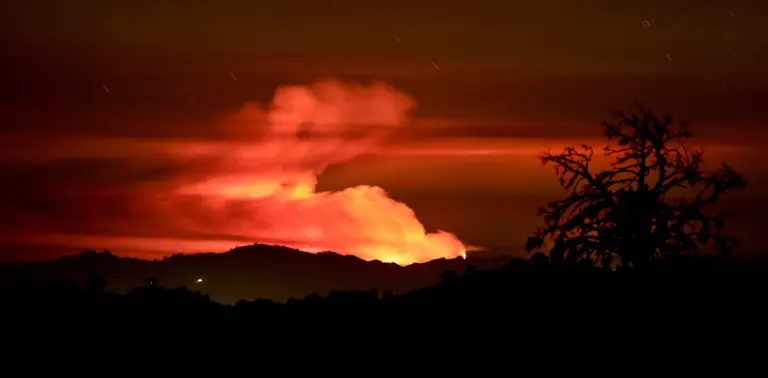
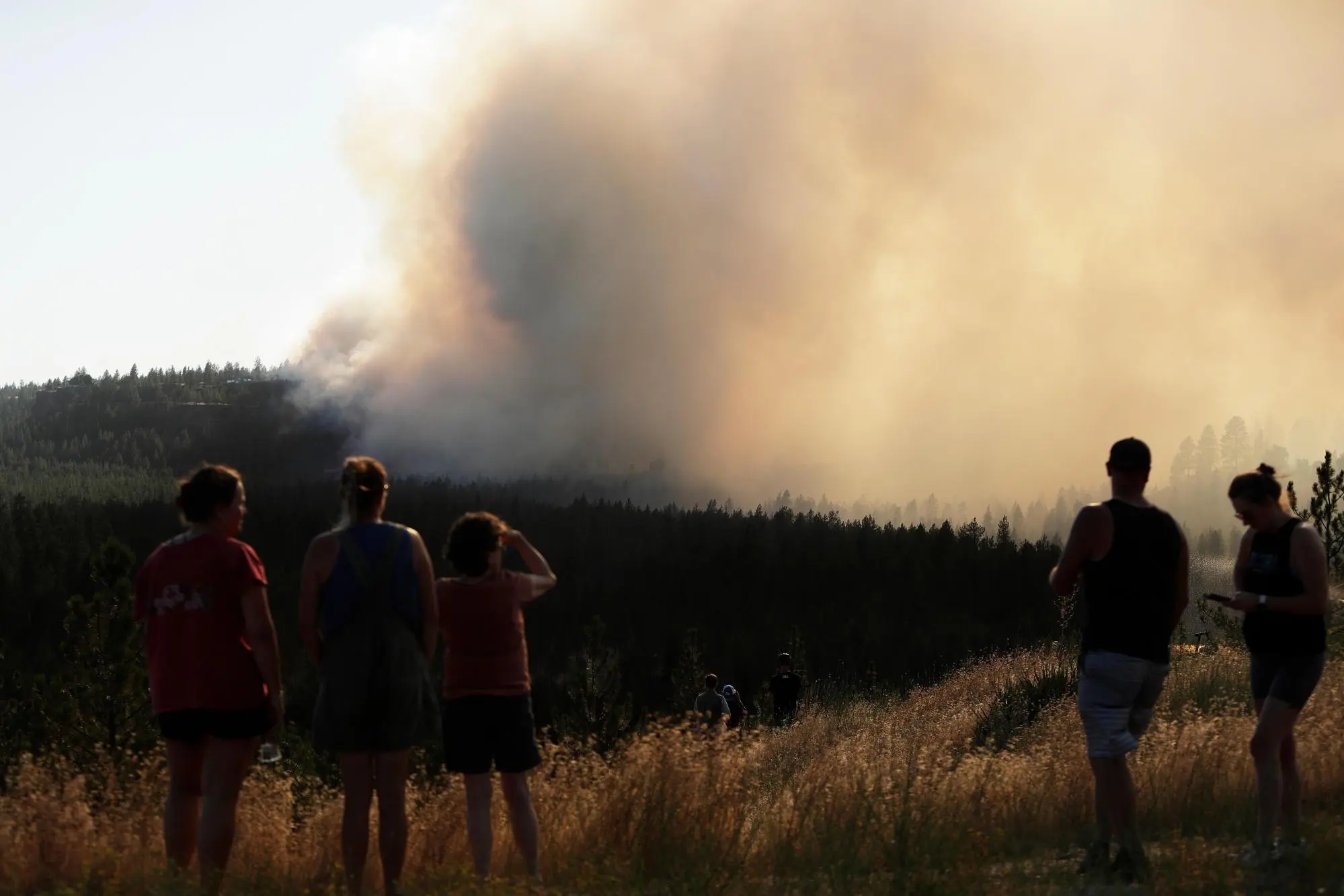
A day later, many parts of that park were indeed blackened by the Old Trails Fire, one of three infernos making up the Spokane Complex firestorm that ignited Aug 1. Whipped by high winds, fed by fuel dried by four years of drought in eastern Washington, those fires have destroyed 600-plus structures and forced the evacuation of 65,000 people.
The towers of malign smoke and videos of flame-engulfed suburbs have also provided vivid, unwelcome reminders to Poer and an untold number of former Sonoma County residents – who migrated from Northern California to Washington state at least in part to get away from frequent wildfires – that escaping those megafires is becoming more and more difficult in the American West.
City and county governments “are going to have to start realizing,” she said, “this is our new normal.”
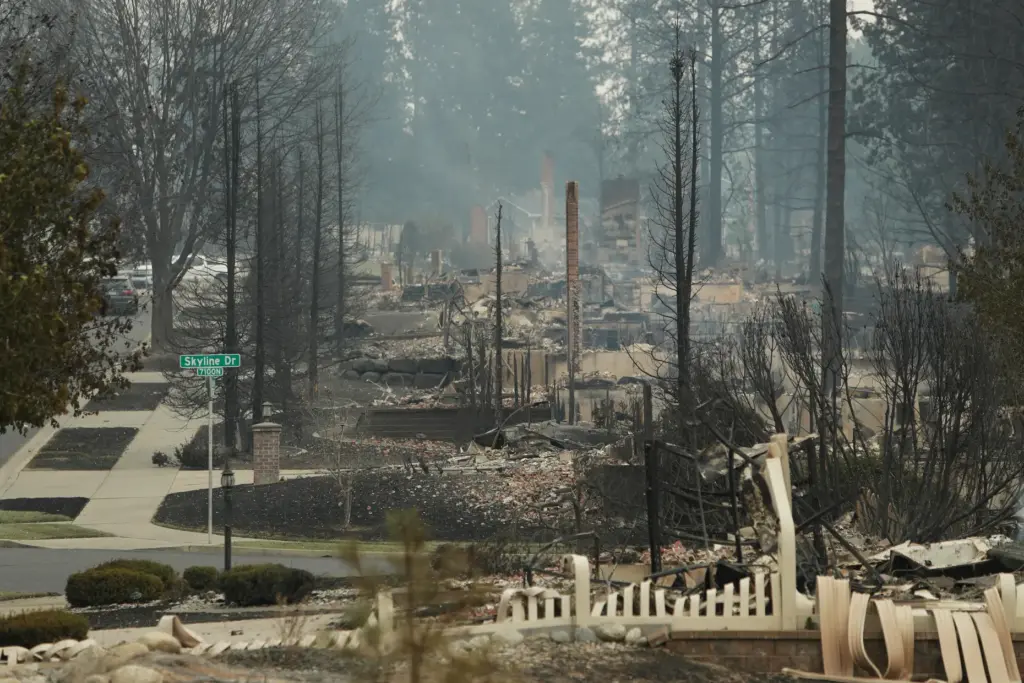 Structures along W. Tiffany Ave. are burned to the ground after a wildfire, Sunday, Aug. 2, 2026, in Spokane, Wash. (AP Photo/Young Kwak)
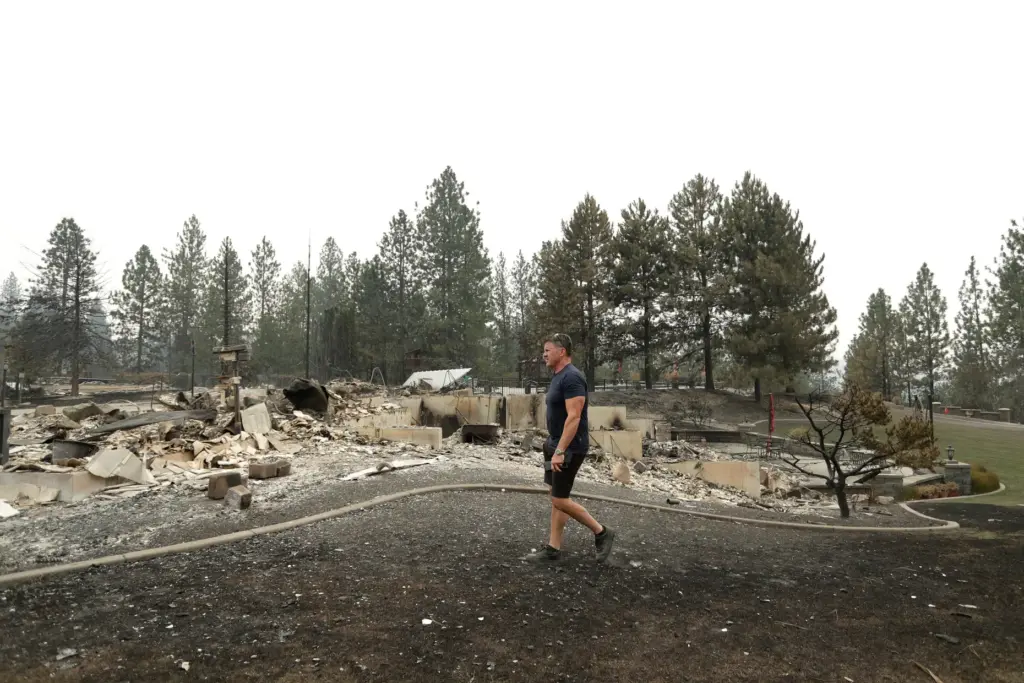 Dan Munson walks in the backyard of his home on W. TIffany Ave. after it burned in a wildfire, Sunday, Aug. 2, 2026, in Spokane, Wash. (AP Photo/Young Kwak)
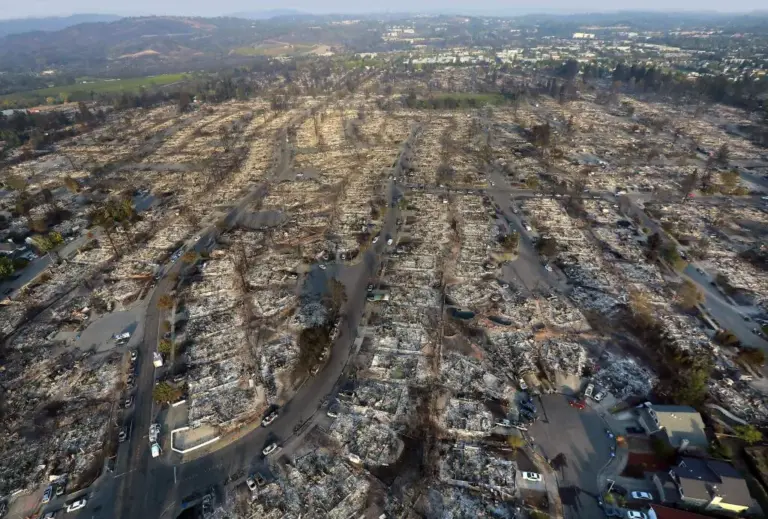 John Burgess / The Press Democrat fileAn aerial view of the destruction in Coffey Park in the immediate aftermath of the 2017 Tubbs Fire during a flight with Helico Sonoma. More than 1,400 homes were destroyed in the northwest Santa Rosa neighborhood, part of the wider toll in the firestorm that included more than 3,000 homes citywide. In all, Sonoma County lost more than 5,300 homes in the firestorm, which also claimed more than 800 homes together in Napa, Lake and Mendocino counties. (John Burgess / The Press Democrat file)
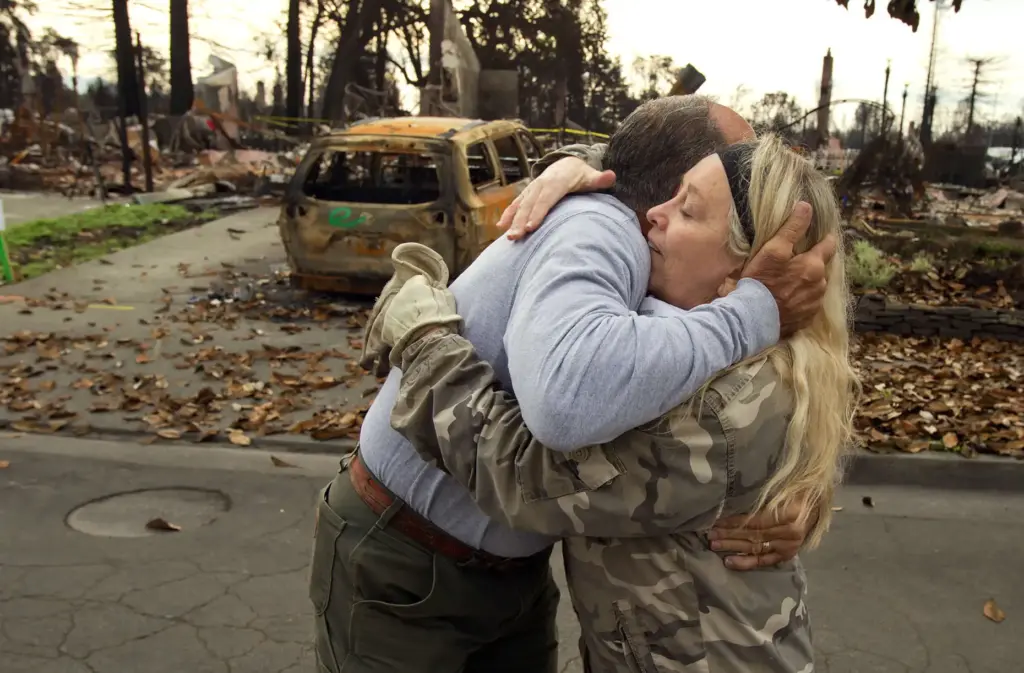 John Burgess / The Press DemocratTom Tantarelli hugs neighbor Cyndy Silver on Miller Dr. between their Coffey Park lots where they lost their homes in the Tubbs Fire in 2017. (John Burgess / The Press Democrat)
Juliana Carretta moved from her Wikiup home north of Santa Rosa to Spokane Valley in 2021, following the Tubbs, Kincade (fall, 2019) and Glass (fall 2020) fires.
“Thankfully, we’re not super-close to the fires,” she said Monday. While running errands Saturday Carretta saw “a tunnel of smoke” coming over Interstate 90, the main-east west thoroughfare for Spokane.
“We could see flames on the mountains – which is how it was when we were leaving Wikiup. I looked up and there was so much fire on the mountain.”
But it was the images of determined residents manning their roofs armed with garden hoses, of homes fully engaged in flames, that upset her most deeply.
“Just like the houses in Coffey Park and Fountaingrove,” she said. “It sends chills down my spine.
“If I hear the wind howling, that anxiety creeps back in.”
In 2020, Christina Schoenthal and her spouse moved from their house on Arista Lane in northwest Santa Rosa, part of a small triangle of homes just west of Coffey Park spared by the Tubbs Fire.
They relocated to Republic, Washington, some 120 miles northwest of Spokane, in the Rocky Mountain foothills above Curlew Lake.
Read more California drugmaker Amgen reports theft of patient data in cyber incident
They believed they were getting away from wildfires. As it it turns out, she said on Monday, “We’re surrounded by fires up here.”
As she noted on social media, “You can run but you can’t hide. Right?”
She was referring not just to the Spokane Complex blazes, but also to a trio of massive wildfires that burned 160 square miles in central and eastern Washington in July.
With so much attention on the fires advancing on Spokane, residents whose lives have been disrupted by those other major fires “are kind of forgotten,” said Schoenthal.
Video and news reports of the Spokane infernos have dredged up intense, unpleasant memories for her.
After evacuating in 2017 as the Tubbs Fire bore down, she and her partner later doubled back to their Santa house, to protect it from looters, she said.
Going through Coffey Park, seeing block upon block of charred, leveled homes, live gas lines blazing like blowtorches – that experience left Schoenthal with post-traumatic stress that’s been flaring up this fire season.
“I’ve been totally paranoid since the fires started,” she said. In addition to forming an evacuation plan with their neighbors, the couple recently purchased a 19-foot Keystone trailer, “something to sleep in if we lose our home, or get evacuated.”
To help ensure they don’t lose their home, they built an abode with metal walls and a metal roof, and have been diligent about maintaining ample defensible space around it.
“Fire season sucks,” she said. “But this one in particular has hit close to home.”
One of the few bright spots during the Spokane fires, said Poer, is the same redeeming quality she saw in such abundance following Tubbs.
“Everybody is reaching out, trying to help other people — the same way they did in Sonoma County.
“Politically we can all be mean and bitchy and hate each other, but when it comes down to it we‘re all still members of the community. We have compassion and concern and care for our fellow human beings.”
You can reach Staff Writer Austin Murphy at [email protected] or on Twitter @ausmurph88.
About the Author