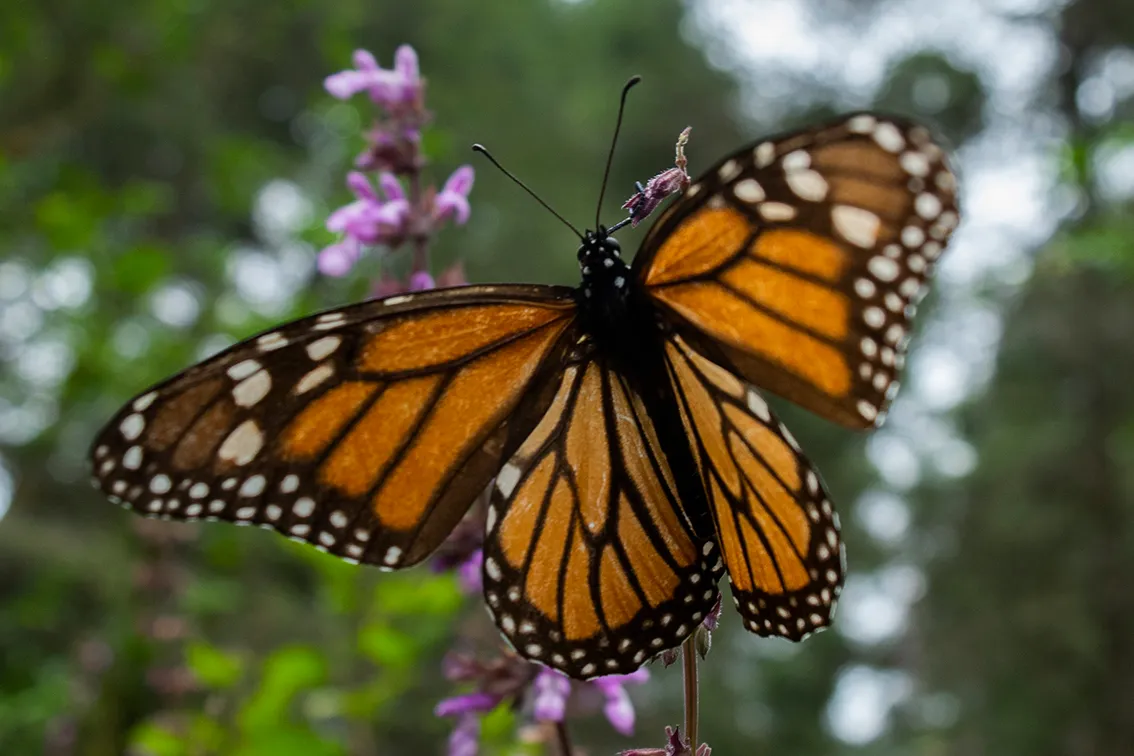
DEAR JOAN: My friend gave me a butterfly house, and I am wondering if you can tell me how to use it correctly? The instructions are confusing.
Read more Crews continue mop-up of Woodside Fire; 2 homes lost
I am fortunate to have monarchs in my yard each year. I have milkweed and many other plants for them. I presume that they either overwinter nearby, or at the coast. Are these houses for use in our area? I was thinking they are more useful where the winters are harsh.
In any case, the instructions mention this puddler, which is the little glass bowl at the bottom. On one page, I read to use sugar water, and the other page says to use water with sand or soil, and with a little salt, as they need the minerals.
Do they need this year round? They seem to be doing fine with what they have, or so I think!
Any clarification would be so greatly appreciated!
— Barbara McCarthy, Los Altos
DEAR BARBARA: Butterfly house is a bit of a misnomer as butterflies don’t live in houses. They seek shelter within plants and under leaves. A butterfly house is more accurately a water station, and that is something the butterflies need and will use.
They are referred to as puddler, and you can fill them with sand and water, or with hummingbird nectar. I think in most cases, and especially during our current hot spell, water will be more appreciated.
In drinking from the watery sand, the butterflies extract nutrients and minerals that are in the soil.
Basic instructions are to fill your puddler almost to the top with coarse sand. You can mix in a couple of teaspoons of compost or worm castings, and a pinch of sea salt. Arrange some small, flat stones around the puddle to give the butterflies a place to land, and then add enough water to moisten or wet the sand. You don’t want to have standing water, but enough to make the sand and additions slightly swampy.
You don’t need to leave your butterfly house out all year, but if you want to keep it up as decoration, just check it often to make sure wasps and spiders haven’t moved in.
DEAR JOAN: I have had two mallard ducks visit my backyard pool for many years, and twice presented us with a litter of ducklings.
I have not seen the female duck for several months and just recently, I found a very large cluster of white feathers floating in the pool. No brown or green colored feathers, like the male’s coloring, just a large amount of small, white feathers, and I have not seen the male duck since. I am wondering if he was attacked and taken?
Just wondering if you might have an idea as to what happened to my male mallard.
— Deidre Silverman, San Rafael
DEAR DEIDRE: As mallards don’t have an abundance of solid white feathers, chances are good the ones you found don’t belong to your frequent visitor. Even if they were, they could be from a summer molt.
Unfortunately, we just don’t know where the mallard went, but let’s be optimistic he is off living his best duck life with his mate and ducklings.
The Animal Life column runs on Mondays. Contact Joan Morris at [email protected].
Read more Bay Area events calendar for Aug. 7-13 weekly editions
About the Author