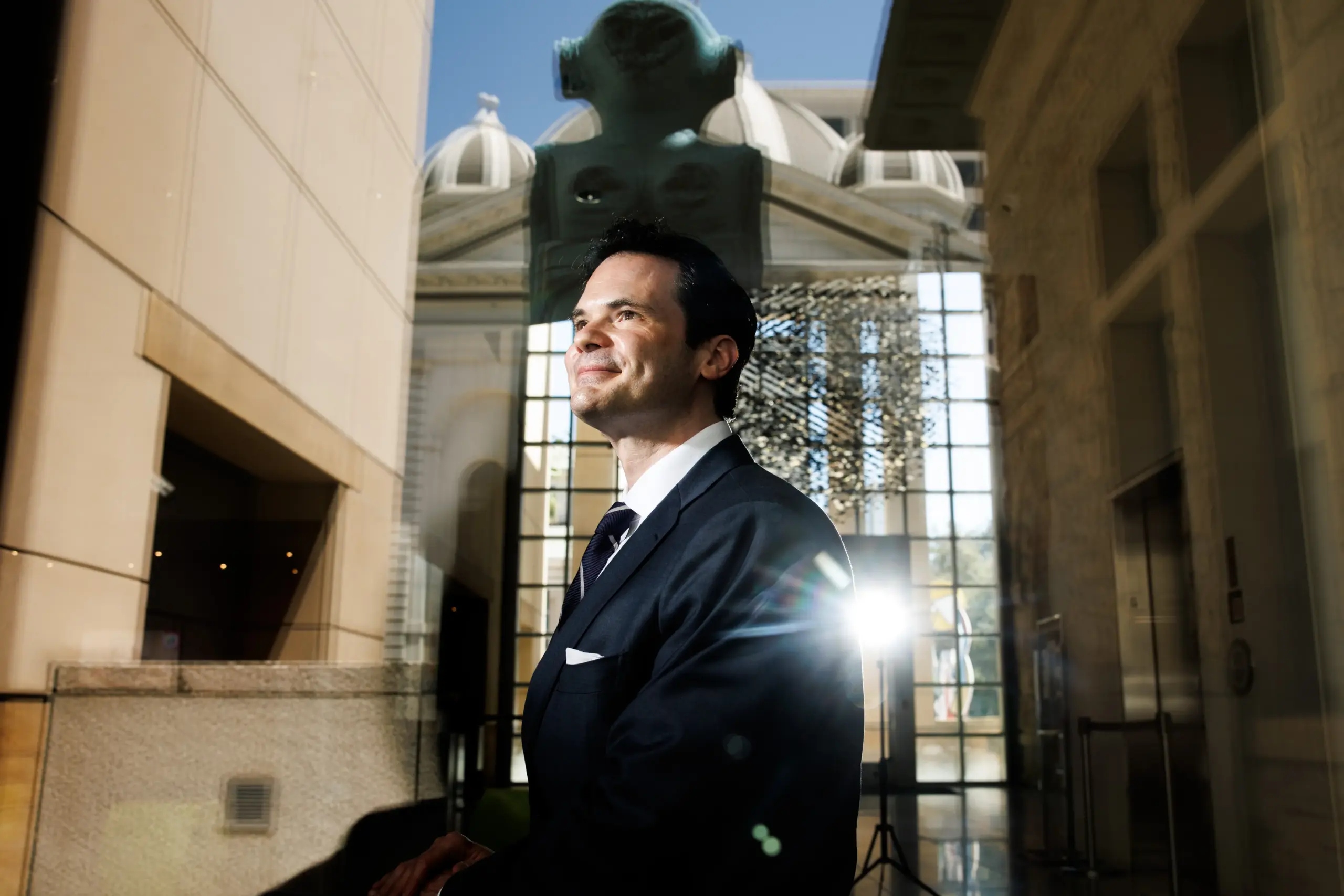
Jeremiah Matthew Davis grew up in a place that seems far away from his new home in San Jose.
Read more SpaceX rocket is on a high-speed collision course with the moon
Starting in October, the 43-year-old Oklahoma native began working as the director and CEO of the San Jose Museum of Art, a position that comes with big expectations. Davis is tasked with helping to grow attendance, revenue and fundraising at the nearly 60-year-old institution so that it can become “an incubator for change,” gain international name recognition and cement its role as a cultural center of the Silicon Valley.
Davis’s journey to San Jose began on his parents’ farm in Osage County, a land of hills, prairies and the Osage Nation. In the pre-internet era, his link to the greater world came from TV, library books and Betamax videos rented from the video store in nearby Skiatook. In those spaces, Davis said he had lots of time to draw, write and develop ideas about wanting to build and to create. He headed east for college at Vermont’s Bennington College and taught at an international school in Istanbul before moving to New York to dive fully into the artistic life by getting an MFA at Columbia and working in the city’s experimental theater scene.
Davis fully transitioned into arts administration in 2016 when he returned to his home state to help develop interdisciplinary visual and performance arts programming for the Oklahoma Contemporary museum in Oklahoma City. When he was artistic director and director, the museum, once housed at the state fairgrounds, grew revenue by 40% and attendance from 10,000 visitors a year to more than 80,000. The museum also moved into a gleaming new, 54,000-square-foot facility in the city’s “Innovation District,” becoming a leading cultural institution in the state.
Now living in downtown San Jose, Davis has begun to implement some lofty goals for the San Jose museum, which is known for exhibiting works by 20th and 21st-century West Coast artists. He recognizes the “multiple headwinds” facing arts nonprofits in the post-pandemic world: rising costs, the changing nature of philanthropy and cuts in federal funding from the Trump administration. Attendance has yet to return to pre-2020 levels, though the museum welcomed 71,000 visitors in its most recent fiscal year.
Davis believes the museum has a lot going for it, given all the city and community support and its South Bay location. Among many things, being next door to San Jose State makes it a potential gathering spot for students — the next generation of museum-goers. And, as he eyes other opportunities, Davis recalls his formative experiences in Osage County and Oklahoma City, saying, “I am a builder. I want to grow, to expand, to collaborate with the community to imagine a future that is possible.”
Q: How are things in San Jose?
A: I love the Bay Area. My wife, Annie, was born in San Francisco, grew up in the East Bay, a little bit in the North Bay. So I’ve been coming here to visit family for about 18 years. The community here has been really warm and welcoming.
Q: Osage County sounds beautiful. I wonder if it was the kind of place that inspired you?
A: It’s a cool place, very rural. My first address was Route 2, Box 38. So that’s how far outside of civilization the family farm still is. I was fortunate. I had parents who welcomed art into our daily lives. Tulsa is also close. When I was younger, we were able to go to the opera, the ballet and some museums. Gradually, I learned more about art and pursued, primarily, music and performance as a young person.
Q: How do you think your work in theater informed your work in museums, where you’re dealing with art that is visual?
A: I was always the most fascinated by theatrical works that were — to employ a phrase that might sound annoying — Gesamtkunstwerk. You know, Wagner’s idea of a total work of art. So that means you’re engaging in various senses. It’s not a strictly visual experience or an oral experience. The theater I was interested in combined elements of poetry, of visual art, of dance and movement, and of storytelling. What I love about museum work and the contemporary visual art space is that it is expansive and imaginative. It still embraces the avant-garde in an old-school way, investing in artists as people who can lead and imagine a future that doesn’t yet exist.
Q: Now that you’re here in San Jose, where do you see this museum going?
There are (so many) positive foundational qualities to the San Jose Museum of Art. We’re sitting now in part of the historic wing, in the floor of the clock tower of what used to be the San Jose Post Office and later became the San Jose Library. In the 1960s, it was empty, marked for demotion. But a group of professors, community volunteers and artists said, “Hold on, this is a beautiful old building … located in the heart of the city.” The result is this art museum. Now, it has a staff that is really committed. We’re deeply involved in outreach to K-12 schools. We have a group of trustees who see this as a potential anchor for the South Bay.
Read more My hotel reservation disappeared. Why won’t Booking.com refund me?
Q: What challenges do you see in going forward?
A: As a result of the pandemic, you have changing audience habits and tastes — a realization that remote is possible. You also have the changing nature of philanthropy. There is fear on the part of many non-profits that the habits of the next generation, who stand to benefit from a historical transfer of wealth, will be different from the boomer generation, who really fueled our philanthropic growth. There’s also the changing relationship of government to philanthropy across the board.
Q: Has that changing relationship with government been an ongoing trend, or is that because of the current administration?
A: The hard break is definitely the current administration’s policy toward eliminating federal support. That said, grants from the National Endowment for the Arts and other organizations have been mostly flat.
Government support was never a driver for an institution like ours. We have a budget that is reasonable, and we can continue to support and grow. We have a fairly diversified stream of revenues. And, there are recent transplants to the area who don’t know we exist yet, but who are interested and attracted to the kind of work that we’re doing. That presents opportunities for us.
Q: Isn’t there the idea that today’s tech leaders and billionaires in the Bay Area don’t support the arts as much as they could?
A: I think if we’re looking to billionaires to help us out, we’re looking in the wrong place. Yes, we have a huge concentration of people in that ultra-high-net-worth category in our region. Could they move the needle? Yes. I mean, they have the resources of nation-states. But it’s a handful of people.
Q: Do you think there’s a hunger for people to get back out into the public and see and do things, whether it’s live music, movies or museums?
A: Google Arts & Culture is a valuable tool, but it pales in comparison to being on site, with a work of art. There is a uniqueness to the live experience that simply can’t be replicated, at least not with existing technology that I have experienced or read about.
Q: Are there any exhibitions coming to the museum that you’re excited about?
A: We’re thrilled to partner with the Minneapolis Institute of Art on an exhibition of the work of María Berrío, a Colombian-born artist who creates large-scale collage works. “a small ocean swallowed,” opening in July. It is a small-group show that explores the natural world, and how humans interact with water — how water can express ideas and connect cultures.
Name: Jeremiah Matthew Davis
Position: Oshman Director and Chief Executive Officer at the San Jose Museum of Art
Education: Columbia University, MFA in Dramaturgy; Bennington College, BA in Social Science and Theatre
Residence: San Jose
Family: Married to Annie Holt
Age: 43
Five Facts about Jeremiah Matthew Davis
— Grew up on a family farm in Skiatook, Oklahoma. In addition to heritage vegetables, sheep, goats, chickens, and a vineyard, there were peacocks.
— Lived and worked in Istanbul for two years after college.
— Served as Artistic Director of Marfa Contemporary in Marfa, Texas from 2016–2018. Collaborating with several artists from Guadalajara, Mexico while working there led to the development of the landmark survey exhibition, La casa que nos inventamos: Contemporary Art from Guadalajara at Oklahoma Contemporary.
— Worked with Woodshed Collective to develop “KPOP the Musical,” which opened at the Circle in the Square Theatre on Broadway in 2022.
— A series of random events led him to kick off the 2011 Coney Island Mermaid Parade as a balloon handler.
Read more Fantasy Studios building in Berkeley is scooped up by East Bay buyer
About the Author