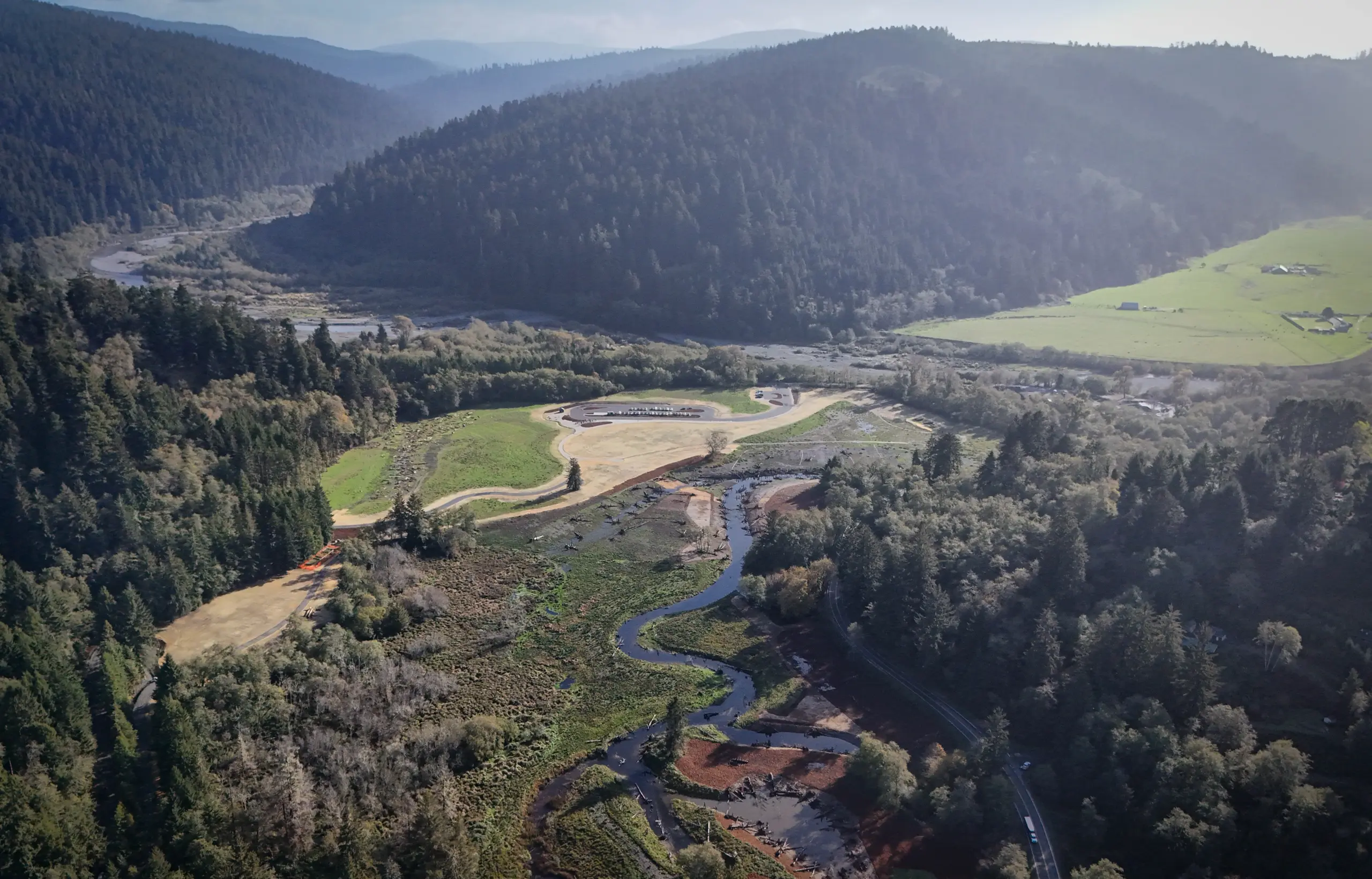
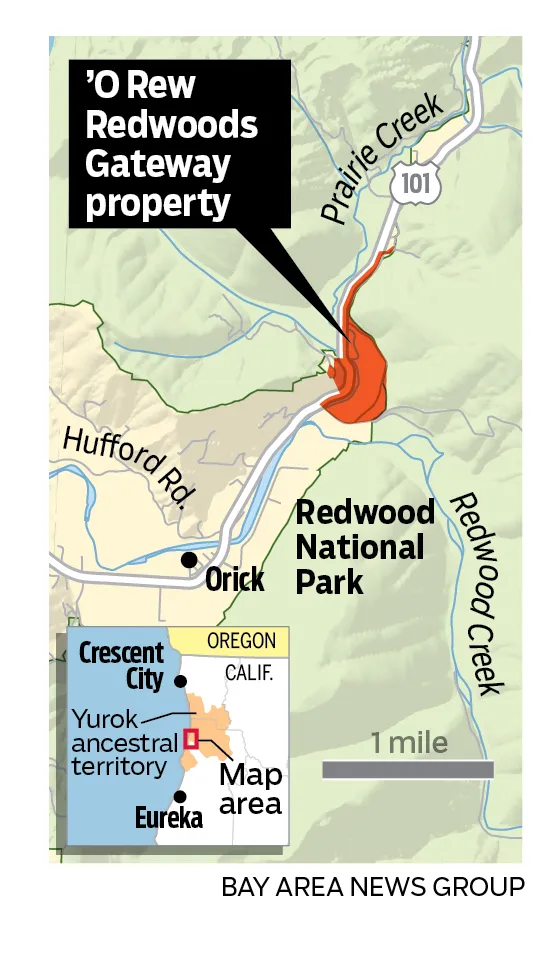
The former site of an aging lumber mill that for decades sawed up old-growth redwood trees — some more than 2,000 years old — on the edges of Redwood National Park will be reborn Tuesday in a unique conservation deal between a Bay Area environmental group and California’s largest native tribe.
Read more FIFA’s Infantino targets critics he says spread ‘hate and false rumors’ about World Cup
San Francisco-based Save the Redwoods League donated the 125-acre property near the town of Orick, in Humboldt County, to the Yurok Tribe, whose members have lived in Humboldt and Del Norte counties for 10,000 years.
The two groups worked for the past five years tearing out asphalt, restoring creeks for salmon and other wildlife and replanting more than 50,000 native plants, including redwoods.
The finished project includes the construction of more than 2.5 miles of hiking trails that connect with famous sites in Redwood National Park, such as Lady Bird Johnson Grove, in addition to adding kiosks and informational signs on the property about the history and culture of the Yurok Tribe.
“We have been in this place since time immemorial. We have endured a lot,” said Rosie Clayburn Katri, historic preservation officer for the Yurok Tribe. “We have fought to stay in our homeland. But we are still here. We are still telling our story and working to reconnect with the land and restore our land.”
As part of the transfer, the league and the tribe signed a contract prohibiting commercial development or commercial logging on the site. The deal is the latest example of environmental groups working with tribes in California and other parts of the West to restore and return property that was taken, often forcibly, as settlements grew in California in the 1700s and 1800s.
“There were a lot of experts saying you aren’t going to be able to do this,” said Steve Mietz, president and CEO of Save the Redwoods League, and former superintendent of Redwood National Park. “But it was such a compelling vision it gained momentum.”
“This is such a resilient ecosystem that once we give it a helping hand it just bounces back,” he added.
Old-growth redwoods are the tallest trees in the world. They reach heights of up to 380 feet, and with their fire-resistant bark can live 2,000 years or more, dating back to the Roman Empire.
Before the Gold Rush, there were an estimated 2.2 million acres of old-growth forest stretching along the coast from Big Sur to the Oregon border.
As California’s population grew, the trees were logged to provide wood for everything from fence posts to railroad ties to houses. Logging rates accelerated after the 1906 earthquake, and jumped again in the 1950s during the post-World War II boom. Today only 5 percent — about 113,000 acres — of old-growth redwood remains, most in parks like Redwood National Park, and the three nearby state parks that are jointly managed with it in California’s rugged northwest corner: Prairie Creek Redwoods, Jedediah Smith Redwoods and Del Norte Coast Redwoods.
As many of the vast forests began to fall, conservation leaders worked to save them. The Sempervirens Fund, a non-profit based in Los Altos, convinced state lawmakers to purchase the old-growth redwoods in the Santa Cruz Mountains that became Big Basin Redwoods State Park in 1902.
Save the Redwoods League, founded in 1918, has played a key role in preserving other legendary old-growth trees around the state, including the Avenue of the Giants and Rockefeller Grove. Of the 139,000 acres in Redwood National and State Parks, Save the Redwoods League has conserved 52,200 acres, or about 38%.
Read more Why Carson Whisenhunt’s next two months will be worth watching for SF Giants
The group spent $2 million in 2013 to buy the 125-acre property near Orick from Green Diamond Resources, a timber company based in Seattle.
The company’s Orick sawmill began operating in 1954 and processed ancient redwoods for 55 years before closing in October 2009.
It was an odd sight for many visitors who came to Redwood National Park after Congress established it in 1968 — a hulking, steaming, clanking sawmill located only a mile or two from trails with iconic redwood giants.
“I had friends and parents who worked there,” said Katri. “One of our tribal members who was a logger said he took no pride in cutting down old-growth redwoods, but it was the only way to feed his family. It’s important to tell that story. The mill did a lot of environmental damage. But it is a complex history. A lot of older Bay Area houses are built of redwood.”
Orick once had five old-growth mills. Now it has none. The mills, like others along California’s North Coast, closed due to heavy logging of old-growth trees that peaked in the 1950s and 1960s. Many had to spend millions to re-tool in order to cut smaller, second-growth redwoods, or close.
Housing construction downturns in the early 2000s also contributed. Public opposition to old-growth logging also played a role, causing California lawmakers to toughen rules on clearcuts and logging on steep hillsides and stream banks. Increasingly powerful environmental laws also limited cutting, like the Endangered Species Act, signed by President Nixon in 1973, which protected spotted owls, Coho salmon, and other dwindling species that live in old-growth forests.
Today nearly all redwood purchased in stores for decking and other construction is second- or third-growth redwood.
The restoration of the property cost $33 million, much of which came from state and federal agencies, including the California Coastal Conservancy, Wildlife Conservation Board and NOAA. The tribe led efforts to restore Prairie Creek, which had been largely denuded and buried by the timber operation.
Other projects to return and restore tribal lands have gained momentum in recent years. Last year, the Western Rivers Conservancy, a non-profit based in Portland, transferred 47,097 acres along the lower Klamath River to the Yurok Tribe, the largest such “land back” deal in California history.
In February, the Washoe Tribe, who have lived around Lake Tahoe for thousands of years, spent $6 million to buy 10,274 remote acres north of Lake Tahoe near the town of Loyalton in Sierra and Lassen counties from the city of Santa Clara, which had purchased it in the 1970s as part of a failed attempt to generate geothermal energy.
In 2020, using a $4.5 million grant from Proposition 68, a state parks and water bond, the Esselen Tribe of Monterey County purchased 1,199 acres along the Little Sur River in Big Sur, regaining land for the first time in 250 years since Spanish missionaries and soldiers pushed tribal members off their original land.
“It’s inspiring,” Mietz said of the trend. “It really shows the power of setting a vision for transforming our landscape and healing both the landscape and our relationship with the people who were the original stewards.”
Read more Sonora man arrested on suspicion of setting Dove Fire
About the Author