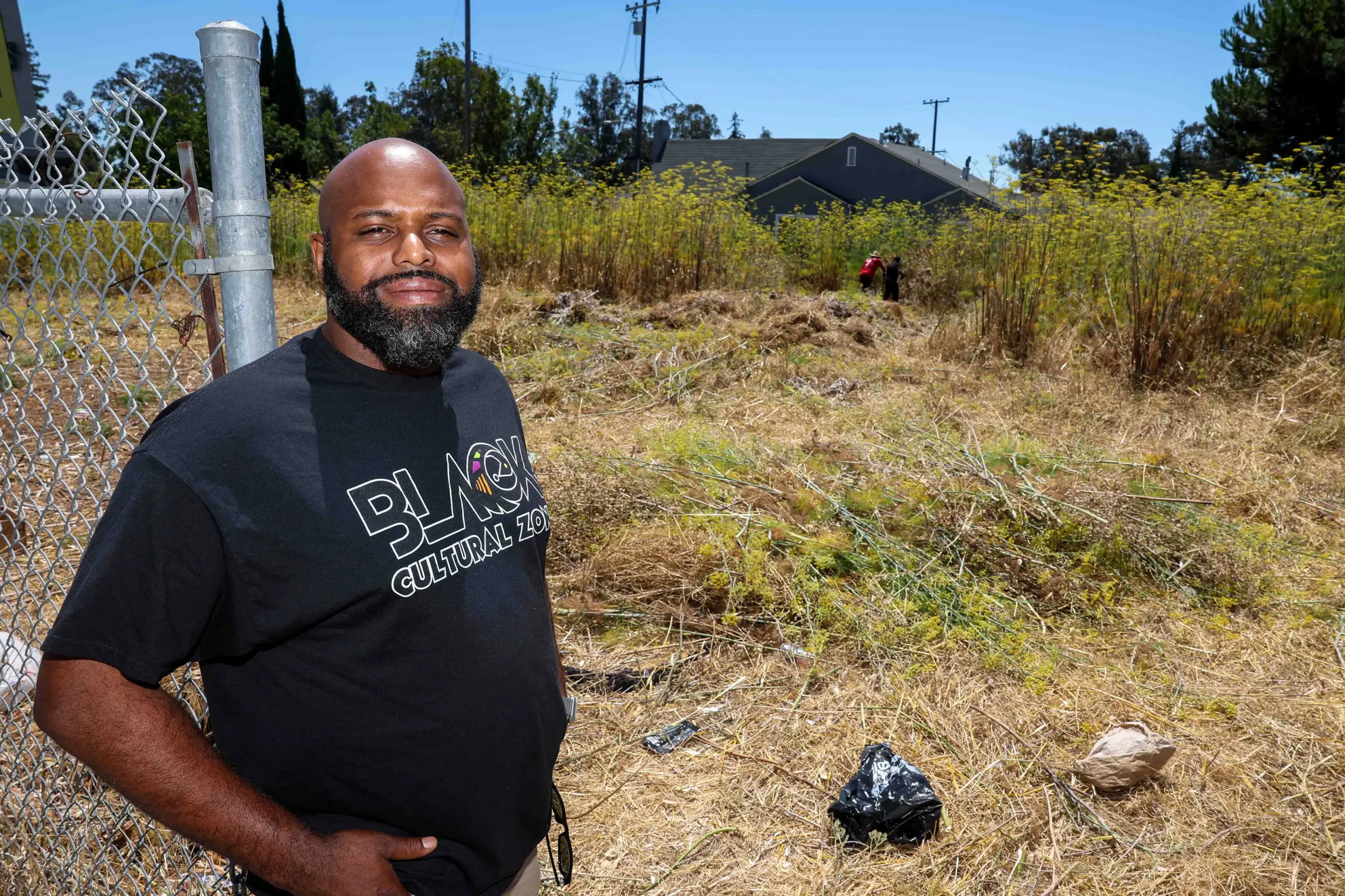
For years, a lot on MacArthur Boulevard in East Oakland has sat vacant. As part of revitalization efforts in Alameda County, a little-used transfer law allowed a nonprofit to purchase it for $10 in the hopes of transforming the blighted property into affordable housing.
Read more They lobbied San Jose leaders repeatedly. Then came favorable votes
The property deed of 8215 MacArthur Blvd. will soon belong to the Black Cultural Zone Community Development Corporation. As the Eastmont neighborhood became increasingly hollowed out beginning in the mid-1990s, the parcel sat unchanged, said Carolyn Johnson, CEO of the nonprofit now set to take it over.
“I’m actually born and raised in this neighborhood,” Johnson said, adding that she graduated from Castlemont High School just two blocks away. “(In the mid-90s) the neighborhood was going through a decline. It had been very hard hit with the crack epidemic, and the beginning of folks losing their homes and losing their property.”
The land was part of a tax default in 1995. The county then sold it to nonprofit affordable housing developer Oakland Community Housing in 2005. But before any progress could be made, the nonprofit dissolved, and the parcel remained vacant.
The county attempted to auction off the property twice: first in 2013 with a minimum bid of $634,255, and again in 2023 with a minimum bid of $1,380,840. Meanwhile, the tax bill continued to balloon to $1.7 million.
With the property worth less than the total debt owed on it, the vacant lot qualified for a Chapter 8 transfer and could be sold at a reduced price in order to be put to public use. The Chapter 8 transfer rule had not been used by the county in a decade.
“It’s very rarely utilized,” said Casey Farmer, a policy and community development consultant at the Alameda County Treasurer’s Office. “The county did this in 2016, and it transferred a number of properties to a nonprofit to low-income homeownerships. The county is essentially the midwife.”
Paperwork for the transfer is still being finalized to deliver the vacant lot to the Black Cultural Zone Community Development Corporation. The nonprofit collective aims to reverse decades of disinvestment and gentrification against Black residents in East Oakland by revitalizing the 50-square-block area between High Street and the San Leandro border.
Its projects include 77th and Bancroft Senior Housing, a 100% affordable senior housing development; and Liberation Park Market Hall & Liberation Residences, a 30,000-square-foot mixed-use retail market and affordable apartment complex.
Read more The hilarious reason Will Ferrell quit working at Disneyland after only one day
Johnson said the nonprofit is expecting to build 40 units of 100% affordable housing at 8215 MacArthur Blvd. It’s an expensive investment: The average cost to build an affordable unit of housing exceeds $850,000 on average in the county, according to the Alameda County Housing and Community Development Department.
“We still are going to have to raise $40 to $50 million for the project,” Johnson said. “So it’s good that we have control over the land, which allows us to enter into partnerships for money with an asset that’s worth close to a million dollars. It gives us bargaining power.”
Johnson said it may take five to seven years to raise the capital needed, but Black Cultural Zone Community Development Corporation is hosting events there in the meantime – food vendors, retail pop-ups and live theatre performances – to give the Eastmont neighborhood immediate value and social connection while waiting for permanent development.
Projects like this, Alameda County Supervisor Nate Miley said, have the potential to be a “rising tide that lifts all boats” for housing and the revitalization of depressed neighborhoods.
“We were always interested in seeing what we could do with tax-deflated properties and see what might be viable for reuse, particularly around affordable housing,” Miley said. “We definitely want to do this with other properties. There are a sizable number in Oakland.”
County housing officials are seeking to replicate the Chapter 8 transfer at other tax defaulted properties. At least 10 others have already been identified, Farmer said.
“This is a really hard time economically, even with vacant land available,” Farmer said. “Truly, the best outcome is that we find a new owner so there’s good productive use of this site. It’s much better than a vacant lot.”
Read more Comic-Con 2026: Here are the biggest celebrities spotted Friday in San Diego
About the Author