Travis P. Wagner and Peter Meyerhof, board members of the Sonoma Valley Historical Society, believe they have set the record straight about the birthplace of the Golden State’s first commercial theater which they contend is the city of Sonoma.
For years, the online Historical Marker database, a free, illustrated and searchable catalog of historical information that describes its entries as being “viewed through the filter of roadside and other permanent outdoor markers, monuments, and plaques,” has recognized the city of Monterey as the location where the first commercial theater in California was founded.
Wagner and Meyerhof, however, contradicted that notion in a June 19 article, “New York Theater Invades Pioneer California,” which the pair wrote and published in the New York History Review.
They pieced the evidence together through old newspaper articles, diaries and other historical records.
Wagner and Meyerhof’s scholarly article, they said, is the first they know of to use firsthand accounts and evidence for their research.
“It wasn’t like we were out to challenge them but they have that and we were like, ‘No actually, it was here,’” Wagner said. “And so here’s all the evidence.”
The story began in 1846, when the United States recruited the 1st Regiment of the New York Volunteers to serve in the Mexican-American War to establish American control in Alta California — a Mexican province that encompassed much of present-day California.
“It just so happens that they recruited a number of amateur and semi-professional actors and entertainers during these tough times to come to California,” Wagner said of those in this New York infantry unit.
Many members were recruited from Lower Manhattan, where working-class theaters were thriving. Among them were amateur actors, musicians and entertainers who brought their love of the stage with them.
“One of the (units) had 10 companies and they spread out throughout the state. And one of them was here in Sonoma. And they were bored,” Wagner said.
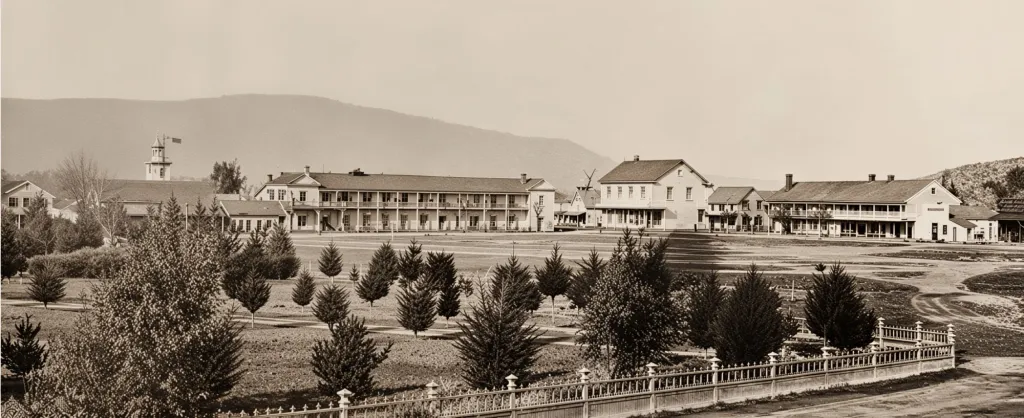
When Company C arrived in Sonoma in April 1847, the soldiers formed a drama club and began performing in a makeshift venue.
According to Wagner, no one knows the first-ever location of the theater. But the second one was in the same building that now houses the El Dorado Kitchen and Sunflower Cafe in the 400 block of First Street West, near the Sonoma Plaza.
As audiences grew, the troupe moved into an unfinished adobe owned by Salvador Vallejo and established the “Colonnade Theater.”
Read more House again passes resolution seeking to halt military action in Iran as some Republicans defect
The theater, which was decorated with rough-hewn benches, tree branches and colorful blankets, could seat about 200 people.
The performances reflected the working-class theater popular in antebellum New York. Audiences could expect melodramas, farces, music, dancing and comedy.
Soldiers also played both male and female characters, as there were few female performers.
The troupe staged plays including, “The Golden Farmer” and “The Omnibus,” while local musicians provided piano and fiddle accompaniment.
The theater quickly became popular, drawing audiences not only from the surrounding areas but also as far away as San Francisco.
Wagner said theater was different back when Company C performed in Sonoma, which was then a small town.
The audiences, for one, weren’t always quiet.
“They were actively booing and hissing and talking and that was just the way the theater was. It was very interactive,” Wagner said.
“You can imagine how difficult it was because the actors didn’t have microphones in some of these huge theaters so they had to overact and yell above the audience.”
But the Gold Rush soon changed the theater’s future.
When Company C was ordered to leave Sonoma in 1848, nearly half of its soldiers, including three members of the acting troupe, deserted to seek their fortunes in the gold fields.
The theater closed when the soldiers left, though some later returned and briefly revived performances in a new location at Mariano Vallejo’s “La Casa Grande.”
By 1849, though, Sonoma’s importance was beginning to decline as San Francisco and other Gold Rush communities grew.
The original actors moved on to mining towns and other emerging California cities, where some continued acting while others became journalists, publishers and miners.
Read more Larry Magid: Trust and safety professionals in age of AI
About the Author