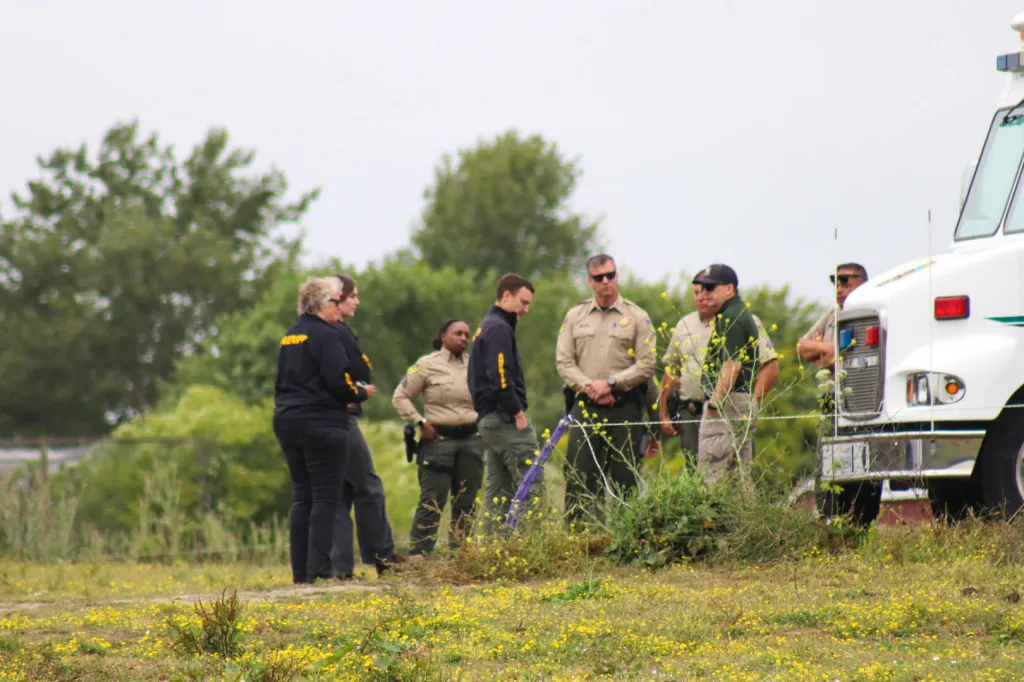
The investigation into Miranda’s Rescue has expanded since deputies uncovered the remains of 117 dogs during a June excavation, a discovery that triggered statewide scrutiny of the nonprofit’s operations. The Humboldt County Sheriff’s Office said Friday the investigation into Miranda’s Rescue has widened, with over six hundred tips, microchip leads, and out‑of‑state connections emerging as they work to determine what happened to the animals recovered from the animal rescue.
Read more Man sentenced to jail for phony insurance claim after road rage collision with big rig
“Every individual animal with a chip has a story and we are following up on that story,” Sheriff William Honsal told the Times-Standard.
He said the public is instrumental in helping nail down those stories.
“It’s still a very active investigation,” Sheriff William Honsal told the Times-Standard. “We’ve had close to … 600 tips that come in either phone calls or emails. All of those tips have been logged into basically a spreadsheet, a system where we can call back and we can call and interview these individuals.”
Honsal said investigators are following up on newly processed microchip data, which shows that about 85 animals need to be tracked to previous locations. He said those records give detectives a starting point for building each animal’s history and determining what happened after it was transferred to Miranda’s Rescue.
“We have a lot of animals that are dead, but now we have to figure out individually every single one of those animals, how they trace back to Miranda’s Rescue,” said Honsal. “It’s not just simple to prove that an animal is dead, but the circumstances surrounding how the animal got there, what their temperament was like, were there any health issues or those kinds of things.”
Investigators are coordinating with state and federal partners as each agency takes on portions of the case, including interviewing victims. Sheriff William Honsal said teams are also managing long‑term evidence storage, preserving the recovered animals, and arranging full necropsies to determine the cause of death.
“Every single one of these dogs has to have a full necropsy as well … to determine the actual cause of death. We have to prove in court that these dogs died a certain way and that they didn’t have any ailments or injuries,” Honsal said. “So that’s a case that we have to prove, and we’re taking that very, very seriously.”
New agencies and departments have joined the investigation since the excavation warrant was served. Additional units within the California Department of Justice are involved in the case, and multiple county agencies have filed complaints related to Miranda’s Rescue. He said those agencies are reviewing evidence tied to the rescue’s conditional use permit, nonprofit operations, and land‑use requirements, and are working together to determine whether Shannon Miranda has complied with the rules governing how the facility is supposed to operate.
Justice is not speedy
“We believe that Miranda’s Rescue has defrauded a whole lot of people, that they said they were something and they really weren’t. They collected a lot of money from a lot of individuals, saying that dogs could live out on their sanctuary, on their farm, or they’d be adopted out. In reality, those dogs were not,” said Honsal. “That is one thing that we’re very diligent on and looking at as well as the animal cruelty end of things. So all these things take time. I understand that people want instant justice, but I also want to remind people generally about how the criminal justice system works. And that is, when we do arrest someone for a felony, essentially, we have to provide all the evidence that proves that case to the prosecuting agency.”
Honsal said felony cases require prosecutors to receive all supporting evidence before charges can be filed, and if a defendant doesn’t waive time or bail out, investigators have only 10 days to prove each count in court. Honsal said prosecutors might see probable cause early on, but they cannot move forward until investigators deliver a complete case.
“We believe it’s going to take several months in order for us to gather all the essential information to present to a prosecuting agency in order to determine whether or not there is evidence to support charges,” said Honsal. “We believe, based upon the evidence that we are currently seeing, that there are criminal violations. We are confident of that, but we are taking our time to make sure that we do everything correctly to ensure that the prosecuting agencies have the amount of evidence they need to proceed.”
Forensic veterinarians have provided preliminary findings showing dogs were killed with a small‑caliber gun. Additional necropsies are pending.
“These were world-renowned veterinarians that were here doing the job. These were preliminary, and that gave some information that they were killed similarly with a small-caliber firearm and likely a .22,” said Honsal. “We’re preserving all these dogs to do more evidence, more necropsies, and we also have the original eight dogs that were provided to us that still have to be forensically provided that autopsy or necropsy, so to speak, and to determine their cause of death. And that is our best evidence right there. Those are going to be scheduled as soon as we can get our forensic veterinarians back into Humboldt County to do that work.”
Federal agents are assisting in the case under statutes including the Animal Welfare Act and the federal Crush Act, though Honsal declined to discuss specific evidence tied to those laws. He said the FBI and USDA are actively involved because of the federal nexus created by the circumstances of the dogs’ deaths, but would not elaborate further while investigators continue reviewing material.
Read more Ballot measure would increase Alameda County minimum wage to $30
“I’m not going to go into specifics because I don’t want to weigh out the evidence that we currently are reviewing right now,” Honsal said. “It’s just one of the federal charges that can be looked at, and the nexus between the federal government and this case. The Animal Welfare Act and the Crush Act are the reasons why the federal government is actively in this case.”
Honsal confirmed that some of the dogs found in the burial pit were traced to owners in other states and said detectives are now contacting those individuals. He said many people will soon learn that a dog they surrendered to Miranda’s Rescue was among the animals recovered, calling those upcoming conversations difficult but necessary as detectives work to document each animal’s history.
“I know it’s going to be difficult for people to have to deal with that, but it’s again important to our investigation that we do those interviews,” said Honsal. “All the evidence that surrounds how that dog was transferred, description of the dog, photos, what dog collar the dog was wearing at the time, all those things are very valuable.”
Avenues of the investigation
Detectives have also reviewed reports of additional properties where dogs may have been taken in prior years, however Honsal said deputies have not found evidence sufficient to obtain search warrants for those locations.
“We would need someone with firsthand knowledge or the evidence to support that for a judge to sign in order for us to go to another location,” said Honsal. “We’re encouraging people to definitely reach out and to continue to provide us with this information.”
Facility owner Shannon Miranda is still legally allowed to operate his rescue because he has not been charged with a crime, and deputies continue inspecting the property three days a week. The rescue now has fewer than 30 dogs on site, with people still adopting animals, and, to his knowledge, is not taking in new intakes.
“He’s still operating his rescue, and he has less than 30 (dogs) there at his rescue now. So they’re still adoptable,” said Honsal. “People can still go there and adopt animals or encourage people to do so.”
Honsal also addressed community frustration over the pace of the investigation, saying personal relationships or small‑town dynamics have no bearing on the investigation or charging decisions.
‘We arrest our friends’
“I think this is a small town, and a lot of people bring up the fact that the reason why he’s not being arrested or why there’s not any prosecution is the fact that people may know him or that kind of thing. Being a small town, we arrest our friends, we arrest our family, that doesn’t matter,” said Honsal. “We don’t care about the relationship. We look at what we can prove in court. That’s what’s important to us…I have no relationship with Miranda’s rescue.”
Honsal said he understands the public’s frustration but urged patience as investigators work through what he described as a massive volume of evidence recovered during the search warrant. He said forensic technicians are reviewing all of it, along with material provided by the public, and emphasized that the sheer amount of information that must be analyzed is a major factor in how long the case will take.
“The evidence is going to be what is presented in this case, and we want to make sure that the truth comes out,” said Honsal. ”We know that a lot of people are frustrated with this case. But we appreciate everyone’s patience. Things are going to take time. We want to do things correctly. The last thing we want to do is proceed when we don’t have the evidence to support any of the charges.”
How to help
The Humboldt County Sheriff’s Office is asking the public for information related to this case, including any details about animals transferred to Miranda’s Rescue within the past year. Anyone with information about the case is asked to call the Humboldt County Sheriff’s Office tip line at 707-268-2539 or email [email protected].
Read more Apple files lawsuit accusing ChatGPT maker OpenAI of stealing trade secrets
Maranda Vargas can be reached at 707-441-0504
About the Author