In one of the most high-profile and closely watched cases in Chula Vista history, a jury on Thursday convicted Larry Millete of first-degree murder for killing his wife and the mother of his three children, May “Maya” Millete, who has not been seen or heard from since she disappeared from the couple’s home in January 2021.
Read more Park Fire: Two years later, trial set for man accused of starting California’s 4th largest wildfire
The Chula Vista jury needed just a single day — about five hours — to deliberate after a trial that lasted seven weeks and featured testimony from more than 60 witnesses. One juror said the evidence was “overwhelming,” and there was little dispute among the jury about what happened.
“Larry did it,” Beverly Feldman said outside the Chula Vista Superior Courthouse. “We believe he murdered her and he knows where (her body) is.”
The 44-year-old Millete, who has been in custody since October 2021, did not appear to react to the verdict as it was announced in a crowded third-floor courtroom. He faces 25 years to life in prison when sentenced.
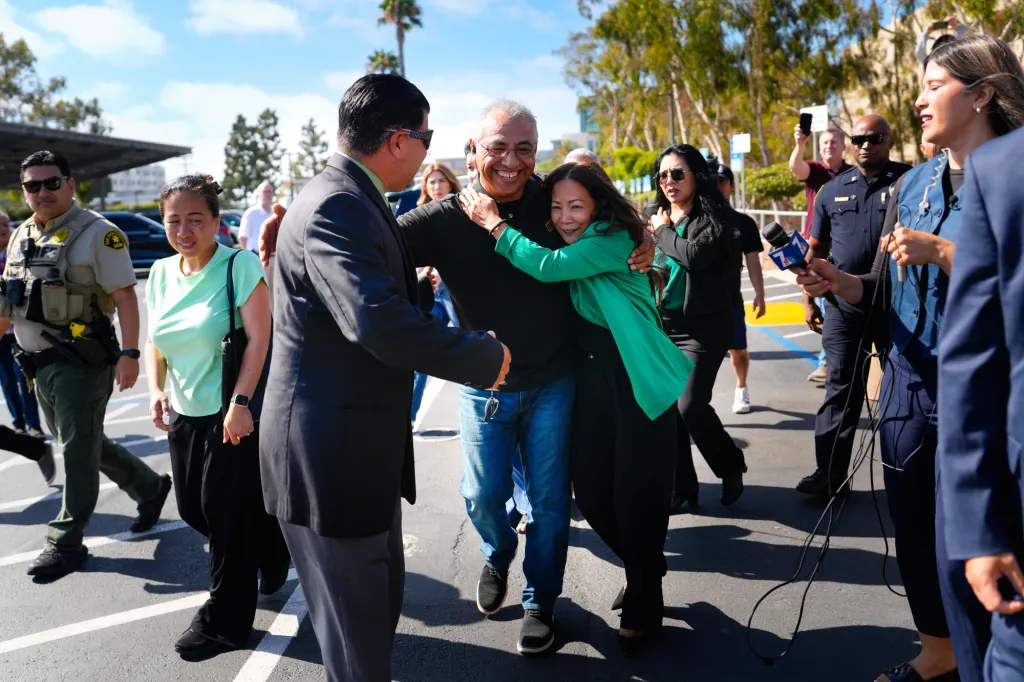
“Justice … (has) been served today,” Maricris Drouaillet, May Millete’s sister, told reporters gathered outside the courtroom. “But we still have my sister out there … We still have to bring my sister home, to bring her to her three children that’s been waiting for her for five years.”
Deputy District Attorney Christy Bowles, who prosecuted the case, said she hoped the verdict would provide a measure of justice and accountability.
“Our thoughts, the thoughts of myself and my team, remain with May Millete’s family, her friends, and especially her three children,” Bowles said outside the courtroom. “No verdict can erase the pain of losing May or the years of uncertainty that have endured.”
May Millete, who worked as a civilian contract specialist at the Naval Information Warfare Center, was last seen alive Jan. 7, 2021, at the family’s home in the San Miguel Ranch neighborhood near Eastlake.
She was 39 years old when she went missing without a trace in a case that drew national headlines — it was featured on television shows such as “Dr. Phil” and “48 Hours,” and in People magazine. Her disappearance prompted hundreds of volunteers to search for her, both in the rugged foothills near her eastern Chula Vista home and in remote desert and mountain regions across Southern California, where she enjoyed off-roading in her Jeep.
Bowles told the jury during trial that May would have never willingly abandoned her children. The prosecutor argued the only reasonable explanation for her disappearance was that Millete killed her and successfully disposed of her body, which has never been found.
Feldman said she’s also a mother of three, and that she and her fellow jurors agreed that May would have never skipped out on her children.
“She loved her children, it was obvious,” Feldman said. “There are mothers like me, like May, that we would not leave our children for nothing.”
Bowles alleged at trial that Millete killed his wife on the same day she’d made an appointment with a divorce lawyer to end their 20-year marriage. Bowles told jurors Millete was angry at May over her yearlong affair with another man and likely poisoned her with the toxic plant hemlock. And she alleged that Millete disposed of May’s body on Jan. 8, when he powered down his phone and left for more than 11 hours to an unknown location.
Feldman said that evidence about Millete’s suspicious actions from the day after May’s disappearance was the strongest and most convincing.
“The prosecution, I tell you, proved … in spades that he had the means, he had the motive, and he had the opportunity,” Feldman said.
Defense attorneys Colby Ryan and Liann Sabatini had argued that there were other plausible explanations for May’s disappearance, and that prosecutors had not proved beyond a reasonable doubt that she was dead or that her husband killed her.
Read more American Airlines delayed my flight, so I drove. Why can’t I get a refund?
Feldman said the jury didn’t see it that way. She said the evidence was overwhelming, and the defense did not do enough to convince the jurors there was any reasonable doubt.
She said the entire jury quickly agreed Millete was guilty of murder, and 11 of the 12 also quickly agreed it was premeditated in the first degree. The only initial holdout, according to Feldman, was a woman who wanted to carefully read back over the judge’s orders on how to decide the degree.
“She wanted to make sure she could sleep at night,” Feldman said. Once that juror felt comfortable convicting in the first degree, Feldman said, the deliberations were done and the jury notified the judge of its verdict.
Family members from both sides of the case attended much of the trial, and during opening statements and closing arguments, court officials opened an overflow room for dozens of reporters and interested members of the public who couldn’t fit in the main courtroom.
South San Diego resident Sylvia Villa, who did not know May but had been following the case since its early stages, said she attended nearly every day of the trial, getting in line at 6 a.m. daily to make sure she could get a seat.
When the verdict was read, she and several other women — supporters of the family who met through their following of the case — quietly celebrated in the overflow courtroom, then moved outside to cheer for May’s family as they exited the main courtroom.
“I thought it was just for Maya,” Villa said. “I hope her soul can finally rest.”
Villa is holding out hope that one day soon, either through luck or Millete having a change of heart, May’s family will find her body and be able to give it a final resting place.
Because there was no body, the case was built on circumstantial evidence. Prosecutors alleged that Millete’s desire to harm his wife was laid out in hundreds of messages that he sent to online spell-casters in a desperate search for a magical solution to his marital problems.
Feldman said those messages, and the abrupt end of those messages once his wife went missing, were also key pieces of convincing evidence.
“This case demonstrates that justice does not depend on recovering a victim’s body,” Bowles, the prosecutor, said. “Circumstantial evidence is evidence, and when it proves beyond a reasonable doubt, the law allows jurors to hold the defendant accountable, which they did.”
Millete’s defense team never conceded during trial that May was dead, instead suggesting that she might still be alive somewhere, or that she might have left her home willingly and then been killed by someone else.
But in the end, the jurors sided with Bowles, who told them during closing arguments Tuesday that “the only reasonable conclusion is that May Millete is dead and the defendant killed her.”
After Thursday’s verdict, May’s sister, the prosecutor and acting Chula Vista Police Chief Dan Peak said the search for May’s body will continue.
“Today gives a little bit of justice on behalf of May, and to her family … but it doesn’t bring closure,” Peak said. “She is still out there. She is still missing. And we’re going to work tirelessly looking for her to try to find her and bring her home, so she can be with her family.”
Read more 15-year-old boy raped outside home in New York, suspect pictured
About the Author