In July, our country celebrates the 250th anniversary of its independence, an independence expressed when colonists dumped British tea into Boston Harbor to protest Britain’s parliamentary tyranny. The British shut the port and suspended town meetings and elections. Massachusetts called for a meeting of all the colonies to rally support.
Read more Today in History: June 20, race-related rioting erupts in Detroit
Meanwhile, the colonists drank herbal teas made from lemon balm, chamomile and oregano grown in colonial gardens, using seeds saved from Old World gardens. Less than two years later, colonists fought and won the War for Independence. A new nation was founded: the United States of America.
Seeds have long been saved; stashes have been found in burial chambers like the pyramids and in old forts like the Masada Hasidic fort burned by the Romans in 73 A.D. Today, as many as 1,700 botanical gardens worldwide store seeds in banks, including the Millennium Seed Bank at Kew Gardens in the United Kingdom and the Berkeley Seed Bank at the UC Botanical Garden at Berkeley.
Saving a seed means collecting, drying and storing it for a growing season in the future. Seed saving helps ensure biodiversity by preserving genetic traits for future adaptability. Seeds of heirloom plants, varieties grown for at least 50 years, will generally grow offspring with characteristics of the parent plant.
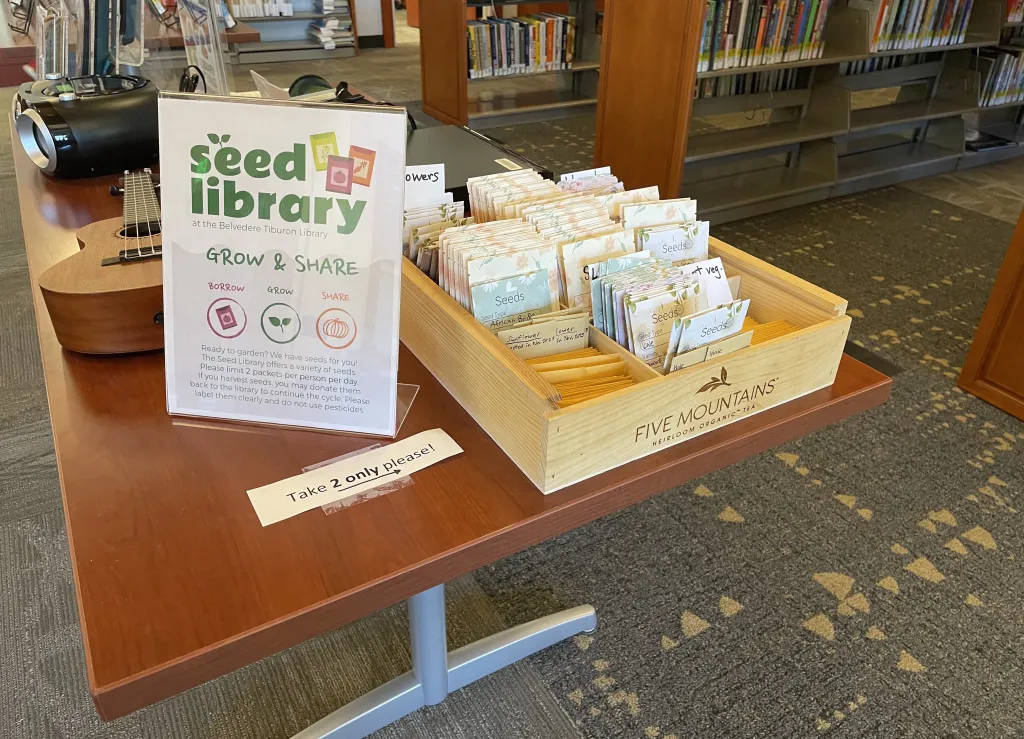
Squash seeds are easy for beginners; wash off vegetative matter, dry on a mesh screen or parchment paper and, when thoroughly dry and hard, store in a glass jar in a cool, dry place. Seeds stored in a refrigerator or freezer remain viable for an even longer time. Label the seeds, noting crop type, variety and date harvested. Marin County libraries accept seeds for exchange for free.
In 2008, the Svalbard Global Seed Vault opened for seed storage. The Global Crop Diversity Trust and the Consultative Group on International Agricultural Research have worked to collect and organize samples to stock the remote and secure vault dug deep into a frozen Arctic mountain in Norway.
The Norwegian government funded the construction of the vault, while the annual operating costs are covered by the Global Crop Diversity Trust. Seeds are stored in black boxes and remain the responsibility of the country that donated the seeds. Operating as a global backup system, Svalbard has been called the Doomsday Vault.
In the early 20th century, scientists became increasingly concerned about shrinking habitats, changing climate and increasing reliance on seeds produced by plant breeders. A small group of scientists led by botanist and geneticist Nikolai Vavilov traveled to five continents to collect rare seeds, tubers, roots and plants and bring them back to Saint Petersburg, Russia, to establish the world’s first seed bank: the Plant Institute.
The collection became one of the largest, with seeds found in no other collections. By 1933, Vavilov was recognized as a pioneer in the field and was honored by many prestigious scientific institutions. In 1941, Vavilov was imprisoned in a gulag, where he died in 1943 of starvation. Brave scientists preserved much of Vavilov’s collection, and many more seed banks have since been established around the world.
The challenge remains that seeds cannot just be put in a bank where their promise of new life will eventually die. Seeds must be grown to produce more seeds. As farms increase in size and plant greater percentages of commercial seed, landscapes become more homogenized.
Recent research by Helen Anne Curry highlights the evolution and adaptation of crop species. When farmers and gardeners choose heirloom varieties, regeneration and growth are ensured. Each of us plays a role in this challenge.
We can go to seed exchanges like Seed Savers Exchange and our local libraries to select heirloom seed varieties to grow. One of the nicest gifts I ever received was an heirloom squash seed grown and saved in an envelope with a recipe. Meet the challenge to save the future; grow, save and share heirloom seeds and, in turn, help preserve biodiversity.
Sponsored by UC Cooperative Extension, University of California Marin Master Gardeners provide science- and research-based information for home gardeners on our website, in public workshops, on our YouTube channel and in the Leaflet, a free bi-monthly newsletter. For help with plant problems, email questions to [email protected], drop off samples 24/7 in the box outside our office or call 415-473-4910 to see when a master gardener will be at the help desk. For more information, go to marinmg.ucanr.edu
Read more New offer emerges for Oakland Arena, but officials say sale process is already locked in
About the Author