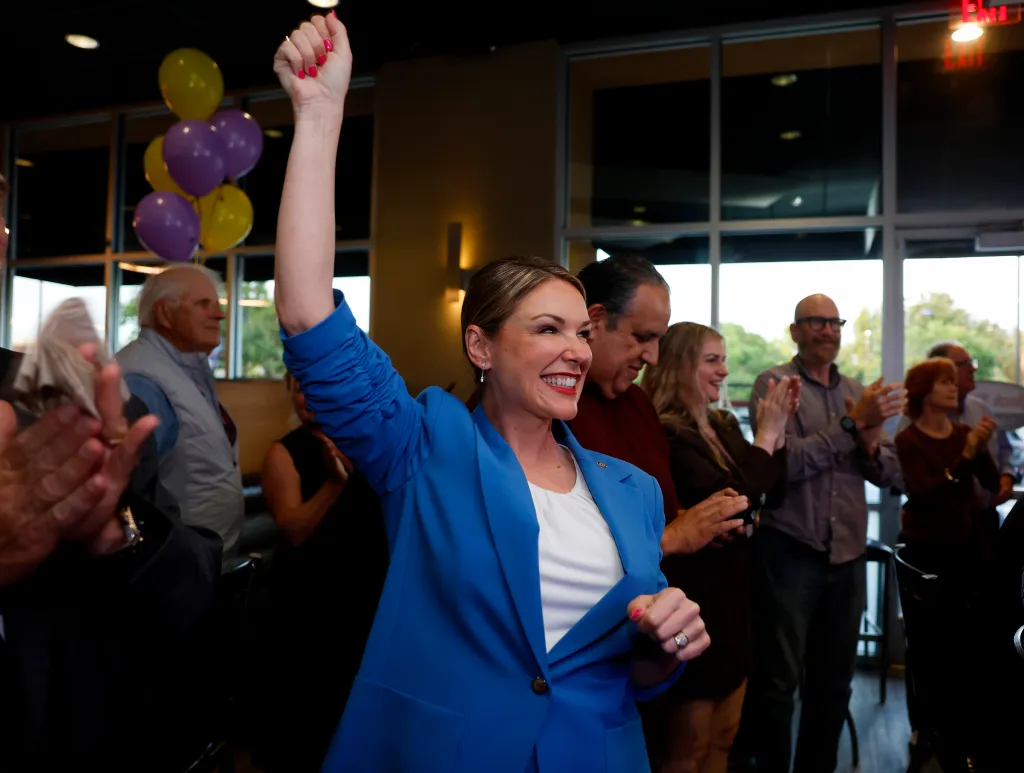
Former police officer Genny Altwer led the primary field in early returns with almost 31% Tuesday night for District 9 — the sole open seat on the San Jose City Council — followed by a trio of candidates who were neck-and-neck.
Read more Tomas Hertl a hero for Vegas after getting call from ex-Sharks teammate
If no single contender clears the 50% threshold required to win the seat outright, the top two will advance to the November general election. As of 10:50 p.m., around 19% of ballots across sent out across Santa Clara County had been tallied, according to the registrar of voters.
Tuesday’s initial results largely reflect early voting via mail-in ballots, meaning tight races could still flip as Santa Clara County continues to count and verify provisional votes in the coming weeks. Whoever wins the seat will succeed outgoing Vice Mayor Pam Foley, who concludes her second and final term at the end of this year.
Behind Altwer, a licensed family therapist, three candidates are locked in a tight race for second place: civic organizer and entrepreneur Mike Hennessy at 21.4%; Gordon Chester, a labor-backed public works staffer focused on housing, at 21.13%; and Scott Hughes, chief of staff to incumbent Foley, at 20.68%.
“We feel incredibly excited, grateful for where we are. We are very optimistic about going into November, the team has been out knocking on doors and our messaging has resonated with voters,” Altwer said. Over the course of the campaign, Altwer said voters have “relayed to us that they don’t want the status quo in city hall – and change is what we’re here to do.”
Her priority lists including keeping police dept fully staffed, building affordable housing and addressing the city’s homelessness crisis.
The winners of San Jose’s City Council races will have to wrestle with multimillion-dollar budget deficits in the coming years, tackle ongoing struggles with homelessness and public safety, and balance the tug-of-war between labor and business at City Hall. At the same time, residents will seek council leadership as they continue to struggle with a high cost of living, uncertain federal and state funding sources for critical programs that help the county’s most vulnerable residents, and a federal immigration crackdown that is moving closer to home with a planned ICE detention center in southern Santa Clara County.
Meanwhile, incumbency is no guarantee for the city’s other contested seats, though Councilmembers Rosemary Kamei of District 1 and Anthony Tordillos of District 3 are running unopposed.
In District 7, situated at the center of the country’s largest Vietnamese community, incumbent Bien Doan was leading with 48% of the vote in a race marked by sharp personal tensions and a 16-year trend of incumbents failing to secure reelection. Van Le, a business owner and East Side Union High School District trustee, followed 23.44%; Rafael Garcia, a career electrician and union leader, held 18.53%; and Hanh-Giao “HG” Nguyen, an aide to Ortiz, trailed at 9.56%.
On the East Side in District 5, the heart of the city’s Latino community, incumbent Peter Ortiz was leading his challengers with 44%, including former Councilmember and State Assemblymember Nora Campos, by 20.4%. Following Campos was Vy Dang, a business owner and Vietnamese community media personality at 19.53%; and current San José Evergreen and former Alum Rock school trustee Karen Martinez at almost 16%.
Marked by a legacy of resilience despite systemic neglect, the area was once dubbed “Sal si puedes” – “get out if you can” – by residents in the 1950s and ’60s, due to the thick mud that covered its streets during the rainy season.
Read more Motorcyclist critically injured in Morgan Hill crash
Whoever wins the East Side seat — where the impacts of budget cuts would be especially pronounced — must navigate a district where economic struggles and immigration fears amid federal crackdowns weigh heavily on a population that is nearly 90% Latino and Asian.
Community leaders have highlighted that federal immigration enforcement has amplified local anxieties. The intersection of King and Story roads, along with the Mexican Heritage Plaza, have served as the epicenter for multiple protests against the federal anti-immigration push. Just this past weekend, community members gathered to protest the planned ICE detention center near Gilroy.
Across the district, new officials must also grapple with the city’s struggle to meet its housing targets in a region consistently ranked among the nation’s most expensive places to live. Under state mandates, San Jose must permit 62,200 new homes by 2031 — the second-largest regional housing allocation behind only San Francisco.
Current ideas under consideration are waivers for builders to include affordable units or to fund them using city-issued certificates sold to private investors and equity claims on projects built with municipal dollars.
Several council candidates have also addressed improving police department retention to rein in overtime costs, scrutinizing city contracts to eliminate wasteful spending and using AI tools to streamline city processes.
The city’s current proposed budget is operating under the presumption that the measure will pass. If it does not, it could widen the city’s current deficit from $50.3 million by another $10 million. This means if it does not pass, the city could face major service, program and staffing cuts.
In tax-weary Santa Clara County, San Jose leaders pushed for the ballot measure to shift the financial burden to visitors by increasing the city’s transient occupancy tax, levied on hotel and short-term rental guests, from 10% to 12%.
During San Jose’s first budget session for the coming year last month, city leaders weighed a $5.5 billion proposal that closes the deficit, in part by eliminating dozens of vacant positions, delaying a new fire station and police training center by two years, and reducing encampment cleanups.
Despite the challenges, Mahan said in a June budget memo released Monday night that the city remains focused on investing in public safety, reducing unsheltered homelessness, cleaning up illegal dumping and growing San Jose’s economy.
Later this month, councilmembers will vote on the final budget, which will set the fiscal direction for the city in the coming years.
Read more Bonta takes double-digit lead to November reelection bid for California attorney general
About the Author