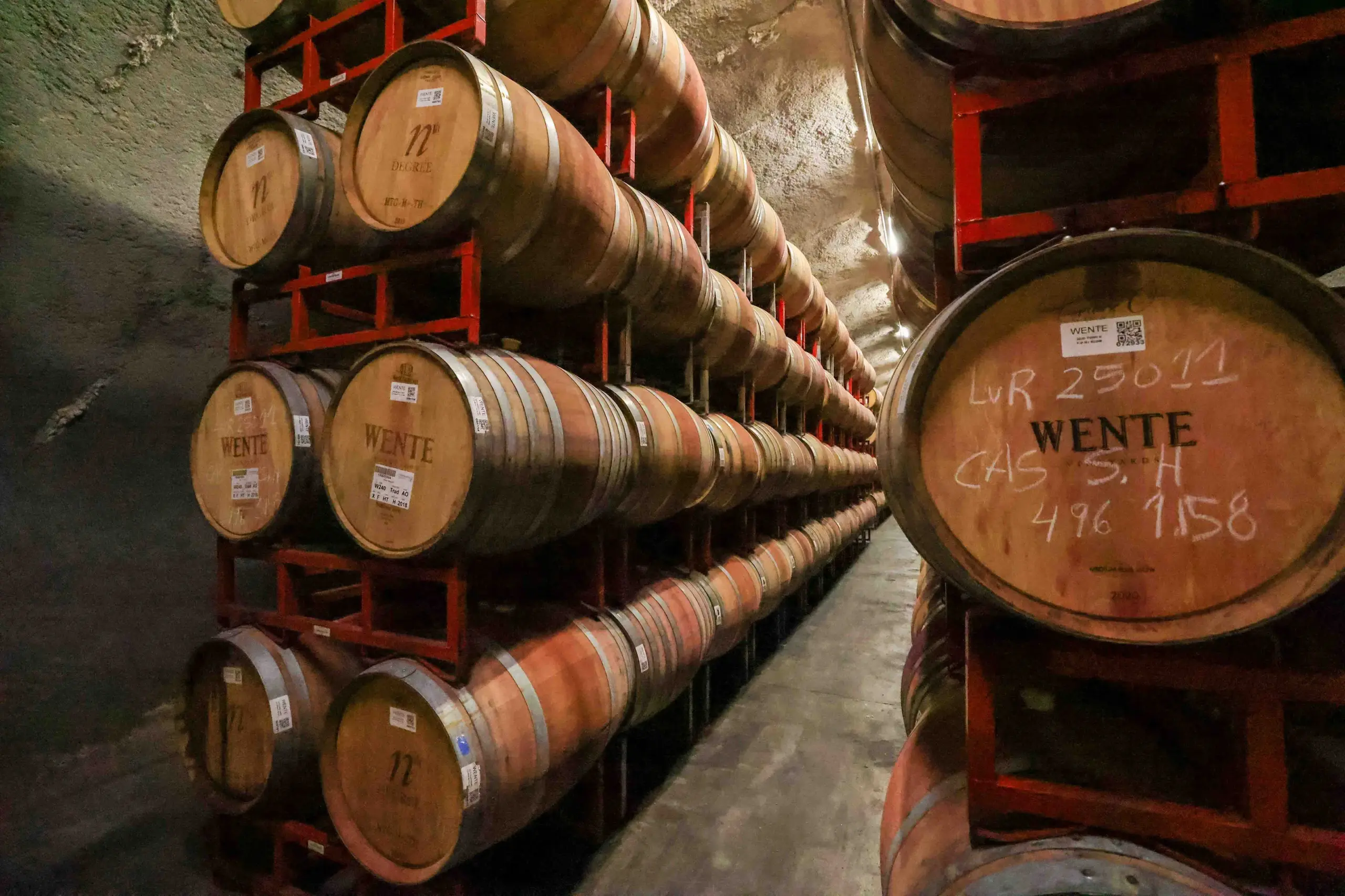
Tucked deep into the Livermore Valley winery estate of Wente Vineyards is a set of elegant, rounded wooden doors that wouldn’t look out of place in Middle-earth, leading directly into the steep hillside.
Read more Suspect Oakland pimp gets probation for pandering
Step through them, and you’ll find yourself in spacious caves, hand-dug well over a century ago, built to provide cool storage in the era before air conditioning. They remain pleasantly cool even on a scorching day outside, adapted with modern touches that provide light and comfort.
In one corridor, you’ll encounter a museum still under development, filled with old machinery found around the vineyards. The team is still figuring out how some of those old devices worked, working with local historians to piece the puzzle together.
Hang around long enough, and you might even sense the presence of the cave’s ghost, Clarence, the winery’s post-Prohibition operator whose ashes were reportedly placed in the side of the cave.
During the pandemic, the winery shut down public access to the caves. This fall, visitors can finally explore those caves again, thanks to the estate’s new series pairing cave tours with wine tastings featuring Wente’s new label, Cresta Blanca, developed to celebrate the vineyards’ 140-plus-year history.
Winemaking at the property has been going on since back in 1882, when it was established as the Cresta Blanca winery by Charles Wetmore, an advocate for California winemaking who became interested in the topic while writing a report on the depressed wine industry at the time in the Daily Alta California, a 19th-century newspaper in San Francisco.
Wetmore planted sauvignon blanc cuttings from France’s Bordeaux region at the Livermore Valley property, and its first vintage, an 1884 dry white wine, went on to win the grand prize at the 1889 Paris Exposition — the same event where the Eiffel Tower debuted on the Parisian skyline.
“He really wanted to bring the quality of the wine level up,” says Brendan Finley, vice president of hospitality at Wente Family Vineyards.
The Cresta Blanca winery eventually shut down during Prohibition, and Wetmore died before it was repealed. But his winery, and the wine caves he’d built into the hillside, remained. Wetmore’s brother, Clarence, eventually reopened the winery, but it was eventually closed and sold. Then, decades later, in 1981, the Wente family acquired the property.
The Wente family has its own long history in Livermore Valley that dates back to the same original period. C.H. Wente, an immigrant from Germany, first learned how to make wine from Charles Krug in Napa Valley, then established his own vineyard in Livermore in 1883. His son Ernest Wente went on to partner with UC Davis to import wine cuttings from France, including one clone of chardonnay that’s become what’s now known as the Wente Clone. Today, about 75% of all California chardonnay comes from that clone, according to the winery.
Then, during Prohibition, the Wente family pivoted to cattle ranching and making wine for churches and medical purposes. Once winemaking was allowed again, Ernest and Herman, his brother, developed the Valle de Oro sauvignon blanc in 1932, which went on to win a grand prize at the 1939 Golden Gate International Exposition.
The third generation, led by Karl Wente, pushed for modernization, new irrigation systems and an expansion to vineyards in the Arroyo Seco area of Monterey County. They also opened a tasting room in 1968.
Read more Highway to Yosemite National Park turns 100. How to celebrate the scenic route
The next generation, Eric, Philip and Carolyn Wente, pushed the family business deeper into the hospitality realm, building a restaurant and concert series in the late 1980s and a golf course in 1998, and established the Murrieta’s Well winery. They also built up Wente’s reputation for sparkling wines. Then, as sparkling wine has taken off elsewhere, the winery pivoted to focus more on its chardonnays — and pinot noirs, too.
Today, the fifth generation of the family — Karl, Niki, Christine, Aly and Jordan Wente — works with the fourth to operate the winery, which claims to be the longest, continuously family-owned and operated winery in the United States. They’ve launched Nth Degree, a limited-production selection of handcrafted wines by Karl Wente. Their latest project? A reboot of the Cresta Blanca wine label.
“There’s so much depth and history, and now that we’re bringing it back to life, we’ve given it a modern look,” says Aly Wente on the brand’s website. The label has a wine goddess on it, which is inspired by a figure engraved on a wooden barrel on the property that commemorates Cresta Blanca’s 1889 Paris Exposition grand prize.
This September, the winery started pairing cave tours with tastings of the Cresta Blanca wines: the 2024 Cresta Blanca Chardonnay ($38), 2025 Cresta Blanca Sauvignon Blanc ($35) and Cresta Blanca Blanc de Blanc Sparkling Wine ($40).
On the tour, visitors also learn the ways that the winery is adapting to shifting industry needs. For instance, it’s built up its programming this summer and uses its large amphitheater and lawn area to accommodate concerts and events up to 1,700 people, according to Finley.
Adjacent to the entertainment space is a cabernet franc vineyard, which has been trimmed back recently to adjust to declining demand. And there’s still more to see: Continue on the tour, and you’ll see a massive tirage warehouse, where wines are stored, and private tasting nooks are set up with thoughtful furnishings and large, bright paintings.
According to Finley, President Trump’s tariffs have impacted the winery’s business. For example, several Canadian provinces have imposed retaliatory boycotts on U.S. alcohol products. The , a Sacramento-based public-policy nonprofit focused on the wine industry, estimated that the boycotts have resulted in about $360 million in lost revenue for the U.S. wine industry in the year between March 2025 and March 2026.
But after five generations of local winemaking, the family-run winery is used to weathering industry storms. Its connection to history is just another reason to visit the region, whether you’re going there for a meal, a tasting, a cave tour, a round of golf or a broader quest to explore the wines of the Livermore Valley.
“There are 50 wineries in Livermore, all family-owned,” Finley says. “So you can make a whole day just coming to Livermore.”
Details: Open for tastings noon-5:30 p.m. Mondays-Wednesdays and noon-6 p.m. Thursdays-Sundays at 5565 Tesla Road, Livermore; cave tours by reservation. wentevineyards.com.
Read more San Jose woman killed when she’s pinned between cars on Highway 101
About the Author